If your outbound sales team sells outside English-speaking markets, there’s a good chance you’ve already asked the question: will AI voice cloning actually pronounce this prospect’s name correctly? The honest answer is that it depends heavily on the language, the name, and how the tool was trained — and most vendors won’t tell you that until after you’ve bought a seat.
This guide walks through what actually determines AI voice cloning accuracy across languages, why non-English names are the most common failure point, and the exact test you should run before you commit budget to a full campaign. It’s based on real product documentation and real sales-call objections, not marketing copy.
Published August 2026
Key Takeaways
- AI voice cloning accuracy isn’t uniform across languages — it depends on how much training data a vendor has for that language and how closely your source recording matches the target accent (ElevenLabs, 2026).
- CSA Research found 76% of consumers prefer buying when product information is in their own language, and companies that skip localization risk losing 40%+ of their addressable market (CSA Research, 2020).
- A common failure mode is “Americanized” pronunciation of non-English names, even when the surrounding sentence is spoken in the target language — test this before you scale, not after.
- The fastest way to catch pronunciation problems is a short trial run with a handful of real prospect names, not a full campaign build.
- Pairing a real recorded intro with AI voice cloning for just the name and details is generally more trustworthy to recipients than a fully synthetic AI avatar, especially in non-English markets.
How Accurate Is AI Voice Cloning in Non-English Languages?
AI voice cloning accuracy in non-English languages depends on two things: how much training data the underlying model has for that specific language, and how closely your source recording matches the pronunciation patterns of your target language. A tool that clones voices well in Spanish won’t automatically clone them well in Vietnamese, because the two languages have wildly different amounts of training data behind them.
AI voice cloning is a machine learning technique that recreates a person’s voice from a short audio sample, then uses that voice model to generate new speech, including words the person never actually said. ElevenLabs, one of the larger voice AI vendors, documents support for voice cloning in 32 languages — but its own documentation notes that “accent fidelity depends on input samples or selected attributes,” and recommends matching your voice selection to your target region for the most natural results. In other words: broad language coverage on a spec sheet doesn’t guarantee accurate pronunciation for your specific prospects.
This matters more than it might seem, because buyers notice. CSA Research surveyed 8,709 consumers across 29 countries and found that 76% prefer buying products when the information is presented in their own language. The same research found that companies which skip localization risk losing 40% or more of their addressable market — people who would rather engage with a brand in their own language than settle for an English-only experience.
“There is a longstanding assumption that enough people feel comfortable using English online, especially when buying high-tech or expensive products. Our 2020 findings show that if a company chooses to not localize the buying experience, they risk losing 40% or more of the total addressable market — the consumers that prefer selecting and buying products at local-language sites. While they may want the products or experiences on the English-language site, most would rather think, act, and buy in their own language.”
— Dr. Donald A. DePalma, Chief Research Officer, CSA Research
For B2B sales teams, the practical translation of that finding is simple: a personalized video sent in a prospect’s own language, spoken with a voice that sounds like it belongs to that language, will outperform a generic English send. But a video where the AI mispronounces the prospect’s own name in an obviously foreign accent can do more damage than sending no personalization at all — it signals that the “personalization” is automated and careless rather than genuine. Sendspark’s AI voice cloning is built around this trade-off: you record one video, and the AI clones your voice to insert each prospect’s name, but the accuracy of that name insertion still depends on how well your source recording and the target language line up — which is exactly what the rest of this guide helps you test before you commit to a full send.
Why Non-English Names and Accents Trip Up AI Voice Cloning
Non-English names trip up AI voice cloning because most voice AI models are trained on datasets that skew heavily toward English, so the underlying pronunciation rules default to American English patterns even when the surrounding sentence is spoken in another language. The result is a specific, well-documented failure mode: a tool speaks fluent German or Dutch, then reverts to American pronunciation the moment it hits a name.
Sendspark’s own product documentation is candid about this. Sendspark’s Help Center describes this exact “Americanization” pattern: even when a sender records their intro entirely in a non-English language, the system can still apply American-style pronunciation to the prospect’s name specifically, because the name-insertion step is handled separately from the surrounding sentence. This is precisely the kind of issue sales teams run into on live calls — not a hypothetical, a documented and actively worked-around limitation.
Common mistake
Don’t assume a platform that lists “German” or “Dutch” as a supported language will automatically pronounce every German or Dutch name correctly. Name pronunciation is handled differently from full-sentence speech in most voice cloning tools, and that’s where accuracy usually breaks down first.
The gap isn’t unique to any one vendor. G2 Research’s analysis of the voice dubbing category found Google Cloud Text-to-Speech earning a 93% satisfaction rating for voice cloning features, and Synthesys AI Studio earning 91% for language features — solid scores, but not perfect ones. That remaining gap between “satisfied” and “flawless” is exactly where mispronounced names live, and it’s wide enough that testing your own prospect list matters more than trusting a vendor’s supported-languages list.
There’s also a workaround worth knowing about before you evaluate tools: Sendspark’s documentation recommends importing contacts with a phonetic spelling substituted into the name field, so the voice model reads the phonetic version instead of the literal spelling. For large contact lists, the same documentation suggests using a general-purpose AI assistant to generate phonetic transcriptions in bulk, then importing those instead of the original names. It’s a manual step, but it’s a real, working fix rather than a “wait for the next model update” promise.
Record One Video. AI Personalizes Thousands.
Sendspark is the AI video personalization platform for B2B sales. Record once, and AI voice cloning generates thousands of individually personalized videos with dynamic backgrounds and personalized thumbnails — each prospect hears their name, sees their website, in your voice. Sales teams see 2-3x more replies.
Get Started NowHow to Test AI Voice Cloning Quality Before You Buy
The fastest way to test AI voice cloning quality before you buy is to run five to ten real prospect names from your own CRM through a trial account, not to build and send a full campaign. This catches pronunciation problems in minutes instead of after a batch of prospects has already received a badly personalized video.
Start by pulling a short, deliberately diverse list of real names from your target account list — include names with unusual spellings, regional variations, and diacritics if your market has them. Generate a short test video for each one using a trial or free tier, and listen critically. Does the name sound like it belongs to the sentence around it, or does it stick out?
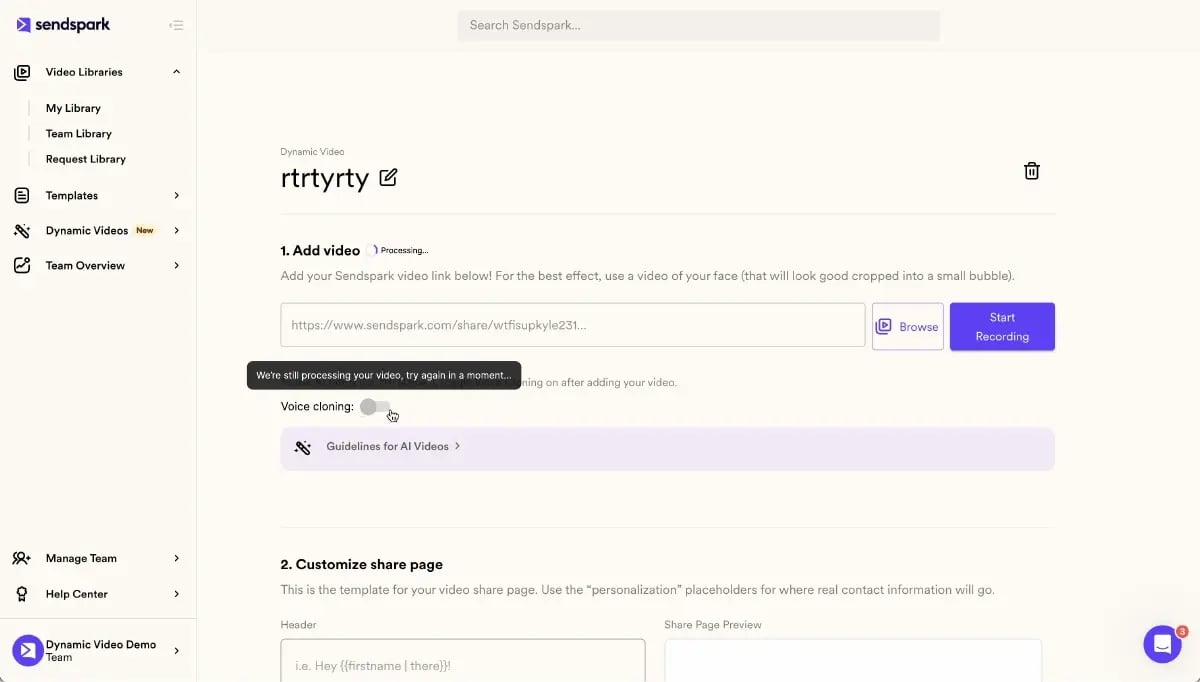
On Sendspark specifically, this test is built around a placeholder keyword: you record your intro using a stand-in word in place of the prospect’s name, and the system swaps in each contact’s actual name at send time — the same mechanism covered in our guide to using AI to say your prospect’s name in video messages. If a specific name comes out wrong during testing, you don’t need to re-record the whole video — Sendspark’s documentation points to a “Modify Variable” option that lets you regenerate just that one name pronunciation without touching the rest of the recording.
Pro tip
If a name still won’t pronounce correctly after a regenerate attempt, swap in a phonetic spelling on import instead of the literal name — for example, importing “Sur-en” for a contact actually named “Søren.” The video will still show the real name on screen if your CRM sync uses a separate display field; only the spoken pronunciation source changes.
Source audio quality determines output quality more than any setting in the tool itself. Record in a quiet room with no echo, use the best microphone available to you, and keep your pace and volume consistent from the first word to the last. If you’re recording your intro in a non-native language, consider having a native speaker record the source clip instead of accepting a heavily accented version of yourself — the AI will clone whatever accent it’s given, including your own mistakes.
Finally, treat this as a documented evaluation, not a one-off check. Score each platform you test on three things: name pronunciation accuracy, overall voice naturalness, and how easy it is to fix a bad name without rebuilding the whole video. Sendspark’s own AI voice cloning best practices guide covers the recording and consent side of this in more depth, and our comprehensive guide to personalized video email walks through the full send workflow once your pronunciation testing is done.
AI Voice Cloning vs. AI Avatars for Multilingual Outreach
For multilingual outreach, pairing a real recorded intro with AI voice cloning for the name and personalized details is generally more trustworthy than a fully synthetic AI avatar, because a real human voice and face carry fewer of the visual and audio artifacts that make viewers suspicious of AI-generated content. Fully synthetic avatars can speak any supported language on demand, but that flexibility comes with a higher uncanny-valley risk — and that risk gets worse, not better, in a language the avatar wasn’t primarily trained on.
This isn’t a hypothetical concern. It shows up directly in sales conversations: prospects evaluating video personalization tools have specifically asked whether a platform uses a synthetic AI avatar or a real recorded video, because a voice or face that “feels clearly AI” undermines the trust the video is supposed to build in the first place. The concern is sharpest in non-English markets, where recipients are already primed to notice anything that sounds slightly off.
| Factor | Fully Synthetic AI Avatar | Real Recording + AI Voice Cloning |
|---|---|---|
| Perceived authenticity | Lower — prone to uncanny-valley artifacts | Higher — retains real human tone and pacing |
| Language flexibility | Broad, limited by model training per language | Limited to languages you or your rep can record in |
| Production effort | Low — no filming required per language | One recording, reused across thousands of sends |
| Risk if pronunciation fails | Compounds visual and audio artifacts together | Isolated to the name-insertion segment only |
| Best fit | High-volume, lower-stakes top-of-funnel sends | Named-account outbound where trust matters most |
The practical takeaway is that you don’t have to pick one approach for your entire outbound motion. Many teams reserve a fully human-recorded, AI-personalized approach for their highest-value accounts and target markets, where the cost of a mispronounced name is highest, and treat broader synthetic coverage as a lower-stakes option for markets where volume matters more than precision. Sendspark’s approach to sales prospecting leans on the first model: you record once, and AI voice cloning plus dynamic backgrounds personalize the rest, rather than generating a synthetic face and voice from scratch for every language.
Common Mistakes When Localizing AI-Personalized Video
The most common mistake teams make when localizing AI-personalized video is skipping the pre-send pronunciation test entirely and discovering problems only after a batch of prospects has already received the video. The fix costs five minutes with a trial account; the failure to catch it costs a damaged first impression with exactly the accounts you were trying to impress.
A second common mistake is ignoring source audio quality, especially when recording in a non-native language. If the source recording is noisy, inconsistent, or delivered with heavy hesitation, the cloned voice inherits every one of those flaws — and those flaws are more noticeable, not less, in a language your audience actually speaks natively. A third mistake is treating a language as a single, uniform pool: Spanish spoken in Spain, Mexico, and Argentina are not interchangeable for pronunciation purposes, and neither are French from France, Quebec, and West Africa. A voice clone tuned for one regional accent can sound noticeably foreign to a prospect from a different region who happens to share the same listed “language.”
Over-personalizing can also backfire in localized outreach specifically, because a video that gets the name right but fumbles cultural or contextual details reads as more effort-intensive to produce than a plainer message — which makes the failure more noticeable, not less. Sendspark’s guide on calibrating personalization in video outreach covers where that line sits in more detail.
| Mistake | Consequence | Fix |
|---|---|---|
| Skipping the pre-send pronunciation test | Mispronounced names reach real prospects first | Test 5-10 real names on a trial account before any full send |
| Ignoring source audio quality | Cloned voice inherits noise and hesitation | Record in a quiet room with a quality microphone |
| Treating a language as one accent | Regional mismatches feel foreign to recipients | Check for regional voice variants before choosing a default |
| Defaulting to a fully synthetic avatar everywhere | Higher uncanny-valley risk on high-value accounts | Reserve real recordings for your most important segments |
| Not fixing a known bad name pronunciation | The same error repeats across every future send | Use a phonetic-spelling import or a variable regenerate tool |
None of these mistakes require a better AI model to fix — they require testing before you scale, which is the same discipline good outbound teams already apply to subject lines and send times. Sendspark’s personalization-at-scale guide and our own guide to trial and plan options are both good next stops if you’re building this testing step into your evaluation process.
Frequently Asked Questions
Which languages does AI voice cloning support?
Support varies by vendor: ElevenLabs documents voice cloning across 32 languages, while other providers support fewer. Listed language support doesn’t guarantee equal accuracy across every one of those languages — always confirm coverage for your specific target market before buying.
Is AI voice cloning accurate for non-English names?
Accuracy for non-English names is inconsistent because most voice models default to American English pronunciation patterns, even mid-sentence in another language. Testing your own prospect list before a full send is the only reliable way to know how a specific tool handles your specific names.
How do I test AI voice cloning pronunciation before sending videos at scale?
Run 5-10 real prospect names from your CRM through a trial account and listen critically to each one. Fix any mispronunciations with a phonetic-spelling import or a per-name regenerate tool before building a full campaign around the results.
Can AI change my voice to speak another language?
Yes — modern voice cloning tools can take a voice sample recorded in one language and generate speech in a different supported language, preserving the tone and pacing of the original speaker. Accent fidelity in the new language still depends on the model’s training data for that language.
Which AI voice clone sounds the most realistic?
Realism varies by language and by how closely your source recording matches your target accent, so there’s no single “most realistic” answer across every market. G2 Research found satisfaction scores in the low-to-mid 90s for leading voice AI vendors, which reflects strong but not flawless performance.
Is AI voice cloning illegal?
Cloning your own voice with your own consent, for your own outreach, is not illegal. Most platforms require you to confirm you have the rights to the voice being cloned, and using someone else’s voice without their permission raises separate consent and impersonation concerns that fall outside standard sales use.
Does AI-personalized video work for non-English prospects?
Yes, when the source recording and target language are properly matched and tested first — CSA Research found 76% of consumers prefer buying when information is presented in their own language, which makes localized video a real advantage when the pronunciation is accurate.
Sources & References
- CSA Research — “76% of online shoppers prefer to buy products with information in their native language; companies risk losing 40%+ of addressable market without localization” (2020)
- ElevenLabs Documentation — “Voice cloning supported across 32 languages; accent fidelity depends on input samples” (2026)
- G2 Research — “Google Cloud Text-to-Speech: 93% satisfaction for voice cloning features; Synthesys AI Studio: 91% for language features” (2026)
- Wyzowl State of Video Marketing — “63% of video marketers now use AI tools to create or edit marketing video” (2026)
Record One Video. AI Personalizes Thousands.
Sendspark is the AI video personalization platform for B2B sales. Record once, and AI voice cloning generates thousands of individually personalized videos with dynamic backgrounds and personalized thumbnails — each prospect hears their name, sees their website, in your voice. Sales teams see 2-3x more replies.
Get Started Now