Published August 2026
A cold call turns into a booked meeting about 2-3% of the time, and getting there takes roughly 40 dials if you’re a top performer — more than 200 if you’re not, according to ZoomInfo Pipeline’s 2026 benchmark data. AI-personalized video prospecting, by comparison, routinely posts double-digit reply rates on the first touch. That gap looks like it settles the cold calling vs. video prospecting debate. It doesn’t.
Cold calling still books meetings that video can’t, and video still reaches prospects that never pick up the phone. This guide breaks down exactly where each tactic wins, backed by real benchmark data, and shows you how to combine cold calling and video prospecting into one sequence instead of picking a side. For the broader question of when any cold channel can perform like a warm one, see our breakdown of warm outbound vs. cold outbound.
Key Takeaways
- Cold calling still converts once you connect — RAIN Group research finds 82% of buyers accept meetings at least occasionally from proactive outreach — but the average team needs over 200 dials per booked meeting, versus roughly 40 for top performers.
- Multichannel B2B sequences that combine 3 or more channels generate 287% more responses than any single channel alone, according to HubSpot.
- Stating your reason for calling within the first 30 seconds raises cold-call success rates by 2.1x, per Gong Labs’ analysis of thousands of recorded sales calls.
- Sendspark’s AI voice cloning and dynamic backgrounds let a rep record one video and generate thousands of personalized versions — each naming the prospect and showing their company’s website — without re-recording for every dial.
- The highest-converting sequences don’t pick a winner. They use video to earn trust before the call and cold calling to close the loop once a prospect is warm.
What Is Cold Calling, and Does It Still Work in 2026?
Cold calling is an outbound sales technique where a rep phones a prospect with no prior relationship or expressed interest in the product. It still works in 2026, but the margins are thin: ZoomInfo Pipeline benchmark data puts average connect rates at 3-10% of dials, and the average meeting-booking success rate at just 2-3% once you do connect.
Those numbers explain why cold calling has a reputation for being brutal, but they don’t mean buyers have tuned it out entirely. RAIN Group’s Top Performance in Sales Prospecting benchmark study found that 82% of buyers accept meetings at least occasionally with sellers who proactively reach out to them. The problem isn’t that buyers reject cold outreach on principle — it’s that most of it is generic enough to get filtered out before it earns a response.
The gap between average and top-performing teams is where the real story is. ZoomInfo’s data shows top performers converting 6-10%+ of connected calls into meetings, three times the average rate, and needing around 40 dials per booked meeting instead of the 200+ a typical team burns through. The same research notes that 80% of sales require five or more follow-up calls — cold calling rewards persistence and a working list far more than it rewards call volume alone.
Common mistake
Judging a cold-calling program by raw dial count instead of connect rate and list quality. A rep who makes 40 dials to a well-researched list will consistently outbook a rep who makes 200 dials to a purchased one.
What’s changed since cold calling’s heyday isn’t whether it works — it’s what it competes against. A prospect who ignores a cold call today has usually already seen a dozen other outbound attempts that week, many of them video. Preparing for the call itself still matters, but the channel it’s competing with has gotten a lot more sophisticated — see Sendspark’s complete outbound prospecting playbook for how the two fit into a broader sales prospecting motion.
Cold Calling vs. Video Prospecting: Quick Comparison
Cold calling and video prospecting solve the same problem — getting a stranger’s attention — through opposite mechanics: real-time voice versus scaled, pre-recorded personalization. The table below compares them across the five factors that matter most when you’re deciding where to put your team’s time.
We evaluated both channels using publicly available benchmark data from ZoomInfo, RAIN Group, Gong, and HubSpot, cross-referenced against Sendspark’s own first-party performance data across its customer base. Each metric reflects typical B2B outbound performance, not best-case or worst-case outliers.
| Metric | Cold Calling | AI Video Prospecting |
|---|---|---|
| Connect / delivery rate | 3-10% of dials connect (ZoomInfo) | ~95%+ email/inbox delivery (standard email deliverability) |
| Meeting/reply success rate | 2-3% average, 6-10%+ for top performers (ZoomInfo) | Up to 200-300% higher reply rates than text-only email (Sendspark data) |
| Time per 100 prospects | 200-400+ minutes of active dialing | One recording, AI-personalized in minutes per batch |
| Scalability | Linear — output scales with headcount | Near-exponential — output scales with AI processing, not headcount |
| Real-time objection handling | Yes — immediate, two-way | No — asynchronous, one-way until a reply |
The pattern is consistent: cold calling wins on immediacy and two-way interaction, video wins on reach and scale. Neither number tells the whole story on its own, which is why the next two sections look at where each channel actually earns its keep.
Record One Video. AI Personalizes Thousands.
Sendspark is the AI video personalization platform for B2B sales. Record once, and AI voice cloning generates thousands of individually personalized videos with dynamic backgrounds and personalized thumbnails — each prospect hears their name, sees their website, in your voice. Sales teams see 2-3x more replies.
Get Started NowWhere Cold Calling Still Wins
Cold calling wins whenever a deal needs real-time back-and-forth: handling an objection the moment it comes up, qualifying budget and authority on the spot, or reaching a specific high-value account fast. No async channel, including video, replicates a live conversation.
Objection handling is the clearest example. If a prospect says “we already have a vendor for this,” a rep on the phone can ask a follow-up question immediately and redirect the conversation. A video that gets the same objection just… ends. The prospect closes the tab, and there’s no way to recover the conversation in the same moment. Pairing a short personalized video response to the objection with a live follow-up call closes that gap without giving up video’s scale advantage.
Cold calling also wins for large or high-priority accounts where a direct call signals effort and urgency in a way an email — even a personalized video — doesn’t always match. And it wins on qualification speed: a two-minute call can confirm budget, timeline, and decision-making authority that would otherwise take several email exchanges to establish.
Pro tip
State your reason for calling in the first 30 seconds. Gong Labs found that reps who clearly state why they’re calling see a 2.1x higher success rate than reps who ease into the pitch. Skip the small talk and get to the point.
Persistence compounds this advantage. Since ZoomInfo’s benchmark data shows 80% of sales require five or more follow-up touches, a rep willing to call back after a missed connection is playing a different game than one who dials once and moves to email. Combined with a structured first-call framework, that persistence turns a mediocre connect rate into a respectable meeting count over a full quarter.
Cold calling also has a lower barrier to starting. It doesn’t require a video library, editing time, or a personalization workflow — just a phone, a list, and a script. For a rep working a short list of 10-15 target accounts this quarter, the setup cost of a calling block is close to zero, which makes it the default choice when the total addressable list is small enough that scale isn’t the bottleneck.
Where Video Prospecting Wins
Video prospecting wins on reach, scale, and first-touch reply rates: it lands in an inbox instead of depending on someone answering a phone, and Sendspark’s own customer data shows AI-personalized video drives 200-300% higher email response rates and 40-50% more meetings booked than text-only outreach, at a fraction of the time cost of dialing the same list.
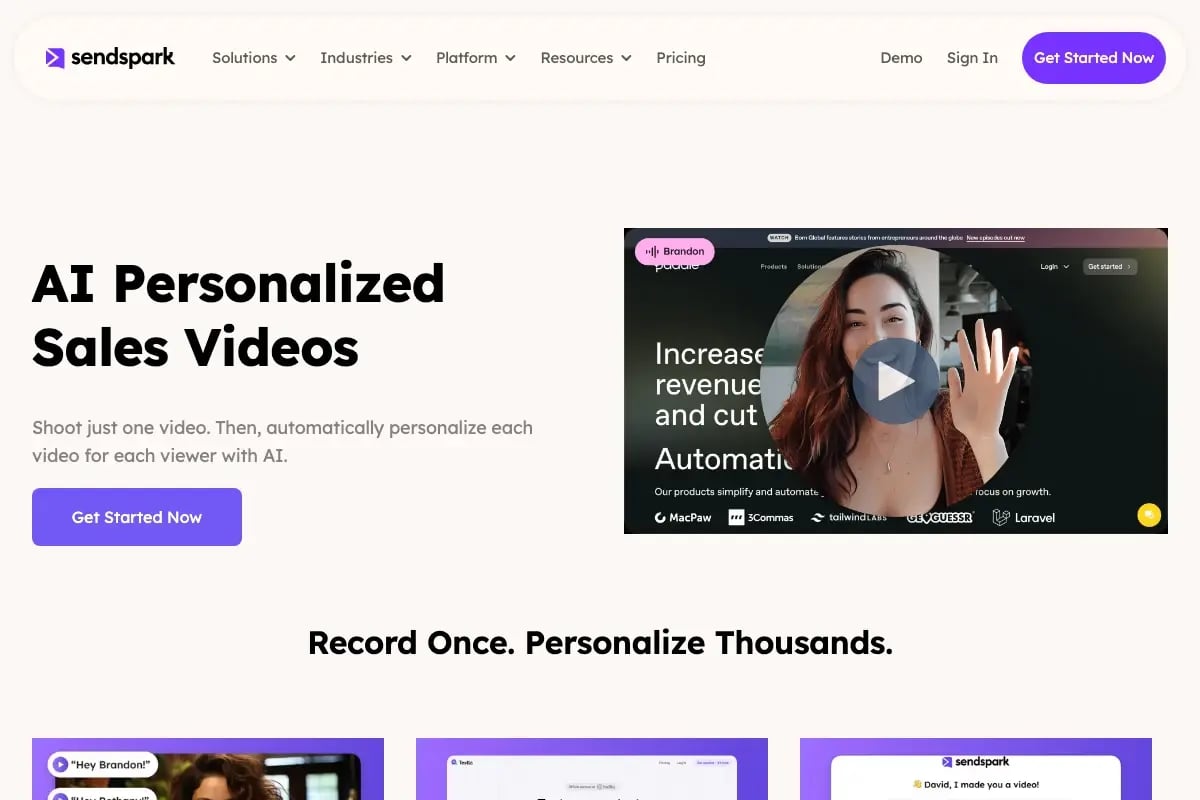
The mechanism behind that lift is personalization at a scale a human rep can’t match manually. With an AI video personalization platform for B2B sales like Sendspark, a rep records one video, and AI voice cloning plus dynamic backgrounds generate a unique version for every prospect — each one saying the prospect’s name, showing their company’s actual website in the background, and sounding like the rep recorded it individually.
Sales and GTM leaders have started saying the quiet part out loud about where this puts video in the outreach mix:
“Video prospecting is the new cold calling — but everyone’s doing it wrong.”
— Jake Dunlap, CEO of Skaled Consulting, LinkedIn
Dunlap’s point cuts both ways: video has become the default channel buyers expect, but most reps still open with the same generic lines that killed cold calling’s reputation in the first place. The advantage only shows up when the personalization is real — a prospect’s actual name spoken naturally, their actual company shown on screen — not a template with a mail-merge field.
Advanced strategy
Use dynamic backgrounds to show the prospect’s own website behind you in the video, not just their name in the script. It’s a stronger signal of research than name-personalization alone, and it’s the detail prospects mention most often when they reply.
Scale is the other half of the equation. A rep dialing 100 prospects needs 200-400 minutes of active calling time and gets 2-5 conversations out of it. The same rep can record one AI-personalized video intro and generate 100 individualized versions in the time it takes to review the batch — no re-recording, no extra hours. That’s the core trade Sendspark’s video prospecting guide covers in more depth: video doesn’t remove the need for good targeting, but it removes the linear time cost of personalizing at volume.
Video also holds up better against list fatigue. A prospect who has ignored three cold calls this month is primed to ignore a fourth. A short, genuinely personalized video breaks that pattern because it doesn’t look like the same outreach they’ve already tuned out — it looks like something built specifically for them, which is closer to the truth than a generic script read from a dialer queue. For more tactical detail on making that first video land, see Sendspark’s video prospecting tips for booking more meetings.
How to Combine Cold Calling and Video Prospecting in One Sequence
The highest-converting B2B outbound sequences in 2026 don’t choose between cold calling and video — they use both. HubSpot’s sales research found that sequences combining three or more channels generate 287% more responses than any single channel run alone, and video plus phone is one of the strongest pairings because each channel covers the other’s blind spot.
A prospect who ignores your video might still answer a follow-up call that references it by name. A prospect who lets your call go to voicemail might watch a video that shows up in their inbox an hour later. Here’s a five-touch sequence built around that overlap:
| Touch | Channel | Timing | Goal |
|---|---|---|---|
| 1 | Personalized video email | Day 1 | Introduce yourself with a dynamic-background intro naming the prospect’s company |
| 2 | Short text follow-up | Day 2 | Low-pressure nudge referencing the video (“Did you get a chance to watch it?”) |
| 3 | Cold call | Day 4 | Reference the video by name in your opener, state your reason for calling directly |
| 4 | LinkedIn message | Day 6 | Reinforce the relationship in a channel the prospect actually checks daily |
| 5 | Second video + call | Day 9-10 | Address a common objection on video, then call to close the loop |
Lead with video when you’re covering volume — a full territory or a list of 50+ target accounts where personalized calling isn’t realistic. Lead with a call when the account is large enough that a single meeting is worth the time, or when you need an answer to a qualifying question today instead of in three days.
The sequencing logic matters more than the exact cadence: video earns the initial attention and does the personalization heavy lifting, the call converts that warmth into a real conversation, and every touch references the one before it so the prospect experiences one coherent outreach, not five disconnected pings. Tools like Outreach and Salesloft can run this exact cadence natively once the video step is built into the sequence — see Sendspark’s roundup of video prospecting tools for SDRs for the full stack.
The Bottom Line: Which Channel Should You Lead With?
Neither channel replaces the other — they solve different parts of the same problem, and the data backs up using both rather than picking one.
| If your priority is… | Lead with… | Why |
|---|---|---|
| Covering a large territory fast | Video prospecting | Scales without added headcount; one recording personalizes at volume |
| Closing a high-value enterprise account | Cold calling | Real-time objection handling and signals urgency |
| Recovering a cold or unresponsive list | Video, then call | Video re-earns attention; the call converts it |
| Maximizing total response rate | Both, in sequence | 287% more responses from 3+ channel sequences (HubSpot) |
Frequently Asked Questions
Is cold calling dead in 2026?
No. Cold calling still books meetings, but connect rates are thin — 3-10% of dials connect, and only 2-3% of connected calls convert to a meeting on average, according to ZoomInfo Pipeline data. It works best for high-priority accounts and real-time qualification, not high-volume prospecting.
Is video prospecting more effective than cold calling?
Video prospecting typically drives higher first-touch reply rates and scales further without added headcount, while cold calling wins on real-time objection handling and immediate qualification. Sendspark customer data shows AI-personalized video driving 200-300% higher response rates than text-only outreach, but the two channels perform best combined, not compared in isolation.
How many touches should a cold calling and video sequence include?
Most effective B2B sequences run 5-10 touches across 2-3 weeks, mixing video, calls, email, and LinkedIn. HubSpot research found that sequences using 3 or more channels generate 287% more responses than single-channel outreach.
What is AI voice cloning and how does it help with video prospecting?
AI voice cloning is technology that learns a rep’s voice from a single recording and uses it to generate personalized audio for each prospect — saying their name and company naturally — without the rep re-recording every version. It’s the core mechanism that lets one video become thousands of individually personalized ones.
How do I improve my cold calling success rate?
State your reason for calling within the first 30 seconds — Gong Labs found this raises success rates 2.1x — and plan for persistence, since 80% of sales require five or more follow-up calls. Pairing the call with a prior video touch also gives the prospect context before you dial.
Can video prospecting replace cold calling entirely?
Not for every account. Video prospecting removes the linear time cost of personalizing outreach at scale, but it’s asynchronous — it can’t handle a live objection the moment it comes up. Most teams get the best results using video to cover volume and cold calling for accounts big enough to justify a live conversation.
What’s the best way to combine cold calling with video outreach?
Lead with a personalized video to earn initial attention, follow with a call that references the video by name, and layer in LinkedIn and email touches in between. This sequencing lets each channel cover the other’s weak point instead of competing for the same moment of attention.
Sources & References
- ZoomInfo Pipeline — “Average B2B cold call connect rates run 3-10%, with 2-3% average meeting-booking success versus 6-10%+ for top performers, and 80% of sales requiring 5+ follow-up calls” (2026)
- RAIN Group — “82% of buyers accept meetings at least occasionally with sellers who proactively reach out to them” (2026)
- Gong Labs — “Salespeople who clearly state their reason for calling see a 2.1x higher success rate” (2026)
- HubSpot Blog — “Multichannel sequences using 3+ channels deliver 287% more responses than single-channel outreach” (2026)
- Jake Dunlap, CEO of Skaled Consulting — “Video prospecting is the new cold calling — but everyone’s doing it wrong” (2026)
Record One Video. AI Personalizes Thousands.
Sendspark is the AI video personalization platform for B2B sales. Record once, and AI voice cloning generates thousands of individually personalized videos with dynamic backgrounds and personalized thumbnails — each prospect hears their name, sees their website, in your voice. Sales teams see 2-3x more replies.
Get Started Now