Most sales leaders don’t build an outbound team — they cobble one together. They hire a couple of SDRs, hand them a list of contacts, set up a basic email sequence, and wonder why pipeline never becomes predictable. The difference between a team that generates consistent meetings and one that churns through reps every six months comes down to structure, roles, and the right tools from day one. Before you build the team, it helps to confirm outbound is the right primary motion for your stage — our inbound vs outbound sales comparison walks through when each approach wins.
This guide walks you through exactly how to build an outbound sales team that scales — from defining roles and ratios to building your playbook, setting quotas, and equipping your reps with the outreach tools that actually move the needle.
Key Takeaways
- Most B2B outbound teams run a 2-3:1 SDR-to-AE ratio — the right number depends on your average deal size and sales cycle length.
- SDRs typically need 60-90 days to ramp to full quota, so plan your hiring timeline at least 3 months ahead of revenue targets.
- A functioning outbound team requires three core roles: SDR/BDR, Account Executive, and an SDR manager once you reach 4+ reps.
- AI video personalization tools like Sendspark help SDRs book 40-50% more meetings by standing out in crowded inboxes.
- Your tech stack — CRM, sequencing platform, prospecting data, and video outreach — is the infrastructure that determines how efficiently the team can execute at scale.
What Is an Outbound Sales Team?
An outbound sales team is a group of sales reps who proactively initiate contact with potential customers rather than waiting for inbound leads. SDRs cold email, call, and send LinkedIn messages to prospects who have never heard of your company. AEs take qualified meetings and close deals. Together, they create a repeatable process for generating pipeline from scratch — giving your business predictable revenue instead of hoping the right buyers find you first.
This is distinct from an inbound or marketing-led model where leads come to you. In outbound, your team controls the top of the funnel. That’s both the challenge and the advantage: you can target exactly the accounts you want, in the verticals you want, regardless of whether you have brand recognition yet. For a deeper breakdown of what this model looks like in practice, see our complete guide to outbound sales. Once your team is up and running, keep their drive strong with the right sales motivational videos and team tactics.
According to Salesforce’s State of Sales report, high-performing sales organizations are significantly more likely to have a dedicated, structured SDR function than average teams. The key word is structured — throwing a few junior reps at a contact list without clear roles, metrics, and a playbook is not an outbound team.
Companies build outbound sales teams when they need to accelerate growth beyond what inbound alone can deliver, enter new markets, or target specific enterprise accounts. If you’re a B2B company with a clear ICP (ideal customer profile) and a product with a sales cycle of 30-180 days, a structured outbound team is one of the highest-leverage investments you can make.
Core Roles in an Outbound Sales Team
An outbound sales team has four core roles: SDR (Sales Development Rep), BDR (Business Development Rep), AE (Account Executive), and SDR Manager. Many teams treat SDR and BDR as interchangeable — and that’s mostly fine — but the distinction matters when you’re designing compensation and quota structures. Here’s how each role works in practice.
| Role | Primary Focus | Key Metric | Typical Comp |
|---|---|---|---|
| SDR | Qualify inbound leads + targeted outbound to named accounts | Meetings set (SQLs passed to AE) | $45K-$70K base + bonus per SQL |
| BDR | Pure outbound — new markets, new logos, strategic accounts | Meetings set / pipeline created | $50K-$75K base + bonus per pipeline |
| AE | Run discovery calls, demos, negotiations, and close deals | Revenue closed per quarter | $70K-$120K base + commission on closed revenue |
| SDR Manager | Coach, manage, and optimize the SDR function; hiring and onboarding | Team quota attainment, rep ramp time | $80K-$120K base + team performance bonus |
SDR vs BDR: Which Do You Need?
Most early-stage outbound teams start with SDRs rather than BDRs. If you have any inbound volume at all — free trial signups, demo requests, marketing-qualified leads — your first hires should qualify those before they go cold, while also working a targeted outbound list. That’s the classic SDR model.
BDRs make more sense when you’re going after large strategic accounts with no inbound signal at all — enterprise land-and-expand motions, new geographies, or vertical expansions where you have zero name recognition. The outreach is more research-intensive, the sales cycle is longer, and the ramp time is higher.
When to Hire Your First SDR Manager
A common mistake is waiting too long to bring in a dedicated manager. Once you have four or more SDRs, a player-coach AE can’t manage them effectively while carrying their own quota. Hire your SDR manager at 3-4 reps, not 6-8. The earlier they’re in, the better the coaching culture and playbook quality from the start. For a deeper look at how managers drive these outcomes, see our sales performance coaching playbook.
How to Structure Your Outbound Team
The most important structural decision is your SDR-to-AE ratio. Get this wrong and you either flood AEs with unqualified leads (they start doing their own SDR work) or starve AEs of pipeline (they hit quota only in good months). The right ratio depends on your average deal size and the length of your sales cycle — not a universal formula.
| Deal Size (ACV) | Sales Cycle | Recommended SDR:AE Ratio | Rationale |
|---|---|---|---|
| $5K-$15K ACV | 14-30 days | 1:1 | High volume of meetings needed; AE works fast |
| $15K-$50K ACV | 30-60 days | 2:1 | AE carries more deals; SDR pipeline keeps them full |
| $50K-$100K ACV | 60-90 days | 2-3:1 | Longer cycles mean AE capacity is high; SDRs must generate more volume |
| $100K+ ACV | 90-180+ days | 3-4:1 | Enterprise deals are few and large; AE bandwidth is high but deals move slow |
These ratios assume SDRs are hitting full productivity. During ramp (the first 60-90 days), their effective SQL output is significantly lower — factor this into your planning by treating new SDRs as 0.5x capacity until they hit month three.
For most B2B SaaS companies in the $15K-$50K ACV range, a 2:1 SDR-to-AE ratio with one SDR manager for every 4-6 SDRs is the standard. This gives AEs a steady meeting flow without overwhelming their calendar, and gives SDRs enough coaching touchpoints to improve their messaging over time.
Record One Video. AI Personalizes Thousands.
Sendspark is the AI video personalization platform for B2B sales. Record once, and AI voice cloning generates thousands of individually personalized videos with dynamic backgrounds and personalized thumbnails — each prospect hears their name, sees their website, in your voice. Sales teams see 2-3x more replies.
Get Started NowBuilding Your Outbound Sales Team Step by Step
Building an outbound team is a five-step process: define who you’re targeting, hire the right people, build the playbook, set metrics, and run a structured onboarding program. Most teams get steps 2-4 right but skip step 1 and step 5 — and that’s why their ramp times stretch to 6 months instead of 90 days.
Step 1: Define Your ICP Before You Hire
The single biggest predictor of SDR success is whether they know exactly who to call. Before you post the first job req, define your ideal customer profile with specificity: industry, company size (employee count and revenue), tech stack signals, pain points, and which persona you’re targeting (VP Sales, Head of Marketing, etc.).
A vague ICP (“B2B SaaS companies”) forces SDRs to improvise on personalization, message testing, and objection handling. A specific ICP (“B2B SaaS companies, 50-200 employees, using HubSpot, Series A-B funded, with an SDR team of 3+”) lets you build proven sequences, benchmark activity metrics, and predict conversion rates. This foundational work pays for itself in lower ramp times and higher quota attainment across the entire team.
Step 2: Make Your First SDR Hire
Your first SDR hire is the most important. They’ll shape the playbook, help train future hires, and set the culture. Look for candidates who have at least some cold outreach experience — even in a different industry — can write a compelling cold email without a template, are coachable and metrics-driven, and have high resilience to rejection (ask them how many “no’s” they expect to get before a yes — anyone who says fewer than 20 doesn’t understand outbound).
For your first hire, prioritize coachability over raw experience. A candidate with 1 year of outbound experience and a growth mindset will outperform a 3-year SDR who is set in bad habits. Compensation at this stage should include a solid base salary and a clear per-SQL bonus structure so that activity and outcomes are directly linked.
Pro tip
Give every SDR candidate a live cold email exercise during the interview: “Here’s our ICP and product. Write me a cold email for a VP of Sales at a 100-person B2B SaaS company.” Their email quality tells you more about fit than three interviews combined.
Step 3: Build the Playbook Before Ramp
A playbook isn’t a Google Doc with some email templates. A real SDR playbook includes: your ICP definition, messaging frameworks for each persona, 5-7 multi-touch sequences (email + phone + LinkedIn), call scripts for common objection scenarios, qualification criteria (what makes an SQL), and handoff process to AE. A structured outbound prospecting system built before your first SDR joins cuts ramp time by a third.
Build the playbook yourself or with your first AE before hiring SDRs. Trying to build it alongside new hires means they’re improvising during their most formative weeks, creating habits that are hard to unlearn.
Step 4: Set Quotas and Activity Metrics
SDR quotas should include two components: an activity metric (outreach touches per day or week) and an outcome metric (SQLs or meetings set per month). Activity metrics keep momentum high during dry spells; outcome metrics ensure the activity is targeted and quality-controlled.
According to HubSpot’s SDR benchmarking research, the industry average is 8-12 meetings set per month for a fully ramped SDR — though this varies significantly by industry, deal size, and outreach channel mix. Start conservative with 6-8 meetings per month and adjust once you have 90 days of actual conversion data from your specific ICP and sequences.
For activity metrics: most outbound platforms recommend 50-80 touches per week across all channels (email, phone, LinkedIn) for an SDR working a focused account list. Tracking these individually is less important than tracking the input-to-output ratio — what’s the conversion from sequence enrollment to SQL? You should know this number within 60 days of launching any sequence. For a deeper look at what to track, see our breakdown of sales rep productivity metrics.
Step 5: Structured Onboarding and Ramp
The industry standard ramp period for an SDR is 60-90 days. During that window, most SDR managers structure onboarding as follows:
- Week 1-2: Product immersion — deep dive into what you sell, who buys it, and why they leave competitors
- Week 2-3: Prospecting fundamentals — ICP research, account list building, CRM setup, sequence enrollment
- Week 3-4: First live outreach — shadow AE calls, send first emails, get first replies
- Month 2: 50% quota target — real outreach at reduced volume with intensive coaching
- Month 3: Full quota — independently managing their account list, sequences, and pipeline
The most common ramp failure point is insufficient coaching in months 1-2. SDRs who don’t get daily feedback on their cold emails and call recordings develop bad habits that persist for the rest of their tenure. Invest in 1:1 coaching time early — it pays back in significantly lower attrition and faster ramp for subsequent hires. For detailed strategies on the full outbound prospecting workflow, see our outbound sales strategy guide.
Common mistake
Many teams skip the structured ramp and put new SDRs on full quota in week 3. This creates short-term pressure that produces bad outreach habits — aggressive follow-ups, copy-paste messaging, and skipped research — that tank conversion rates for months afterward.
The Outbound Sales Tech Stack
Your outbound team’s tech stack determines how efficiently they can execute at scale. The right stack lets two SDRs do the work of five by automating the grunt work while keeping personalization high. The wrong stack either over-automates (generic spray-and-pray) or under-automates (manual, slow, and inconsistent). Here’s what a modern outbound tech stack looks like layer by layer.
| Layer | Purpose | Common Tools | Priority |
|---|---|---|---|
| CRM | Track contacts, deals, and pipeline activity | HubSpot, Salesforce | Must-have (day 1) |
| Sequencing | Automate multi-touch outreach (email + tasks) | Outreach, SalesLoft, Apollo | Must-have (day 1) |
| Prospecting data | Build targeted account and contact lists | ZoomInfo, Apollo, Clay | Must-have (week 1) |
| Video outreach | AI-personalized video emails that stand out | Sendspark | High-impact (month 1) |
| Sales intelligence | Buying intent signals, company news, trigger events | 6sense, Bombora, Gong | Growth stage |
| Call recording | Coach reps, analyze calls, track talk time | Gong, Chorus, Fireflies | Growth stage |
The CRM Layer: HubSpot vs Salesforce
For outbound teams at the 5-25 SDR stage, HubSpot is often the right CRM choice — it’s faster to implement, has a more intuitive interface for SDRs, and integrates natively with most sequencing and data tools. Salesforce becomes the better choice as you scale past 25+ reps, particularly if you need complex territory management, custom objects, or deep RevOps reporting.
Whatever CRM you choose, make sure it’s set up correctly before your first SDR logs in. Required configurations: contact stages mapped to your pipeline stages, deal properties aligned to your qualification criteria, and activity logging connected to your sequencing platform so all touches are captured automatically.
Sequencing: Where Most Outbound Teams Start
Your sequencing platform is the engine of the outbound team. It handles the timing and automation of email steps, creates tasks for phone and LinkedIn touchpoints, and tracks reply rates and conversion by sequence. Apollo is the best starting point for most early-stage teams — it combines prospecting data, sequencing, and basic CRM capabilities in one platform at a lower cost than the enterprise alternatives. Outreach and SalesLoft are the better choice once you need deeper customization, A/B testing at scale, and richer analytics. For a broader comparison, see our list of the best outreach software tools.
Video Outreach: The High-Differentiation Layer
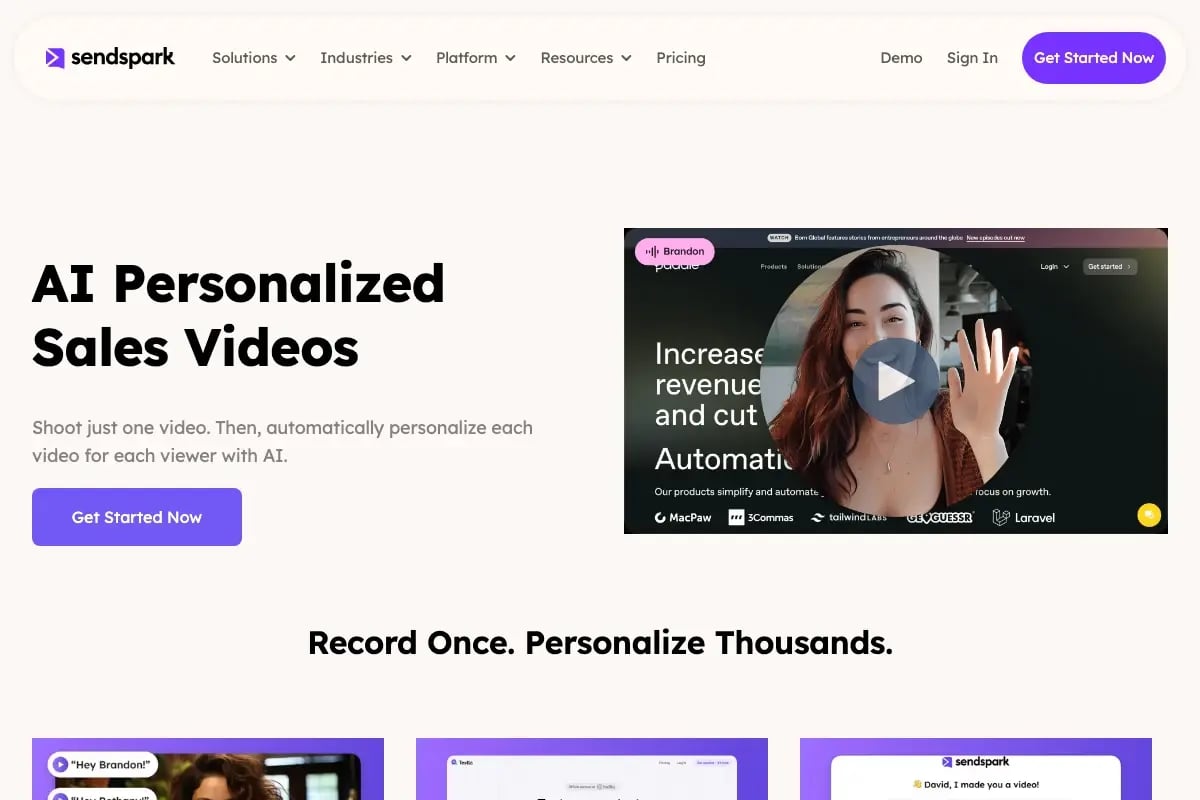
In a crowded inbox where every SDR is sending variations of the same personalized cold email, AI-personalized video is the highest-leverage differentiator in the modern outbound stack. AI-personalized video for sales prospecting works by letting reps record a single video once, then using AI voice cloning and dynamic backgrounds to automatically generate thousands of individually personalized videos — each one showing the prospect’s company website behind the speaker and addressing them by name, in the rep’s own cloned voice.
This isn’t screen recording in an email — it’s a fundamentally different approach that makes every prospect feel like the rep recorded a video specifically for them, even when the team is sending at scale. According to Sendspark’s own data, teams using AI-personalized video outreach see 40-50% more meetings booked and reply rates that increase by 200-300% compared to text-only sequences. For a step-by-step playbook on how top SDRs deploy this in their sequences, see the Record Once, Personalize Thousands playbook.
“The reps who stand out in a crowded inbox aren’t sending more emails — they’re sending better ones. AI video personalization lets every rep send outreach that feels 1:1, even at 1,000-prospect scale.”
Building the Stack Incrementally
Don’t try to implement all six layers at once. Start with CRM, sequencing, and prospecting data on day one. Add video outreach in month one once reps have their messaging dialed in — you want them using video to amplify a proven message, not mask a weak one. Add sales intelligence (intent data) once you have enough activity data to correlate triggers with conversion rates, typically 90-120 days into the team’s operation.
The goal is a stack where the tools reinforce each other: CRM data informs sequencing targeting, video outreach increases reply rates that go back into the CRM, and intelligence signals tell reps which accounts to prioritize in their Apollo queue on any given day.
Frequently Asked Questions
How many SDRs do I need to start an outbound sales team?
You can start with a single SDR. In fact, many successful outbound teams begin with one SDR and one AE — the SDR books meetings, the AE runs them. This lets you validate your ICP, messaging, and conversion rates before investing in a larger team. Once your first SDR is consistently hitting quota (6-10 meetings per month), that’s the signal to hire your second and build out the manager layer.
How long does it take to build an outbound sales team?
Hiring, onboarding, and reaching full productivity typically takes 4-6 months from when you make the decision to build. Plan for 4-6 weeks to hire your first SDR, 60-90 days for ramp to full quota, and another month to dial in sequences based on real reply data. From decision to a fully functioning team generating consistent pipeline: budget 6 months minimum.
What is the average SDR quota for outbound meetings?
According to HubSpot’s SDR benchmarking research, the average fully ramped SDR books 8-12 qualified meetings per month across most B2B industries. This varies significantly by deal size: teams selling $5K ACV products often hold SDRs to 15-20 meetings per month, while enterprise teams with $100K+ deals might target 4-6 highly qualified SQLs. Set your quota based on what your AE can realistically close from — not what a benchmark says other teams are doing.
What’s the difference between an SDR and a BDR?
The terminology overlaps significantly across companies, but the most common distinction is: SDRs work both inbound leads (following up on demo requests, trial signups) and outbound prospecting to a named account list, while BDRs are purely outbound with a focus on new business development — often targeting new verticals, new geographies, or large enterprise accounts that require a more research-intensive approach. When starting out, hire SDRs. Move to a BDR model when you’re going after strategic accounts that need dedicated, high-touch outbound.
How do I measure outbound sales team performance?
Track performance at three levels: activity (touches per day, sequence enrollment rate), pipeline (SQLs per month, meeting-to-opportunity conversion rate), and revenue impact (pipeline sourced by SDR, revenue closed from SDR-sourced meetings). The most important ratio is pipeline sourced to revenue closed — this tells you whether SDRs are qualifying well or just flooding AEs with low-quality meetings. For a comprehensive list, see our guide on sales rep productivity metrics.
What tools do outbound sales teams need?
Every outbound team needs four core tools: a CRM (HubSpot or Salesforce), a sequencing platform (Outreach, SalesLoft, or Apollo), a prospecting data source (ZoomInfo, Apollo, or Clay), and an AI video personalization tool like Sendspark for standing out in crowded inboxes. These four tools cover 80% of what an SDR needs to execute at scale. Sales intelligence (intent data) and call recording tools are the next tier once the team is past its initial ramp.
How do I keep outbound SDRs from burning out?
SDR burnout usually comes from three sources: unclear expectations, too much manual work, and rejection without coaching. Fix these with a clear quota and activity framework so reps know exactly what good looks like, a tech stack that automates the repetitive work, and a coaching culture where daily feedback on emails and calls makes rejection feel productive rather than personal. According to RAIN Group’s prospecting research, it takes an average of 8 touches to land a meeting — reps who understand this normal cadence have significantly lower attrition than those who expect faster results.
Sources & References
- Salesforce State of Sales — Benchmarks on high-performing sales team structure and SDR function adoption rates across B2B organizations (2024)
- HubSpot SDR Benchmarking Research — “Industry average is 8-12 meetings set per month for a fully ramped SDR” (2024)
- RAIN Group: Top Performance in Sales Prospecting — “It takes an average of 8 touches to reach a prospect and set a meeting” (2023)
Record One Video. AI Personalizes Thousands.
Sendspark is the AI video personalization platform for B2B sales. Record once, and AI voice cloning generates thousands of individually personalized videos with dynamic backgrounds and personalized thumbnails — each prospect hears their name, sees their website, in your voice. Sales teams see 2-3x more replies.
Get Started Now