
Published August 2026
Most B2B sales teams don’t lose deals because reps are lazy. They lose them because nobody notices a stalled deal until it’s already dead. Revenue intelligence platforms exist to fix that blind spot: they mine your calls, emails, and CRM activity for the signals a busy rep misses, and surface them before the deal slips. Below are the eight platforms worth evaluating in 2026, what each one actually does well, and how to pick between them.
Key Takeaways
- Revenue intelligence platforms mine calls, emails, and CRM activity for deal-risk and forecasting signals. Gartner projects 60% of B2B sales organizations will run on data-driven selling by 2025.
- Gong and Clari lead on conversation-intelligence depth; Salesforce and HubSpot Sales Hub bundle a lighter version of revenue intelligence into a CRM seat you likely already pay for.
- A Forrester study commissioned by Gong found one enterprise deployment delivered 481% ROI over three years, driven mostly by faster rep onboarding and fewer lost deals, not the license cost itself.
- The Clari-Salesloft merger closed in December 2025, signaling the category is consolidating around a single “revenue orchestration” layer. Buy for CRM and workflow fit, not just today’s feature list.
- Insights only move pipeline when a rep acts on them fast. Pairing a deal-risk alert with an AI-personalized video follow-up closes the gap between insight and outreach.
What Is a Revenue Intelligence Platform?
A revenue intelligence platform is software that uses AI to analyze sales calls, emails, and CRM activity, then surfaces deal risk, coaching gaps, and forecast accuracy without a rep having to log any of it manually. That’s the core difference from a CRM, which only stores what a rep types in by hand.
A revenue intelligence platform instead tells you what actually happened on the call, and whether the deal is really as healthy as the pipeline stage suggests.
It’s also a different layer than plain “conversation intelligence.” Conversation intelligence (call recording, transcription, talk-time ratios) is one input. Revenue intelligence takes that input plus email activity, calendar data, and CRM fields, and turns it into a forecast and a risk score at the deal, rep, and team level. It’s a natural complement to dedicated deal management software, which tracks the workflow a deal moves through rather than analyzing what happened inside it.
How we evaluated: We compared these eight platforms on conversation-intelligence depth, native CRM fit (Salesforce and HubSpot especially), forecasting sophistication, and how much of the workflow lives inside the tool versus requiring a separate sales engagement platform. Pricing for all eight is enterprise custom-quote, so we note relative cost signals instead of exact numbers where vendors don’t publish them.
| Platform | Best for | Standout feature | Pricing model |
|---|---|---|---|
| Gong | Deep conversation intelligence at scale | Deal Intelligence + “Ask Anything” AI search across every recorded call | Custom quote |
| Clari | Forecast accuracy and pipeline inspection | AI-driven Commit forecasting, now bundled with Salesloft’s engagement workflow | Custom quote |
| Salesforce Revenue Intelligence | Teams already living in Salesforce | Embedded analytics inside Sales Cloud, no extra login | Sales Cloud add-on, custom quote |
| Chorus by ZoomInfo | Combining call intel with B2B contact data | Deal Recommendation Engine layered on ZoomInfo’s data graph | Custom quote |
| People.ai | Automated activity capture and CRM hygiene | Zero-touch logging of email, calendar, and call activity to the CRM | Custom quote |
| Aviso AI | AI-native forecasting for complex enterprise deals | Predictive win-rate scoring and a conversational deal-Q&A assistant | Custom quote |
| Revenue Grid | Guided-selling prompts inside the inbox | Real-time next-best-action nudges directly in Outlook and Gmail | Custom quote |
| HubSpot Sales Hub | Small and mid-market teams already on HubSpot | Built-in deal insights with no separate platform to manage | From ~$90/seat/mo (Professional, billed annually) |
“By 2025, 60% of B2B sales organizations will transition from experience- and intuition-based selling to data-driven selling, merging their sales process, applications, data, and analytics into a single operational practice.”
— Gartner, Future of Sales research
That prediction is exactly what revenue intelligence platforms are built to operationalize: turning “the rep says the deal is on track” into a data-backed answer.
8 Best Revenue Intelligence Platforms for B2B Sales Teams in 2026
The best revenue intelligence platform for your team depends on whether you need deep conversation analysis, tighter forecasting, or a lighter add-on to a CRM you already run. Here are the eight worth shortlisting, ranked roughly by how much of the sales workflow they cover.
1. Gong
Gong records, transcribes, and analyzes every sales call, then surfaces which talk tracks correlate with wins across your whole team. Its “Ask Anything” feature lets managers query the entire call archive in plain English (“show me every deal where the prospect mentioned budget freeze this quarter”). A Forrester Total Economic Impact study commissioned by Gong modeled a composite enterprise customer achieving 481% ROI over three years, driven largely by a 50% cut in new-rep onboarding time. Best for teams that want conversation intelligence as the primary layer, not an add-on.
2. Clari
Clari built its name on forecast accuracy: it rolls up rep-level commit numbers into a single AI-adjusted forecast and flags deals that don’t match the pipeline stage they’re sitting in. Since closing its merger with Salesloft in December 2025, Clari now also owns the sales engagement workflow (sequences, dialer, inbox), positioning itself as a single “revenue orchestration” layer instead of two separate tools. Best for RevOps teams whose top complaint is forecast whiplash.
3. Salesforce Revenue Intelligence
Salesforce Revenue Intelligence lives natively inside Sales Cloud, so deal-risk and pipeline analytics show up where reps already work instead of in a separate app they have to remember to check. It’s the most CRM-native option on this list, which is also its main limitation: it’s built to analyze Salesforce data, not to replace or unify data sitting outside it. Best for Salesforce shops that don’t want to add another login to the sales stack.
4. Chorus by ZoomInfo
Chorus by ZoomInfo pairs conversation intelligence with ZoomInfo’s contact and company data, so a deal-risk flag can be traced back to a specific stakeholder gap (“no economic buyer has joined a call in three weeks”). Its Deal Recommendation Engine proactively surfaces at-risk deals rather than waiting for a manager to pull a report. Best for teams that already buy ZoomInfo for prospecting data and want the two systems connected.
5. People.ai
People.ai focuses on the unglamorous problem underneath every revenue intelligence rollout: dirty CRM data. It automatically captures email, calendar, and call activity and writes it to the CRM without a rep lifting a finger, which is what makes the AI layer on top of it actually trustworthy. Best for orgs whose forecast problem is really a data-hygiene problem in disguise.
6. Aviso AI
Aviso AI targets long, complex enterprise sales cycles with predictive win-rate scoring at the opportunity level and a conversational assistant reps can ask deal-specific questions. It leans more heavily on AI-native forecasting math than on conversation recording. Best for enterprise teams with six-figure deal sizes and multi-quarter cycles.
7. Revenue Grid
Revenue Grid takes a different approach: instead of a dashboard reps have to open, it pushes next-best-action guidance directly into Outlook and Gmail while they’re writing an email or prepping for a call. Best for teams that want guided selling embedded in existing inbox habits rather than a new tool to adopt.
8. HubSpot Sales Hub
HubSpot Sales Hub bundles a lighter version of deal insights and forecasting into the CRM seat many small and mid-market teams already pay for, starting from roughly $90/seat/month on the Professional tier billed annually. It won’t match Gong or Clari on conversation-intelligence depth, but for a 5-25 person sales team it avoids adding a fourth or fifth tool to the stack. Best for teams that want “good enough” revenue intelligence without a separate contract.
Record One Video. AI Personalizes Thousands.
Sendspark is the AI video personalization platform for B2B sales. Record once, and AI voice cloning generates thousands of individually personalized videos with dynamic backgrounds and personalized thumbnails — each prospect hears their name, sees their website, in your voice. Sales teams see 2-3x more replies.
Get Started NowHow to Choose the Right Revenue Intelligence Platform for Your Team
Choose a revenue intelligence platform by matching it to your deal complexity, your existing CRM, and your team size, in that order. A platform that’s overkill for a five-person team is as costly a mistake as one that’s too shallow for a 50-person enterprise floor.
Common mistake
Buying conversation intelligence (Gong, Chorus) to solve a forecasting problem, or buying a forecasting tool (Clari, Aviso) to solve a coaching problem. Match the tool to the actual gap, not the loudest feature in the demo.
Deal size and cycle length. Short, high-volume sales cycles get more value from conversation-intelligence tools like Gong or Chorus that coach reps on talk tracks across hundreds of calls a month. Long, complex enterprise cycles get more value from Aviso or Clari’s forecasting math, where a single missed risk signal on a six-figure deal matters more than call-volume coaching. See our breakdown of a typical B2B sales cycle for how deal stages map to the risk signals each platform tracks.
Existing CRM stack. If your team lives in Salesforce, Salesforce Revenue Intelligence removes a login and a data-sync problem. If you’re on HubSpot, HubSpot Sales Hub’s native deal insights do the same. Bolting Gong or Clari onto either CRM still works, but you’re managing a second system of record for risk signals.
Team size and budget. Teams under 25 reps rarely need Gong or Clari’s full feature set and often can’t justify the enterprise contract; revenue enablement platforms or a CRM-native option like HubSpot Sales Hub or Salesforce Revenue Intelligence usually cover the gap for less.
Buy for consolidation, not just today’s feature list. The Clari-Salesloft merger closed in December 2025, folding a sales engagement platform into a revenue intelligence one. Expect more of this. Picking a platform that’s actively expanding its category (rather than a point solution likely to be acquired or squeezed) reduces the odds of a forced migration in 18 months. For a broader look at the tooling layer underneath revenue intelligence, see our guide to revenue operations software and how it differs from RevOps automation tools.
Why Pair Revenue Intelligence With AI-Personalized Video Outreach
Revenue intelligence tells you which deals are at risk; it doesn’t act on that insight for you. When Gong flags a deal that’s gone quiet, or Clari’s forecast drops a deal a stage, the rep still has to write and send a follow-up — and a generic templated email is exactly what a stalled deal doesn’t need.
This is the insight-to-action gap. A deal-risk alert is only worth something if the follow-up that comes out of it actually gets a response. According to HubSpot’s 2025 State of Sales Report, sellers already spend roughly a quarter of their working hours on direct selling activity, with the rest lost to admin and manual outreach prep — so the follow-up on a flagged deal often gets a rushed, generic email instead of the attention the deal actually needs.
The same HubSpot research found AI adoption among sales reps rose from 24% in 2023 to 43% in 2024. Reps are using AI to analyze deals faster than ever, but analysis alone doesn’t close the gap: a risk flag from Gong or Clari still needs a fast, personal-feeling response, not just a faster dashboard to read it on.
Advanced strategy
When a revenue intelligence alert flags a stalled deal, record one video addressing the specific objection your platform surfaced, then use Sendspark’s AI voice cloning to personalize the delivery for each stakeholder on the deal, in your voice, without re-recording. The result reads as high-effort follow-up because it is, without costing the rep the extra hour.
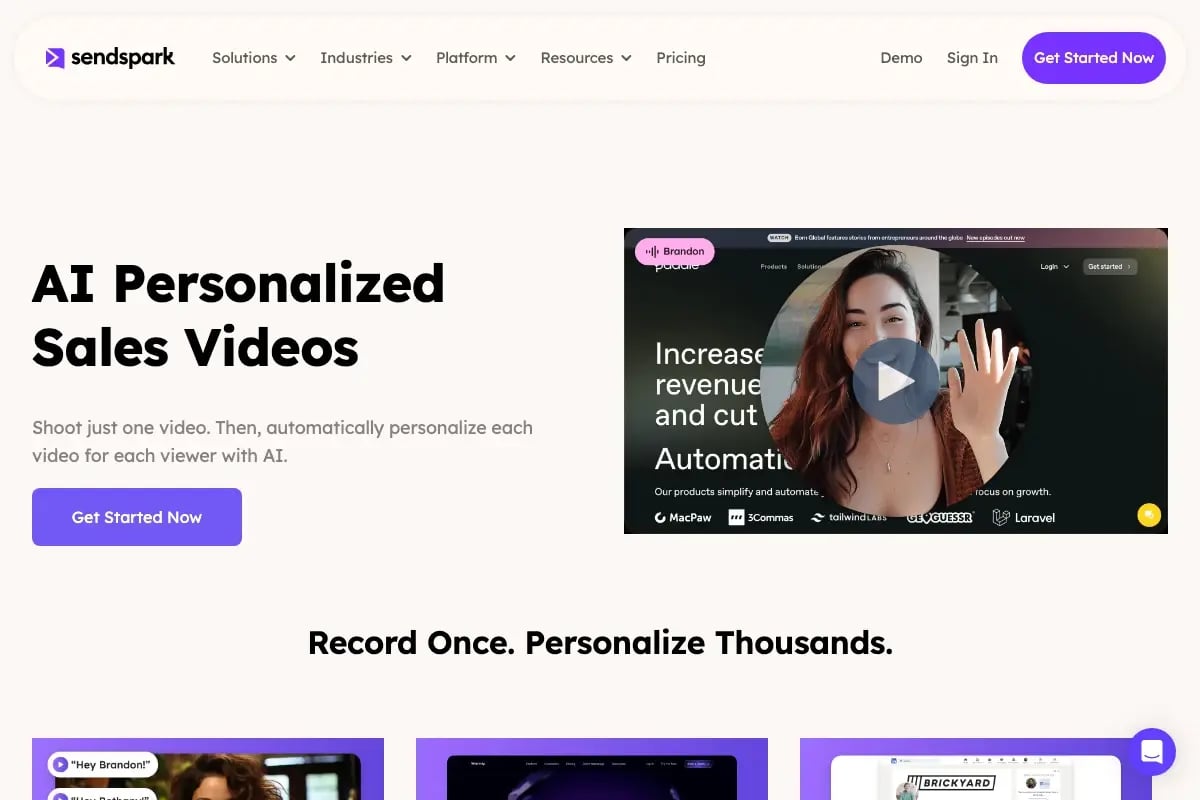
Sendspark’s AI-personalized video layer is built for exactly this handoff: record one video responding to the risk signal, and AI voice cloning with dynamic backgrounds generates a personalized version for every stakeholder on the deal, each showing that stakeholder’s name and company. Video analytics then tell you who actually opened and watched it, closing the loop the original alert started. It connects to your existing stack through HubSpot and Salesforce, so the follow-up video and its engagement data land back in the same deal record your revenue intelligence platform is already watching.
For teams evaluating whether the ROI justifies the stack, our pricing page breaks down what a video personalization layer costs against the reply-rate lift, and our demo walks through the deal-risk-to-video workflow directly. For the fuller playbook on where AI-personalized video fits across an outbound motion, see our comprehensive guide to AI video personalization for outbound sales.
| If your gap is… | Start with | Pair with |
|---|---|---|
| Forecast accuracy | Clari or Aviso AI | AI-personalized video for flagged deals |
| Coaching / talk tracks | Gong or Chorus by ZoomInfo | Sendspark follow-up video using the winning talk track |
| CRM data hygiene | People.ai | Video analytics synced back to the clean CRM record |
| Budget-constrained, CRM-native | HubSpot Sales Hub or Salesforce Revenue Intelligence | Sendspark’s HubSpot/Salesforce integration |
Frequently Asked Questions
What is a revenue intelligence platform?
A revenue intelligence platform is software that uses AI to analyze sales calls, emails, and CRM activity to surface deal risk, coaching gaps, and forecast accuracy automatically. Unlike a CRM, which only stores what a rep manually enters, it captures and interprets what actually happened in the sales process.
What does revenue intelligence do?
Revenue intelligence flags deals that don’t match their pipeline stage, identifies which talk tracks correlate with wins, and rolls rep-level forecasts up into a single AI-adjusted number for leadership. It turns scattered call, email, and CRM data into one risk score per deal.
How is a revenue intelligence platform different from a CRM?
A CRM is a system of record that stores data a rep enters manually, while a revenue intelligence platform is a system of analysis that captures activity automatically and interprets it. Most revenue intelligence platforms, including Salesforce Revenue Intelligence and HubSpot Sales Hub, sit on top of an existing CRM rather than replacing it.
What is the difference between revenue intelligence and conversation intelligence?
Conversation intelligence, like call recording and talk-time analysis, is one input into revenue intelligence. Revenue intelligence combines that call data with email activity, calendar data, and CRM fields to produce a broader deal-risk score and forecast, not just call-level coaching feedback.
How much do revenue intelligence platforms cost?
Most standalone revenue intelligence platforms, including Gong, Clari, and Aviso AI, are enterprise custom-quote products with no published pricing. CRM-native options are cheaper to start: HubSpot Sales Hub Professional runs from about $90 per seat per month billed annually, with revenue intelligence features included.
Can revenue intelligence platforms work with Salesforce and other CRMs?
Yes. Gong, Clari, Chorus by ZoomInfo, People.ai, Aviso AI, and Revenue Grid are all built to sync with Salesforce and other major CRMs, while Salesforce Revenue Intelligence and HubSpot Sales Hub are native extensions of their own CRM rather than separate integrations.
How do I choose a revenue intelligence platform?
Match the platform to your specific gap: conversation-intelligence tools like Gong for coaching, forecasting tools like Clari or Aviso for pipeline accuracy, and CRM-native options like Salesforce Revenue Intelligence or HubSpot Sales Hub for smaller teams that don’t want a new system of record. Deal size, cycle length, and existing CRM stack should decide before feature lists do.
Sources & References
- Gartner — “By 2025, 60% of B2B sales organizations will transition from experience- and intuition-based selling to data-driven selling” (2020)
- Forrester Total Economic Impact study (commissioned by Gong) — modeled a composite enterprise customer achieving 481% ROI over three years, including a 50% cut in rep onboarding time (2024)
- Salesloft newsroom — Clari and Salesloft completed their merger, combining forecasting and sales engagement into one platform (2025)
- HubSpot 2025 State of Sales Report — sellers spend roughly a quarter of their working hours on direct selling, with the remainder consumed by admin and manual tasks (2025)
- Gartner Market Guide for Revenue Intelligence Platforms — formal market guidance recognizing the convergence of conversation, forecasting, and revenue intelligence into a single category (2025)
Record One Video. AI Personalizes Thousands.
Sendspark is the AI video personalization platform for B2B sales. Record once, and AI voice cloning generates thousands of individually personalized videos with dynamic backgrounds and personalized thumbnails — each prospect hears their name, sees their website, in your voice. Sales teams see 2-3x more replies.
Get Started Now