Your sales kickoff wraps with a standing ovation, a new pitch everyone loves, and a Slack channel full of fired-up reps. Three weeks later, half the team is back to the old talk track and nobody can remember the new objection-handling script. That gap between “great event” and “changed behavior” is the actual cost of a sales kickoff (SKO) — and it’s almost always a reinforcement problem, not a content problem.
Most sales organizations already know this, at least in theory. Enablement teams spend months building the perfect SKO deck, booking the right speakers, and rehearsing the big product reveal. Far fewer teams spend even a fraction of that effort planning what happens on day 4, day 30, or day 90 after everyone flies home. That imbalance is exactly why the training decays so fast — nobody built a system for it to survive past the closing session.
Published September 2026
Key Takeaways
- A widely cited Xerox study found 87% of sales training is forgotten within 30 days without reinforcement, yet most SKOs still budget for the 2-3 day event and nothing after it.
- Highspot’s State of Sales Enablement Report 2025 found 55% of organizations struggle with either sales training or coaching, meaning the SKO event usually isn’t the failure point — the follow-through is.
- RAIN Group surveyed 221 sales leaders, enablement professionals, and sellers and found engagement and hands-on practice, not executive keynotes, are what actually drive lasting behavior change from a kickoff.
- Recording a short practice or teach-back video within 48 hours of SKO and reviewing it async on a weekly cadence mirrors the reinforcement pattern research shows prevents skill decay.
- Refreshing messaging with a new 90-second video each quarter costs a fraction of running a second full kickoff event.
What a Sales Kickoff Actually Costs You When Reinforcement Is Missing
A sales kickoff without a reinforcement plan loses most of its value within weeks, because reps forget new training almost as fast as they learn it. A study by Xerox, cited by ExecVision co-founder Steve Richard, found that 87% of sales training is forgotten within 30 days when there’s no structured follow-up. The SKO itself isn’t the problem — what happens (or doesn’t happen) in the weeks after is.
Sales kickoffs are also one of the largest single line items in a sales enablement budget. Flights, venues, production, and two or three days of pulled-off-quota selling time add up fast for any team above a handful of reps. That spend is only justified if the behavior change outlasts the closing keynote.
“Sales kickoffs (SKOs) are among the most visible — and expensive — sales enablement investments. A high spend often doesn’t translate to ROI. Even when sellers leave feeling motivated and energized, the feeling seldom sticks. New initiatives and skills go unadopted, and reinforcement is scarce.”
— RAIN Group, based on a survey of 221 sales leaders, enablement professionals, and sellers
Highspot’s State of Sales Enablement Report 2025 puts a number on the follow-through gap: 55% of organizations struggle with either sales training or coaching. Combine that with the forgetting curve above and the pattern is clear — the event isn’t broken, the system around it is. Fixing that system doesn’t require a bigger kickoff. It requires a cheap, repeatable way to keep the new message alive between kickoffs.
How Teams Try to Reinforce SKO Training (Compared)
Most sales organizations reinforce SKO training through one of five methods: manager 1:1 coaching, quarterly refresher sessions, e-learning modules, a peer library of recorded calls, or short async practice videos. Each trades off differently on cost, how well it scales past a handful of reps, and how consistently it actually gets used.
| Reinforcement Method | Cost to Scale | Manager Time Required | Consistency Across Reps |
|---|---|---|---|
| Manager 1:1 coaching | High — scales linearly with headcount | High, ongoing | Depends on the manager |
| Quarterly refresher sessions | Moderate — another live event to plan | Moderate, in bursts | Good, but gaps between sessions |
| E-learning modules | Low once built | Low | Low — passive, easy to skip |
| Peer library of recorded calls | Low | Low | Depends on call volume and quality |
| Async practice/teach-back video | Low — one recording per rep | Low — async review, no scheduling | High — every rep produces one, trackable |
None of these methods is wrong on its own. The teams that get the most from their kickoff usually combine two: a manager coaching cadence for depth, paired with async video practice for consistency, because it’s the only method on this list that scales without adding more of a manager’s calendar.
Pro tip
When you assign a teach-back video, ask reps to work from bullet points, not a script read off the SKO deck. A rep who has to explain the new positioning in their own words is the one who actually learns it.
The 5-Step Framework for an SKO That Actually Sticks
An SKO that sticks follows a simple five-step pattern: anchor the event around two or three behaviors instead of twenty slides, capture the core message on video once, have every rep record a short teach-back within 48 hours, put a manager review cadence in place for about eight weeks, then refresh with a new short video each quarter instead of a second full event.
Step 1: Anchor the SKO Around 2-3 Behaviors, Not 20 Slides
Pick the two or three specific things you want every rep doing differently after the event — a new discovery question, a reframed objection response, a different opening line. A 40-slide deck of “everything new this year” gives reps nothing concrete to practice and nothing concrete for a manager to check. If you can’t name the two or three behaviors on one line, the SKO agenda is trying to do too much.
Step 2: Capture the Message Once on Video
Whoever owns the new positioning — a product marketer, a sales leader, a top rep — records it a single time. That one recording becomes the reference every rep and manager points back to when the live-event memory fades, which research shows happens within days, not months. It also replaces the usual post-SKO scramble of half-remembered notes and slightly different versions of the pitch floating around Slack.
Step 3: Every Rep Records a Teach-Back Within 48 Hours
Within two days of the SKO, each rep records a short video explaining the new message in their own words, as if pitching a colleague. This is the step most teams skip, and it’s the one closest to the 48-hour reinforcement window that keeps information moving from short-term to long-term memory. It also surfaces exactly which reps didn’t absorb the new material, while there’s still time to correct it before it reaches a live prospect.
Step 4: Manager Review Cadence for ~8 Weeks
A manager reviews each rep’s teach-back async and leaves feedback, then repeats a lighter version weekly for about eight weeks. This is the “spaced repetition” piece — short, frequent touchpoints beat one long review session, and it never requires everyone’s calendars to align. Eight weeks isn’t an arbitrary number: it’s roughly the window most reinforcement research points to before a new habit holds without active coaching.
Step 5: Refresh Quarterly With a New Short Video, Not a New Event
Messaging drifts, competitors change their pitch, and a new objection shows up. Instead of waiting for next year’s SKO to correct it, record a new 90-second update and push it to the team. It costs a fraction of a live refresher session and reaches everyone the same day, which matters most in the exact weeks when a competitor just changed their pricing page or a prospect started asking a question nobody prepared for.
Record One Video. AI Personalizes Thousands.
Sendspark is the AI video personalization platform for B2B sales. Record once, and AI voice cloning generates thousands of individually personalized videos with dynamic backgrounds and personalized thumbnails — each prospect hears their name, sees their website, in your voice. Sales teams see 2-3x more replies.
Get Started NowCommon Sales Kickoff Reinforcement Mistakes
The most common SKO reinforcement mistakes are running a keynote-heavy agenda, treating training as one-and-done, skipping manager follow-through, waiting for next year’s event to fix messaging drift, and having no way to measure who actually practiced. Each one independently cancels out most of the value of the live event.
- Keynote-heavy agenda. RAIN Group’s research found executive keynotes contribute less to lasting behavior change than hands-on practice and team-building, even though they’re often the biggest line item on the agenda.
- One-and-done training. A single exposure to new material, without repetition, is exactly the setup the forgetting curve predicts will fail within a month.
- No manager follow-through. If the manager doesn’t ask about the new pitch again until the next 1:1 cycle, reps default back to what already feels comfortable.
- Waiting for next year’s SKO to fix drift. Positioning and competitive responses change faster than the annual calendar. A message that was accurate in January can be stale by Q3.
- No way to measure who practiced. Without a record of who completed a teach-back or watched a refresher, “reinforcement” is just a plan, not a program.
Common mistake
Don’t wait for next year’s SKO to correct messaging drift. A quarterly refresh video costs a fraction of a second live event and reaches the whole team the same day it’s recorded.
Building Video Reinforcement Into Your SKO Follow-Up
Video reinforcement works because it removes the two biggest blockers to consistent follow-through: scheduling and scale. A rep records a teach-back on their own time in under five minutes, a manager reviews it whenever they get a gap in their day, and the whole team’s practice is organized in one place instead of scattered across calendars and calls.
In practice, this looks like recording with Sendspark’s AI video scripts and teleprompter tool so reps can work from bullet points instead of a memorized script, then dropping the recording into a shared Team Library organized by objection, competitor, or segment — the same structure covered in our guide to building sales battlecards reps will actually use. Once videos are organized this way, a manager can review a whole team’s teach-backs in one sitting instead of chasing down individual calls.
Reps can record with either the desktop app or the Chrome extension, whichever fits how they already work — someone practicing a discovery question can knock out a 60-second take between calls without booking any studio time or scheduling a peer-review session. That low a barrier to entry is what actually gets a team of 30 reps to produce 30 teach-backs in the same week, instead of the five or six you’d get from a sign-up sheet for live roleplay slots.
Video analytics close the measurement gap from the mistakes above — you can see who watched a refresher to the end and who clicked through, which turns “we reinforced the training” from a claim into a number you can report to sales leadership.
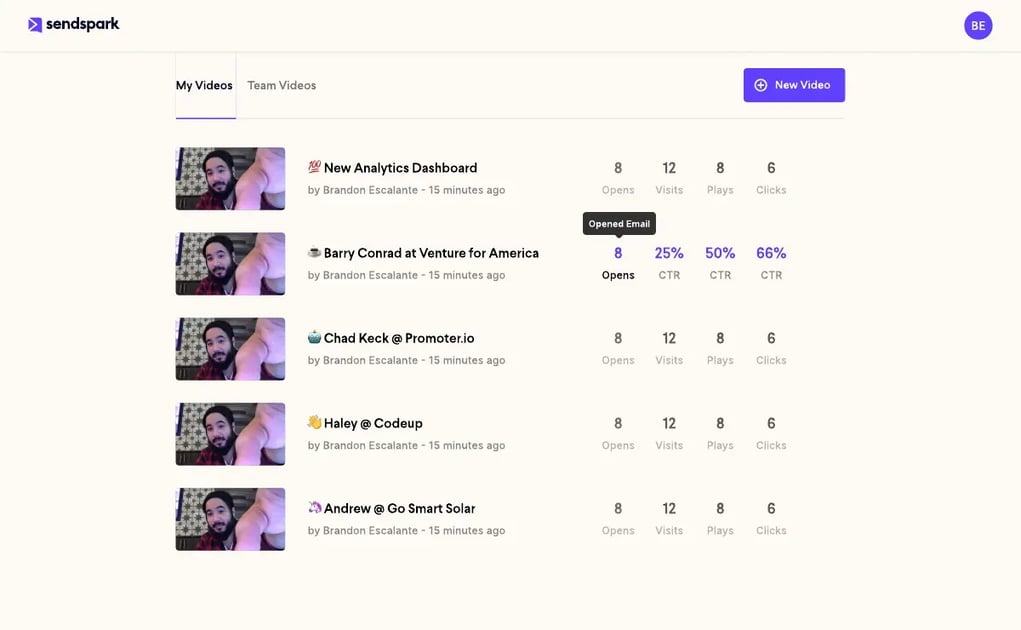
It’s worth noting this is the same recording workflow reps use for the customer-facing side of the job: the identical one-take video they record to explain new positioning internally is the format Sendspark then personalizes at scale with AI voice cloning and dynamic backgrounds for actual prospect outreach. Practicing the pitch on video before SKO ends is also rehearsal for the outbound motion it’s about to fuel.
Have your top-performing reps record their teach-back first and share it as the internal benchmark — newer reps learn faster from a peer’s real 90-second video than from a manager’s written notes.
For a deeper comparison of how live roleplay, AI roleplay simulators, and video review stack up as ongoing practice methods (not just for the weeks after SKO), see our full breakdown in sales roleplay training: live practice, AI simulators, or video review. And if reinforcement is one piece of a broader coaching program, our guides to building a sales training and coaching program and sales leadership coaching frameworks cover the manager side in more depth. For the outbound execution that reinforced messaging eventually feeds, our sales prospecting solution page and our comprehensive guide to video prospecting are the next stops.
| SKO Reinforcement Checklist | Timing | Owner |
|---|---|---|
| Anchor on 2-3 behaviors | Before SKO | Sales leadership |
| Capture the message on video | During SKO | Product marketing / top rep |
| Every rep records a teach-back | Within 48 hours after SKO | Every rep |
| Async manager review | Weekly for ~8 weeks | Frontline managers |
| Refresh video for messaging drift | Quarterly | Sales enablement |
Frequently Asked Questions
What is a sales kickoff (SKO)?
A sales kickoff is a structured, multi-day gathering of a sales team, typically at the start of the fiscal year, used to communicate goals, launch new messaging, and align reps around strategy through workshops and presentations.
Why do sales reps forget SKO training so quickly?
A Xerox study found 87% of sales training is forgotten within 30 days without reinforcement. Without repetition, new information decays from short-term to long-term memory almost as fast as it’s presented.
How often should you reinforce sales kickoff training?
Reinforce within 48 hours of the event, then continue on a weekly cadence for roughly eight weeks. This spaced-repetition pattern combats the forgetting curve without requiring a second full training event.
What’s the best way to measure sales kickoff reinforcement ROI?
Track who completed a post-SKO teach-back video and who engaged with quarterly refresher content, using watch-through data rather than self-reported completion, so leadership sees actual participation instead of an estimate.
Should sales kickoffs be in-person, virtual, or hybrid?
Format matters less than reinforcement. RAIN Group’s research found engagement and hands-on practice drive lasting change more than the venue, so any format works if it’s followed by a structured practice cadence.
How can video help reinforce sales kickoff training?
Video removes the scheduling burden of manager coaching at scale — each rep records a short teach-back on their own time, and a manager reviews it asynchronously, without needing every calendar to align.
What’s a realistic first step for sales kickoff reinforcement if we’ve never done it?
Pick one behavior from the SKO, have every rep record a single 60-second video explaining it in their own words within 48 hours, and have managers leave one round of feedback. Expand from there.
Sources & References
- ExecVision (Steve Richard, Co-Founder) — “A Xerox study found 87% of sales training is forgotten in just 30 days” (2019)
- RAIN Group — “Surveyed 221 sales leaders, enablement professionals, and sellers; SKOs are among the most expensive enablement investments, and reinforcement is scarce” (2026)
- Highspot (Bridgette Roberts, Product Marketing Manager) — “55% of organizations struggle with either sales training or coaching” (2025)
- Spekit (Elle Morgan, Director, Content & Communications) — “Six essential ingredients for an SKO that translates into lasting revenue impact” (2026)
Record One Video. AI Personalizes Thousands.
Sendspark is the AI video personalization platform for B2B sales. Record once, and AI voice cloning generates thousands of individually personalized videos with dynamic backgrounds and personalized thumbnails — each prospect hears their name, sees their website, in your voice. Sales teams see 2-3x more replies.
Get Started Now