
Most B2B sales teams track video views and call it a day. That’s leaving pipeline on the table. In 2026, video marketing ROI is measured in pipeline velocity, engagement-weighted deal scores, and revenue attributed directly to personalized video touchpoints — not vanity metrics.
Key Takeaways
- Personalized video in outbound can lift email response rates by 200–300% and meeting bookings by 40–50% — but only if you track the right metrics.
- Apple Mail Privacy Protection has broken open-rate tracking; shift your measurement baseline to video play rate, watch time, and CTA clicks.
- AI voice cloning economics flip the math: record one video, generate thousands of personalized versions, and drop your cost per personalization from minutes to seconds.
- Engagement-weighted pipeline scoring — weighting deals by how deeply prospects engage with video — is a leading indicator of close probability more accurate than activity count alone.
- Multi-touch attribution models (first-touch, last-touch, view-through) are the only reliable way to tie video touchpoints to closed-won revenue in a modern B2B sales funnel.
How Video Marketing ROI Has Changed in 2026
Video marketing ROI in 2026 is no longer about counting views or impressions. It’s about connecting individual video interactions — plays, rewinds, CTA clicks, reply rates — to pipeline movement and closed-won revenue. The shift happened because AI personalization, revenue intelligence platforms, and privacy-first email infrastructure all matured at the same time, forcing B2B teams to build more sophisticated measurement systems.
Three years ago, most sales teams used video as a one-to-many broadcast tool. You’d film a product demo, blast it to a list, and measure success by total plays. That model is dead for a simple reason: personalization at scale is now table stakes. According to the Salesforce State of Sales report, buyers now expect personalized outreach at every touchpoint — and generic video performs no better than a generic cold email.
What’s actually changed in 2026 measurement frameworks:
- Signal-based attribution: Video play events are now first-class signals in CRM platforms, not footnotes. Every watch is a data point your revenue team can act on.
- Privacy erosion of email metrics: Apple Mail Privacy Protection pre-fetches email content, making open rates unreliable. Video engagement data — real human plays — has become a more trustworthy engagement signal than email opens.
- AI personalization economics: The cost to produce a personalized video dropped by orders of magnitude. That means ROI math now includes the cost-per-personalization, not just cost-per-video.
- Account-based measurement: ABM teams need to attribute video touches at the account level, not just the individual contact level — because buying committees, not individuals, sign contracts.
The bottom line: if your video ROI framework still starts and ends with “views,” you’re measuring a proxy that doesn’t predict revenue. The rest of this guide walks through what to track instead — from core engagement metrics to AI-era economics. If you haven’t yet mapped video types to funnel stages and distribution channels, our B2B video marketing strategy playbook covers that groundwork first.
The Core Engagement Metrics That Still Matter
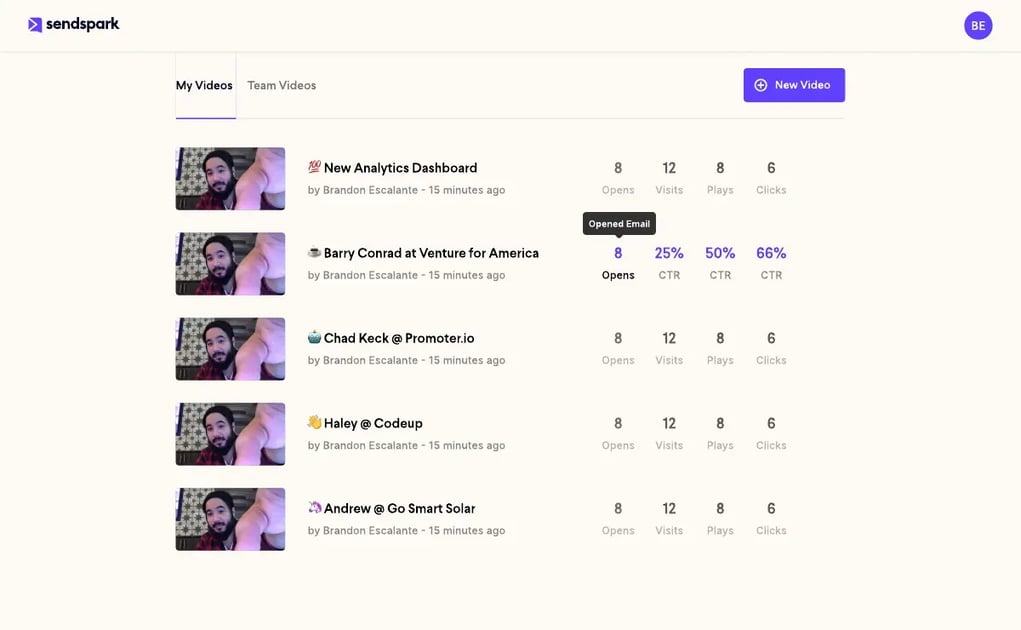
Engagement metrics are the foundation of video marketing analytics. Play rate, average watch percentage, and CTA click rate are the three signals that tell you whether your video is actually reaching and resonating with prospects — before you layer on any pipeline or revenue data. Get these right first; everything else builds on them. Organic search traffic is one channel worth tracking here too – optimizing videos for SEO can bring in engaged viewers before a single outreach send goes out.
Play Rate
Play rate is the percentage of people who clicked play after seeing your video thumbnail. A low play rate means your thumbnail, subject line, or delivery context isn’t compelling enough — the video never gets a chance. For personalized sales video sent via email, a strong play rate sits above 40%. Personalized thumbnails that show the prospect’s name or company logo consistently outperform generic video previews.
This is also the metric least affected by Mail Privacy Protection. An email “open” can be faked by Apple’s proxy. A video play requires genuine human intent — someone had to click. That makes play rate one of the most honest engagement signals in modern outbound.
Average Watch Percentage (Completion Rate)
Watch percentage tells you how compelling your content is once someone starts watching. The Wistia State of Video Report consistently shows that shorter, highly relevant videos retain viewers far better than long-form content. For sales prospecting videos, aim for under 90 seconds and target 70%+ average completion. If watch percentage drops below 50%, your hook or your personalization relevance needs work.
Watch percentage also tells you where prospects drop off. A cliff at the 20-second mark usually means your opening line isn’t relevant enough. A drop at the 60-second mark often means the video ran too long. Both are fixable — but only if you’re watching the data.
CTA Click-Through Rate
Your video’s call-to-action click rate bridges engagement and pipeline. It’s the moment a viewer moves from passive watching to active intent. Sales teams using personalized video see CTA click-through rates increase by up to 50% compared to text-only outreach. The CTA itself matters as much as the video — “Book a 15-minute call” outperforms “Learn more” in nearly every B2B context.
Pro tip
Don’t just track whether someone clicked your CTA — track when they clicked. Prospects who click a CTA after watching 80%+ of a video convert to booked meetings at roughly 2x the rate of those who click after only 30%. Segment your follow-up cadence accordingly.
Reply Rate and Response Velocity
For cold outbound, reply rate is the most direct engagement metric you have. Teams using AI-personalized video in prospecting sequences report 200–300% higher email response rates compared to plain-text emails. Response velocity — how quickly a prospect replies after watching — is an underused signal. A reply within 24 hours of a video send indicates high intent and should trigger immediate follow-up, not a 3-day wait in your sequence.
Track these metrics in Sendspark’s built-in video analytics dashboard, where play events, watch time, and CTA clicks sync automatically to your CRM so your sales reps see engagement signals right inside their workflow.
Pipeline and Conversion Metrics for Sales Video
Pipeline metrics connect video engagement to sales outcomes. The key measures are video-influenced opportunity creation rate, meeting-booking rate per video send, and stage-to-stage conversion rates for deals where video was a touchpoint. These metrics prove that video moves deals — not just inboxes.
Meeting Booking Rate
The cleanest leading indicator of pipeline impact is how many video sends result in a booked meeting. Sales teams that embed video in their prospecting sequences book 40–50% more meetings compared to text-only outreach at the same volume. To measure this cleanly, tag every outbound sequence that includes a video touchpoint, and calculate booked meetings per 100 sends separately for video and non-video sequences.
Your sales prospecting workflows should log video sends as distinct activities in your CRM so this comparison is always available. If you’re using HubSpot, the Sendspark HubSpot integration logs every video open and CTA click as a contact activity automatically.
Video-Influenced Pipeline Value
Not every opportunity was created because of a video — but video may have been a meaningful touchpoint in moving it forward. Video-influenced pipeline captures the total dollar value of open opportunities where at least one video interaction occurred. This is different from video-attributed pipeline, which requires video to be the primary driver. Both numbers matter, and most mature teams track both.
Stage-to-Stage Conversion Rates
Where in the funnel does video have the biggest lift? Track conversion rates separately for video-touched and non-video-touched deals at each pipeline stage. Common findings:
- Prospecting → Meeting booked: biggest lift, often 40–50% improvement
- Meeting → Proposal: moderate lift, especially when follow-up videos recap key points
- Proposal → Closed-won: meaningful lift when video is used to address objections or engage the buying committee directly
| Funnel Stage | Key Video ROI Metric | Benchmark (Personalized Video) | What to Track in CRM |
|---|---|---|---|
| Awareness / Outbound | Play rate, reply rate | 40%+ play rate; 200–300% reply lift | Video send activity, first reply date |
| Consideration / Meeting | Meeting booking rate, CTA click rate | 40–50% more meetings vs. text-only | CTA click event → meeting created |
| Evaluation / Proposal | Watch percentage, multi-viewer opens | 70%+ completion on follow-up recaps | Unique viewers per opportunity |
| Decision / Close | Video-attributed pipeline, win rate delta | Higher win rate for video-touched deals | Video touchpoints on closed-won deals |
| Expansion / Retention | Re-engagement rate, upsell conversion | 2x reply rate on renewal campaigns | Video sends on existing accounts |
Record One Video. AI Personalizes Thousands.
Sendspark is the AI video personalization platform for B2B sales. Record once, and AI voice cloning generates thousands of individually personalized videos with dynamic backgrounds and personalized thumbnails — each prospect hears their name, sees their website, in your voice. Sales teams see 2-3x more replies.
Get Started NowRevenue Attribution: Tying Video to Closed-Won Deals
Revenue attribution for video means connecting specific video interactions to deals that actually closed. The challenge is that most B2B deals involve 6–10 touchpoints across multiple channels. Attribution models — first-touch, last-touch, and multi-touch — each tell a different part of the story, and the right model depends on how you sell.
First-Touch Attribution
First-touch attribution gives 100% of the credit for a closed deal to the first interaction that brought the prospect into your funnel. If a cold video email was the first touchpoint that got a reply, that deal’s full value is attributed to video. This model overstates video’s impact when video is used deep in the funnel but understates it when video opens doors that other channels then close. It’s most useful for evaluating prospecting and cold outreach campaigns.
Last-Touch Attribution
Last-touch attribution assigns all credit to the final touchpoint before a deal closed. Sales teams that use video for proposal walkthroughs, objection handling, or executive stakeholder outreach tend to score well under last-touch models. The risk: last-touch attribution undervalues video in prospecting sequences, which often initiate the relationship even if they’re not the final touch.
Multi-Touch Attribution
Multi-touch attribution distributes credit across every interaction in the buyer’s journey — linear (equal weight), time-decay (more weight to recent touches), or W-shaped (heavy weight to first touch, last touch, and opportunity creation). For most B2B sales teams, a W-shaped or time-decay model captures video’s contribution most accurately.
If your team uses Salesforce, the Sendspark Salesforce integration logs video engagement events as campaign member activities, making it straightforward to include video touches in any multi-touch attribution report you’re already running.
View-Through Attribution
View-through attribution credits a conversion to a video even when the prospect didn’t click directly from the video to take action — they watched, then converted later through another channel. This is especially relevant for video campaigns that run through LinkedIn or email sequences where prospects may watch a video Tuesday, then respond to a follow-up call Thursday. Ignoring view-through conversions systematically undervalues video’s contribution to pipeline.
Revenue Intelligence Integration
Platforms like Gong’s revenue intelligence layer call data, email signals, and engagement patterns on top of CRM data to predict deal outcomes. When video engagement signals are fed into these platforms — plays, watch duration, CTA clicks — they enrich deal health scores and give your revenue team a more complete picture of where each opportunity stands. Video is no longer a standalone channel; it’s a data feed into your broader revenue intelligence stack.
AI-Era Video ROI Metrics: What Changed for B2B Sales in 2026
AI-era video ROI isn’t just about better analytics — it’s about fundamentally different economics. When AI voice cloning lets you record one video and generate thousands of personalized versions, the cost structure of personalized outreach changes entirely. That requires new metrics: cost per personalization, engagement-weighted pipeline value, predictive engagement scores, and account-level attribution. These didn’t exist as standard KPIs three years ago.
Record-Once Economics and Cost Per Personalization
Traditional personalized video required a rep to record each video individually. At 5–10 minutes per video, sending 500 personalized videos meant 40–80 hours of recording time. That math made personalization a luxury reserved for the highest-value accounts.
AI voice cloning flips the model. With Sendspark’s AI intros, you record one video. The AI clones your voice to insert each prospect’s name, company, and personalized context — while dynamic backgrounds pull in each prospect’s website and personalized thumbnails make the preview uniquely theirs. What took 80 hours now takes under an hour for a campaign of 500. The cost per personalization drops from roughly 10 minutes of rep time to seconds. That’s not incremental improvement — it’s a category shift in how you calculate video ROI.
To measure this properly, track:
- Time saved per campaign: Compare hours previously spent recording individual videos vs. hours spent with AI personalization. Teams consistently save 10+ hours per campaign.
- Cost per personalized video: Divide total campaign cost (platform + rep time) by the number of unique personalized videos generated.
- Revenue per video send: Divide video-attributed pipeline by total videos sent. This is the headline ROI number that justifies program investment.
Engagement-Weighted Pipeline Scoring
Standard pipeline reports treat a $100K deal the same whether the prospect watched 90% of your video or never opened your email. Engagement-weighted pipeline scoring corrects this by adjusting deal values based on depth of engagement. A prospect who watched your demo video three times, clicked your CTA, and shared the link with a colleague is a much hotter opportunity than someone at the same deal stage who hasn’t engaged at all.
To build this, assign engagement scores to specific video behaviors — for example: play = 1 point, 50% watch = 2 points, 75% watch = 4 points, CTA click = 6 points, forwarded or shared = 8 points. Multiply raw pipeline value by a normalized engagement multiplier. The result: a more accurate forecast than activity-based scoring alone. Research from McKinsey’s growth and sales practice consistently shows that behavioral engagement signals are stronger predictors of purchase intent than demographic or firmographic data alone.
Account-Based Attribution for Buying Committees
In enterprise B2B deals, you’re not selling to one person — you’re selling to a committee of 6–10 stakeholders. Account-based attribution aggregates all video interactions at the account level, not just the individual contact level. When your economic buyer watches a video AND their IT director plays the same video AND a VP of Finance clicks the CTA on a different video in the same sequence, those signals together indicate committee-level engagement. That’s far more predictive than any single contact’s behavior.
Account-based attribution requires your video platform to pass engagement data at the account level to your CRM. Every video interaction is a video signal — a real-time behavioral data point that tells you where an account is in their buying journey. Aggregated across a buying committee, those signals become a buying intent score your revenue team can act on today.
Common mistake
Teams often measure video ROI only at the individual contact level and miss buying committee engagement entirely. If three people at the same company each watch a video in the same week, that’s a hot account — not three lukewarm contacts. Make sure your attribution model aggregates video signals at the account level before you report on video’s impact on pipeline.
Mail Privacy Protection and Privacy-First Measurement
Apple Mail Privacy Protection pre-loads email content — including tracking pixels — in the background, regardless of whether the recipient ever actually opened the email. This inflates open rates and makes them meaningless as an engagement signal. If your video ROI framework relies on email open rates as a proxy for engagement, you’re measuring Apple’s servers, not your prospects’ intent.
The fix is straightforward: replace email open rate with video play rate as your primary engagement signal. A video play requires deliberate human action — someone clicked play. It can’t be pre-fetched. This is exactly why sophisticated sales teams have moved video engagement to the center of their measurement model. The HubSpot State of Marketing report confirms that video engagement metrics have become primary KPIs for sales teams precisely because they survived the privacy-first transition that made email opens unreliable.
Predictive Engagement Scoring and Agentic Workflows
The next frontier in video ROI measurement is predictive: using historical engagement patterns to score new prospects before they even watch. If prospects with similar firmographic profiles who watched 80%+ of your intro video historically converted to meetings at 3x the rate of low-engagement viewers, that pattern can train a predictive score applied at the start of each new campaign.
Agentic workflows take this further. In 2026, leading revenue teams are connecting video engagement signals directly to automated next-step triggers: a prospect watches 90% of a video → the CRM auto-enrolls them in a high-priority sequence → an AI-generated follow-up video lands in their inbox within the hour. This is the convergence of AI video and sales automation that separates the top 10% of sales teams from everyone else. Sendspark’s video personalization platform is built to feed these agentic loops — every engagement event is an API-accessible data point your automation stack can act on.
How to Track Video ROI with Sendspark
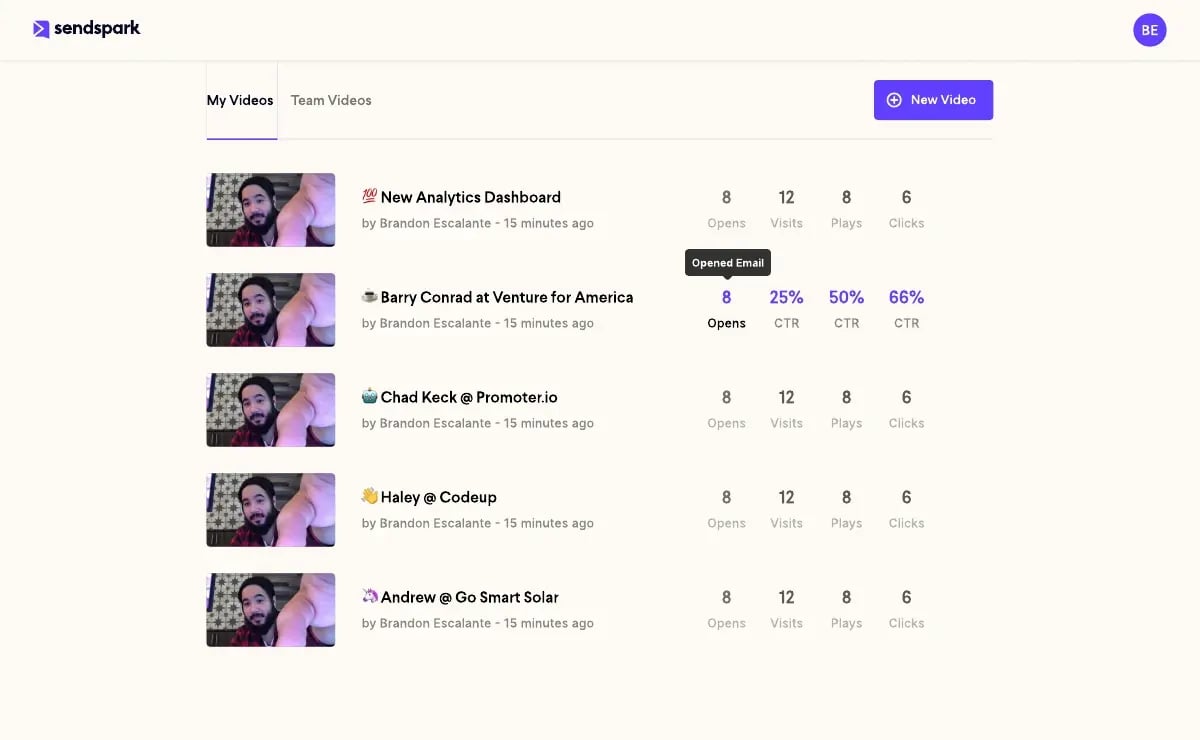
Sendspark gives B2B sales teams a complete loop: create AI-personalized videos at scale, deliver them through email and LinkedIn, and capture every engagement signal in a native analytics layer that syncs to your CRM. You don’t need a separate analytics platform to measure video ROI — it’s built into the workflow from send to close.
Step 1: Set Up Your Measurement Baseline
Before your first campaign, establish baselines for your current outreach: reply rate, meeting booking rate, and opportunity creation rate from standard text-based sequences. Run a 4-week video campaign against the same ICP segment and compare. This A/B comparison is the fastest way to generate a credible internal ROI story for your leadership team.
Use Sendspark’s built-in video analytics to pull play rate, watch percentage, CTA click rate, and reply data for every video in the campaign. Export these alongside your CRM pipeline data to calculate video-influenced and video-attributed pipeline for the same period.
Step 2: Connect Video Signals to Your CRM
ROI measurement only works if video engagement data lives where your revenue team already works. Sendspark’s HubSpot and Salesforce integrations log every video play, completion, and CTA click as a contact or lead activity. That means your AEs see engagement signals on their prospect records, your managers see them in pipeline reports, and your revenue operations team can build attribution models without manual data exports.
For teams running account-based plays, filter video engagement by account to surface buying committee signals. If multiple contacts at one account engage with video in a short window, that’s a trigger to escalate your outreach — and it’s visible in your CRM the moment it happens.
Step 3: Build Your AI Personalization Campaigns
The record-once workflow in Sendspark is where ROI math becomes compelling. Record a single base video — your prospecting pitch, your follow-up, your meeting recap. Sendspark’s AI voice cloning then generates individually personalized versions: each prospect hears their own name, their company mentioned, in your voice. Dynamic backgrounds pull in each prospect’s website. Personalized thumbnails include each prospect’s name or company logo so the email preview is uniquely theirs before they even click play.
For a step-by-step walkthrough of building these campaigns, see our complete AI video personalization playbook or our comprehensive guide to video prospecting.
Step 4: Report ROI to Leadership
Present video ROI in the language your leadership team cares about: pipeline generated, win rate improvement, average deal size for video-touched vs. non-video-touched opportunities, and time saved per rep per month. Supplement with engagement metrics as evidence of program health, but lead with revenue impact. That’s what earns budget and headcount.
Teams that have read our video sales enablement guide consistently find that framing video as a revenue program — not a content initiative — is what drives executive buy-in. For a broader foundation on using video across the full sales motion, see our pillar guide on video for sales and our personalized video strategy guide.
Record One Video. AI Personalizes Thousands.
Sendspark is the AI video personalization platform for B2B sales. Record once, and AI voice cloning generates thousands of individually personalized videos with dynamic backgrounds and personalized thumbnails — each prospect hears their name, sees their website, in your voice. Sales teams see 2-3x more replies.
Get Started NowFrequently Asked Questions
How do you measure ROI on video marketing?
Measure video marketing ROI by connecting video engagement events — plays, watch duration, CTA clicks — to pipeline and revenue outcomes in your CRM. Calculate video-influenced pipeline (deals where video was a touchpoint), video-attributed pipeline (deals where video was the primary driver), and compare win rates and deal sizes for video-touched vs. non-video-touched opportunities. Divide total revenue generated by video-touched deals by your total investment in video creation and distribution.
What is a good ROI for video marketing?
For B2B outbound, a strong baseline ROI is a 200–300% lift in email reply rates and 40–50% more meetings booked compared to text-only sequences at the same volume. On a revenue basis, teams typically aim for at least a 5:1 return on total video program investment — meaning $5 in pipeline created or influenced for every $1 spent on video tools and production. AI personalization dramatically improves this ratio by reducing cost per video send.
Which video metrics matter most for B2B sales teams?
The highest-signal metrics for B2B sales are play rate, average watch percentage, CTA click rate, reply rate, and meeting booking rate per video send. Play rate tells you if your delivery and thumbnails are working; watch percentage tells you if your content is relevant; CTA click rate and reply rate tell you if you’re driving action. Track all five consistently before adding more complexity.
How do you attribute pipeline to personalized video?
Tag every outbound sequence that includes a video touchpoint, then compare opportunity creation and win rates between video-touched and non-video-touched segments. Use a multi-touch attribution model — W-shaped or time-decay — to distribute pipeline credit across all touchpoints, including video plays and CTA clicks. For ABM programs, aggregate video engagement at the account level to capture buying committee signals, not just individual contact activity.
How does Apple Mail Privacy Protection affect video tracking?
Apple Mail Privacy Protection pre-fetches email content — including tracking pixels — through Apple’s proxy servers, which inflates email open rates and makes them unreliable engagement signals. Video play rate is unaffected because a play requires deliberate human action that can’t be pre-fetched. Shift your primary engagement metric from email open rate to video play rate to maintain accurate measurement in a privacy-first environment.
How do you calculate ROI for AI voice cloning at scale?
Calculate AI voice cloning ROI by comparing the cost of traditional one-to-one video recording (rep time × hourly rate × number of videos) against the cost of AI-generated personalization (platform cost + minimal setup time). Teams typically save 10+ hours per campaign by recording once and generating hundreds or thousands of personalized videos via AI. Divide total video-attributed pipeline by total program cost — platform, rep time, and overhead — to get a clean ROI figure that accounts for the efficiency gains AI personalization delivers.
Sources & References
- Salesforce State of Sales — “Buyers expect personalized outreach at every touchpoint” (2024)
- Wistia State of Video Report — “Shorter, highly relevant videos retain viewers significantly better; completion rate benchmarks by video length” (2024)
- HubSpot State of Marketing — “Video engagement metrics have become primary KPIs for sales teams in the post-privacy-first era” (2024)
- Apple Support — Mail Privacy Protection — “Mail Privacy Protection stops senders from using invisible pixels to collect information about the user” (Apple, ongoing)
- McKinsey Growth, Marketing & Sales Insights — “Behavioral engagement signals are stronger predictors of purchase intent than demographic or firmographic data” (2024)
- Gong Revenue Intelligence Resources — “Engagement signals from multiple channels enrich deal health scores and forecast accuracy” (2024)
Topics: blog