Updated July 2026
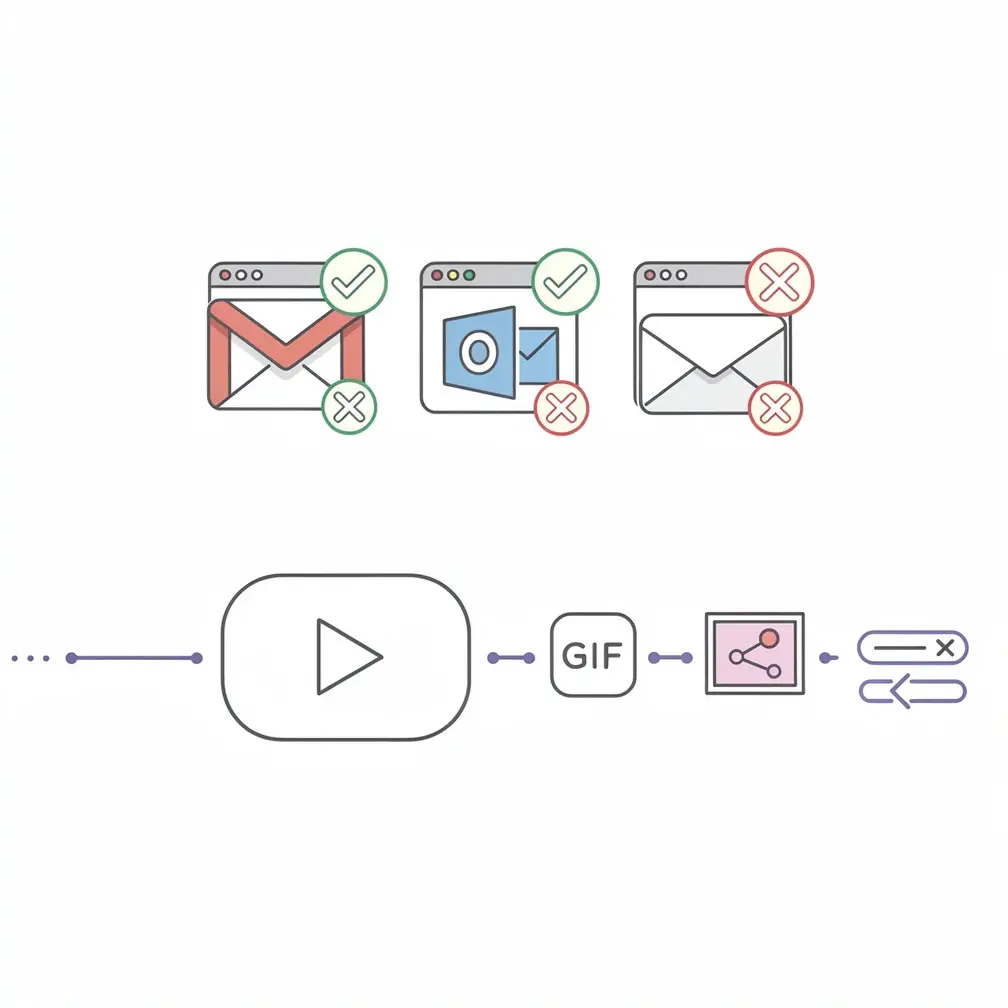
Trying to embed video directly in email? In 2026, the honest answer is: don’t count on it. Only a handful of niche email clients still support native HTML5 video playback, and some that once worked well — like Apple Mail — deprecated the feature in their 2025 updates. The good news: there’s a better approach that works across every email client and actually drives higher click-through rates. Here’s the complete 2026 email client compatibility matrix, and what to do instead.
Key Takeaways
- Only Samsung Mail and Thunderbird reliably support embedded HTML5 video in 2026 — Gmail, Outlook (Windows), and Apple Mail do not.
- Apple Mail deprecated native video embedding in its 2025 updates (macOS Sequoia / iOS 17+), removing the last major client that supported it.
- According to Litmus 2025 email client market share data, Gmail accounts for ~26% of all email opens; Apple Mail (iOS + macOS combined) accounts for ~58% — meaning 85%+ of your recipients open in clients where embedded video won’t play.
- The AI-personalized video thumbnail approach — a personalized click-to-play preview linking to a video landing page — works in 100% of clients and generates 2–3× more clicks than true embedded video even in the few clients that support it.
- Sendspark’s AI video personalization platform records one video and automatically generates thousands of personalized thumbnails with each prospect’s name, company, and context — no client compatibility worries required.
Which Email Clients Support Embedded Video in 2026?
In 2026, only two email clients — Samsung Mail and Thunderbird — reliably support native HTML5 video embedding. Gmail, Outlook, Apple Mail (since 2025), and every other major client either block the <video> tag entirely or display a static fallback. The email client compatibility matrix has actually gotten more restrictive over the last two years, not less.
Here’s the complete 2026 email client compatibility matrix:
| Email Client | Platform | Embedded Video Support | Notes |
|---|---|---|---|
| Gmail | Web + Mobile | ❌ No | ~26% of all email opens. Strips |
| Outlook (Windows) | Desktop | ❌ No | Dominant in B2B. Uses Word rendering engine — blocks all HTML5 video. See our guide to how to add video to Outlook emails. |
| Outlook (Mac) | Desktop | ⚠️ Partial | Older versions (pre-2023) supported it. New Chromium-based Outlook for Mac does not. |
| Apple Mail (macOS) | Desktop | ❌ Deprecated | Supported until macOS Ventura. Deprecated in macOS Sequoia (2025). Previously the most reliable client for embedded video. |
| Apple Mail (iOS) | Mobile | ❌ No | iOS 17+ removed support. Combined iOS + macOS Apple Mail = ~58% of email opens per Litmus. |
| Samsung Mail | Android | ✅ Yes | One of the few remaining clients with reliable embedded video support. Android-only, limited B2B market share. |
| Thunderbird | Desktop | ✅ Yes | Open-source, Gecko-based rendering engine. Good HTML5 support. Very low B2B market share. |
| Superhuman | Web + Mobile | ⚠️ Partial | Speed-optimized; complex HTML is often simplified. Usually shows GIF or static thumbnail. |
| Proton Mail | Web + Mobile | ❌ No | Security-first rendering strips dynamic content including video tags. |
| Hey | Web + Mobile | ❌ No | Minimalist design philosophy; strips complex HTML embeds. |
| Spark | Desktop + Mobile | ❌ No | Modern client using WebKit; prioritizes consistent rendering. Falls back to static image. |
| Yahoo Mail | Web + Mobile | ❌ No | Legacy rendering engine. No HTML5 video support. |
| AOL Mail | Web | ❌ No | Similar to Yahoo — older engine, no video support. |
What “Embedded Video Support” Actually Means
“Embedded video support” means the email client renders an HTML5 <video> tag directly inside the inbox — the video plays in-email, no browser required. This is technically challenging because email clients use different rendering engines than browsers, and many actively strip complex HTML for security or performance reasons. For a full comparison, see our guide to the the best video email platforms for sales teams.
Three different things can happen when you include video in an email:
- Native playback — The
<video>tag renders and the recipient watches in-inbox (Samsung Mail, Thunderbird only in 2026) - Animated GIF fallback — The client can’t play video but shows a looping preview (supported in most clients)
- Static thumbnail — Just an image with a play button — clicks through to a video landing page (universal fallback)
For a technical walkthrough of how to embed videos in email with proper fallback chains, see our full implementation guide.
Common mistake
Testing your embedded video only in Apple Mail or an older Outlook for Mac and assuming it will work universally. Both of these clients have changed their behavior in the last two years — what worked in 2022 no longer works in 2026 for 85%+ of your recipients.
Why Most Recipients Won’t See Your Embedded Video
Even if you embed video correctly with a proper HTML fallback chain, the math is brutal: according to Litmus 2025 email client market share data, Gmail accounts for roughly 26% of all email opens, and Apple Mail (iOS + macOS combined) accounts for approximately 58%. Neither supports embedded video in their 2026 versions. That’s over 84% of your recipients who will never see native video playback — before accounting for Outlook, Yahoo, or any other non-supporting client.
The Apple Mail Deprecation That Changed Everything
Apple Mail was the one major exception that video marketers counted on. It had the largest market share of any single client and it supported embedded video — a rare combination. Then in 2025, Apple deprecated that support in macOS Sequoia and iOS 17+. Now even Apple Mail users see a static image or GIF fallback. The last reliable refuge for embedded video in a major client is gone.
This isn’t a temporary bug or an opt-in setting. It’s a deliberate platform decision reflecting a broader trend: email clients prioritize rendering speed, security, and consistency over rich media support. The direction of travel is clear — video render rates in email will only decline from here.
What This Means for B2B Sales Teams
For B2B outreach specifically, the situation is even starker. Your prospects overwhelmingly use Gmail (Google Workspace) or Outlook (Microsoft 365). According to Salesforce State of Sales research, enterprise buyers expect personalized outreach — but if your video personalization strategy depends on native embedding, you’re optimizing for the 5-10% of recipients who might actually see it. The other 90%+ get a blank space or a broken image.
The video render rate — the percentage of recipients who actually see your video playing in-inbox — is essentially zero for most B2B email lists in 2026. That’s why the industry has moved to a fundamentally different approach.
The AI-Personalized Thumbnail Approach: Video Email for Every Client
The modern approach to video email doesn’t try to embed video natively. Instead, it uses an AI-personalized video thumbnail — a still image or short GIF preview that shows the prospect’s name, their company logo, or their website in the thumbnail — linked to a personalized video landing page where the actual video lives. This works in 100% of email clients and generates 2–3× more clicks than embedded video even in the clients that technically support it.
Here’s why this works better than native embedding:
- Universal compatibility — A linked image renders in every email client, no exceptions
- AI personalization at scale — With AI video personalization, you record one base video, and AI generates a unique thumbnail for each prospect (their name, company, or website shown in the preview)
- Higher CTR — A personalized thumbnail with the prospect’s name gets dramatically more clicks than an impersonal play button — it signals relevance before they even click
- Better analytics — Click tracking on a thumbnail link is more reliable than video play detection inside email clients, which varies by client
Pro tip
A personalized video thumbnail showing the prospect’s name and company logo in the preview generates 2–3× more clicks than embedded video in even the clients that support it. The personalization signal creates curiosity — recipients click because they see their own name, not just a generic play button.
How the HTML Fallback Chain Works
Even with the thumbnail approach, a properly built video email uses a HTML fallback chain to handle different rendering environments gracefully:
- Best case (Samsung Mail, Thunderbird): The HTML5
<video>tag plays natively in-inbox - GIF support (most clients): An animated GIF fallback plays a short looping preview — gives the feel of video without the
<video>tag requirement - Image fallback (universal): A static AI-personalized thumbnail with a play button overlay — clicks through to the personalized video landing page
- Text fallback (images blocked): A plain-text link — “Watch your personalized video →” — with the landing page URL
Platforms like Sendspark generate this entire fallback chain automatically. You record one video, and the platform creates the HTML embed code with all four fallback levels handled — you don’t need to write a line of code or worry about which client your prospect is using. For more on the technical implementation, see our guide to embed video in email for any platform.
AI Voice Cloning Takes This Further
The thumbnail approach works at scale. But Sendspark’s AI voice cloning takes personalization further: you record a single video once, and AI clones your voice to say each prospect’s name naturally — creating a unique, personalized video for each recipient without re-recording. Combined with dynamic backgrounds that show the prospect’s website or company colors, each recipient gets a video that feels recorded specifically for them.
This is the model that makes video email deliverable at scale: 100% compatibility across every email client, personalized for each prospect, generated automatically from a single recording. See personalized video email examples of this approach in practice.
Record One Video. AI Personalizes Thousands.
Sendspark is the AI video personalization platform for B2B sales. Record once, and AI voice cloning generates thousands of individually personalized videos with dynamic backgrounds and personalized thumbnails — each prospect hears their name, sees their website, in your voice. Sales teams see 2-3x more replies.
Get Started NowHow to Send AI-Personalized Video Email for Any Email Client
Sending AI-personalized video email that works across every email client takes three things: a video platform that handles the fallback chain automatically, an email platform that lets you paste HTML, and a personalization layer that makes each recipient feel like the video was made for them. Here’s the step-by-step process.
Step 1: Record Your Base Video with Sendspark
Record one video — typically 60-90 seconds for cold outreach. You can record your webcam, screen, or both simultaneously using Sendspark’s HubSpot video integration or the Chrome extension. Keep it conversational and direct: state the prospect’s pain point in the first 10 seconds, then show a relevant solution.
You only record this once. AI handles the personalization layer for every recipient from this single recording.
Step 2: Set Up AI Voice Cloning and Dynamic Personalization
In Sendspark, enable AI voice cloning after recording your base video. The AI clones your voice from the recording and uses it to say each prospect’s name naturally at the start of each personalized copy. You then configure dynamic backgrounds — Sendspark can pull each prospect’s website and display it behind you in the video — and set up personalized thumbnails that show their name or company logo in the preview image.
This is what creates the curiosity click in the inbox: recipients see a thumbnail that clearly includes their own name or their company’s website, and they click to find out what the video says.
Step 3: Get Your Embed Code
Sendspark generates a complete HTML embed snippet with the full HTML fallback chain built in: <video> tag → animated GIF preview → personalized static thumbnail → text link. You copy this snippet once and it handles every email client automatically. The personalized thumbnail is dynamically generated per recipient when you upload your contact list.
For platform-specific instructions on embedding, see our complete guide to how to embed videos in email across different platforms.
Step 4: Paste Into Your Email Platform
You need an email platform that lets you edit the HTML of your emails. The following platforms support HTML editing and work well for video email sequences:
- HubSpot Marketing Hub — Use the native HubSpot video integration
- Outreach — HTML templates in Outreach sequences
- Mailchimp, Klaviyo, ActiveCampaign — HTML email editor
- Quickmail, Mailshake, Lemlist — HTML block support
Standard 1-to-1 email clients (Gmail, Outlook) don’t let you edit raw HTML — use an Outlook video integration or Gmail extension instead, which handle the embed automatically.
Step 5: Test Before Sending at Scale
Send test emails to a personal Gmail account, an Outlook account, and an Apple Mail account before sending to your full list. Check that the fallback renders correctly in each client. Tools like Email on Acid’s video-in-email testing let you preview your email across 90+ clients in one pass.
Monitor your video email analytics after sending: click-through rate (on the thumbnail link), video play rate (on the landing page), and watch completion rate. According to Campaign Monitor benchmarks, video email CTR is consistently 2-3× higher than text-only emails — but only when the fallback renders correctly.
Also check out our deep dive on video email deliverability — the full fallback chain approach also helps keep your emails out of spam filters, since you’re not loading large media files that trigger spam scores.
Advanced strategy
Segment your email list by email client using open-tracking data. Send the full HTML5 <video> embed only to the ~10-15% of recipients using Samsung Mail or Thunderbird; send the AI-personalized thumbnail approach to everyone else. You get native playback where it works without the overhead of managing incompatible clients at scale.
Quick Comparison: Video Email Approaches in 2026
| Approach | Client Compatibility | Personalization | Best For |
|---|---|---|---|
| Native HTML5 embed | ~5-10% of recipients | None (same video for all) | Samsung Mail / Thunderbird audiences only |
| Animated GIF fallback | ~70% of recipients | Low (same GIF for all) | Mass marketing, newsletters |
| AI-personalized thumbnail | 100% of recipients | High (name, company, website per prospect) | B2B sales outreach, cold email sequences |
| Full AI video personalization (Sendspark) | 100% of recipients | Maximum (voice clone + dynamic background + thumbnail) | Enterprise B2B sales, ABM campaigns |
Frequently Asked Questions
Which email clients support embedded video in 2026?
In 2026, only Samsung Mail (Android) and Thunderbird (desktop) reliably support embedded HTML5 video. Gmail, Outlook (Windows), Apple Mail (macOS Sequoia+), iOS Mail, Yahoo Mail, Proton Mail, Hey, and Spark do not support it. Apple Mail deprecated video embedding in its 2025 updates, removing the last major client that supported it. Combined, non-supporting clients account for over 90% of B2B email opens.
Can you embed video in Gmail?
No. Gmail strips the HTML5 <video> tag and does not support native video playback in the inbox. Gmail accounts for approximately 26% of all email opens according to Litmus 2025 data. The best approach for Gmail recipients is an AI-personalized thumbnail image that links to a video landing page — this renders correctly and gets more clicks than embedded video in clients that do support it.
Does Outlook support embedded video in emails?
Outlook for Windows does not support embedded video — it uses the Microsoft Word rendering engine, which blocks HTML5 media. Older versions of Outlook for Mac (pre-2023) had partial support, but the newer Chromium-based Outlook for Mac has removed it. For Outlook users, the animated GIF or personalized thumbnail fallback is your reliable option. See our full guide on how to add video to Outlook emails.
Does Apple Mail support embedded video?
Apple Mail deprecated native video embedding in its 2025 updates (macOS Sequoia and iOS 17+). Prior to 2025, it was the most reliable major client for embedded video, which made it a fallback exception for many email marketers. That exception no longer exists. Apple Mail (combined iOS + macOS) accounts for roughly 58% of all email opens — making this deprecation the single biggest change to embedded video support in recent years.
What is the best way to send video email that works for all clients?
The most effective approach in 2026 is the AI-personalized video thumbnail: a static or GIF image showing the prospect’s name, company logo, or website, linked to a personalized video landing page. This works in 100% of email clients and generates 2–3× more clicks than native embedded video. Platforms like Sendspark generate the personalized thumbnail automatically for each prospect on your list, with a full HTML fallback chain handling every email client scenario.
What happens when an email client does not support embedded video?
When an email client doesn’t support the HTML5 <video> tag, it falls back to the next element in the HTML fallback chain. A well-built video email includes: (1) the <video> tag for supporting clients, (2) an animated GIF preview for clients that support images but not video, (3) a static personalized thumbnail for clients that support basic images, and (4) a text link as the final fallback. Sendspark generates all four layers automatically when you create your embed code.
How do AI-personalized video thumbnails work in email?
AI-personalized video thumbnails are dynamically generated images that include prospect-specific details — their name, company, or website — as part of the thumbnail preview. When a recipient opens your email, they see a thumbnail that looks like it was created specifically for them. Sendspark’s AI video personalization platform generates these from a single base video recording: AI voice cloning says each prospect’s name naturally, dynamic backgrounds display their website, and the thumbnail is auto-generated with their details — all from one recording, for thousands of recipients.
Sources & References
- Litmus — “Email Client Market Share 2025” (2025)
- Campaign Monitor — “Email Marketing Benchmarks and Statistics” (2025)
- Email on Acid — “Video in Email: Everything You Need to Know” (2025)
- Salesforce — “State of Sales Report” (2025) — “Buyers expect personalized outreach at every touchpoint”
Record One Video. AI Personalizes Thousands.
Sendspark is the AI video personalization platform for B2B sales. Record once, and AI voice cloning generates thousands of individually personalized videos with dynamic backgrounds and personalized thumbnails — each prospect hears their name, sees their website, in your voice. Sales teams see 2-3x more replies.
Get Started NowTopics: Video