Updated July 2026
75% of B2B buyers now prefer a remote or self-serve buying experience, according to Gartner’s 2025 B2B buyer research. That single number explains everything about why virtual selling has become the default operating model for B2B sales teams worldwide — and why choosing the right virtual sales platform stack has become one of the most consequential decisions a sales leader makes.
Virtual selling is not just about working from home. It is a complete methodology — using personalized video, digital collaboration tools, and async communication to meet buyers where they already are. And in 2026, that methodology has gained a fifth layer: agentic selling, where autonomous AI agents handle multi-step research, enrichment, and outreach workflows without rep intervention at each step.
This guide covers every tool category in the modern virtual sales platform stack, the AI-powered additions that have reshaped the space since 2022, and the new agentic selling layer that is redefining what “automation” means for B2B teams. When evaluating these tools, pairing your core platform with the right deal management software ensures deals move efficiently from prospect to close.
Key Takeaways
- Virtual selling is now the default in B2B — 75% of buyers prefer remote or self-serve interactions (Gartner 2025), and top-performing teams are 2.8x more likely to use a connected virtual sales platform stack (Salesforce State of Sales 2025)
- The optimal 2026 stack has five layers: core (CRM + AI video + scheduling), sequencing, intelligence, AI automation, and agentic selling — autonomous AI agents that run multi-step workflows without per-step human input
- Sendspark’s AI Intros let you record one video and personalize it for every prospect using AI voice cloning — sales teams using AI-personalized video report 2–3x more replies and 40–50% more meetings booked
- Layer 5 agentic tools (HubSpot Breeze Agents, Salesforce Agentforce) can research, enrich, and sequence outreach autonomously — but personalized video remains the highest-converting touchpoint even inside agent-driven pipelines
- Start with Layer 1 (CRM + Sendspark + Calendly) before adding AI agents — autonomous workflows amplify good processes, they cannot fix broken ones
What Is Virtual Selling?
Virtual selling is the practice of conducting the entire B2B sales process through digital channels — personalized video, email sequences, virtual demos, and online collaboration tools — without requiring in-person meetings at any stage of the deal. It is a complete methodology, not a location. A rep sitting in a company headquarters can practice virtual selling if they are using async video, digital proposals, and collaboration tools to engage a buyer who prefers not to meet face to face.
It is worth separating virtual selling from remote selling, because the two terms are often confused. Remote selling describes where a rep works — outside a traditional office. Virtual selling describes how they sell. The distinction matters because the methodology drives results regardless of physical location. For a deeper breakdown of how to put it into practice, see our guide on virtual selling best practices.
According to Gartner’s 2025 B2B buyer research, 75% of B2B buyers now prefer a remote or self-serve experience. Buyers are making more of their purchasing decisions before they ever talk to a sales rep — which means teams that show up with strong digital content, async selling strategies, and personalized video outreach are the ones that earn the meeting in the first place. For B2B sales teams, building a robust virtual sales platform stack is no longer optional. It is the baseline expectation of modern buyers.
The Best Virtual Selling Tools by Category
The best virtual sales platform stack covers five core jobs: communicating with prospects, managing pipeline, booking meetings, running sequences, and closing with proposals. Each category below represents a distinct function in the virtual sales workflow. Pick the right tool for each job, integrate them, and you have a stack that compounds over time.
AI-Personalized Video Outreach — Sendspark
Sendspark is the leading AI video personalization platform for B2B sales and the anchor of any modern virtual selling stack. With 50,000+ campaigns powered, Sendspark lets reps record one video and use AI to automatically personalize it for each prospect — replacing the time sink of recording hundreds of individual takes. This is the AI video personalization platform built specifically for virtual selling at scale.
The core differentiator is AI Intros: Sendspark clones your voice and uses it to open each video with the prospect’s name and company, spoken naturally in your own voice. It also renders a dynamic background showing each prospect’s actual website — making every video feel genuinely 1:1. Record once, and AI personalizes it for every person on your list. Sales teams using Sendspark report 2–3x more replies and 40–50% more meetings booked compared to standard email outreach. See video prospecting examples that show exactly how teams use this in outreach sequences.
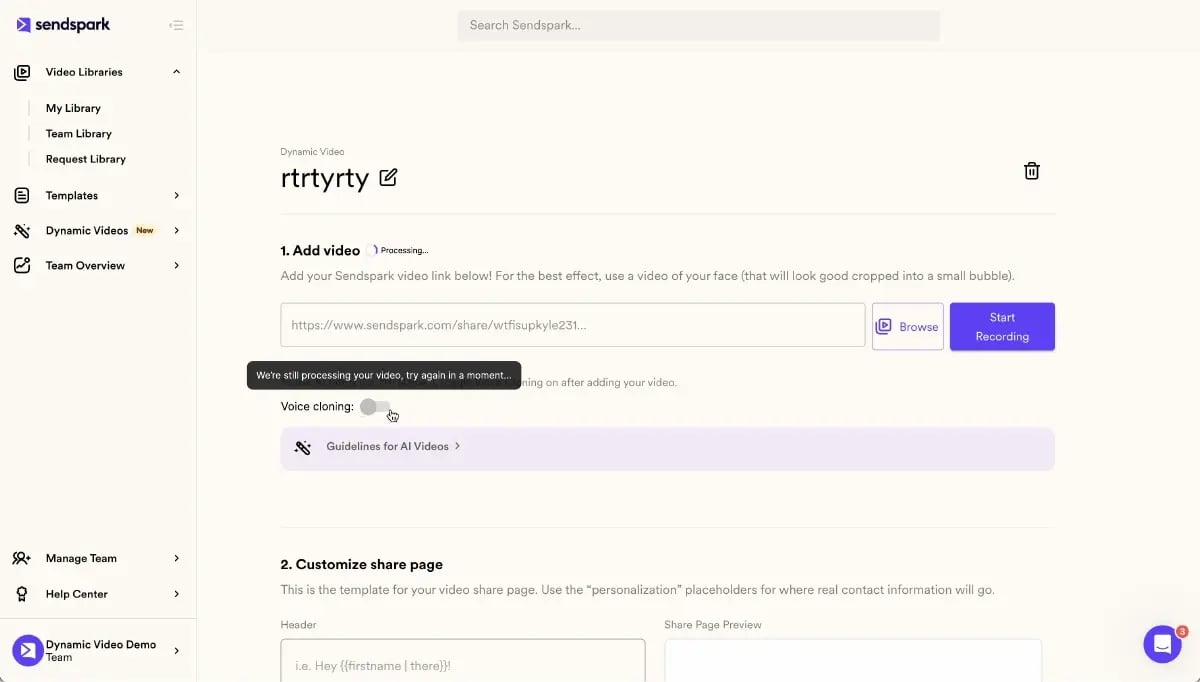
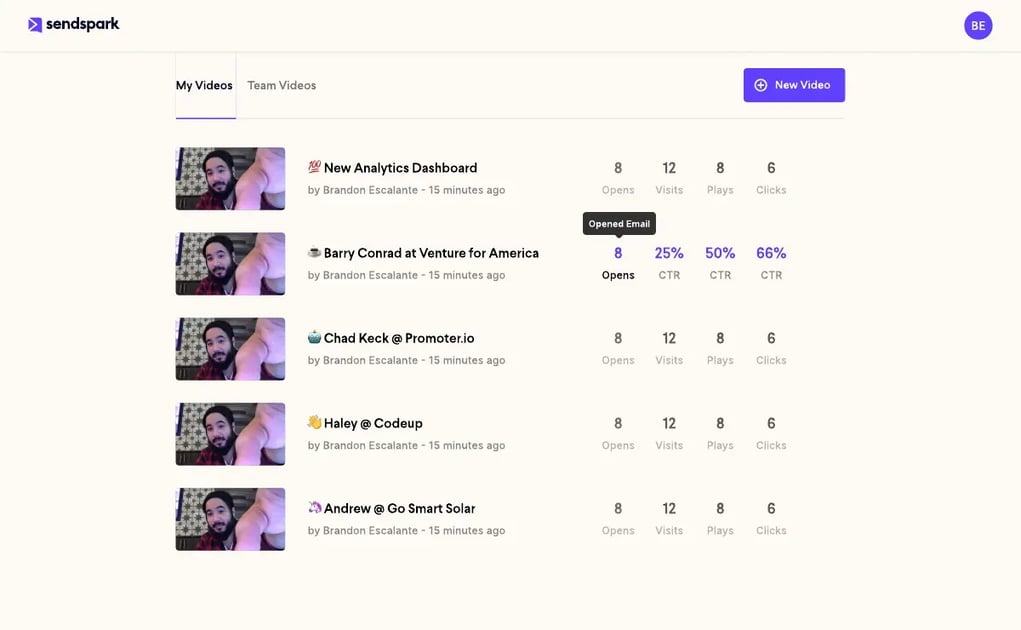
Beyond outreach, Sendspark supports Combined Videos — a personalized AI intro stitched to a reusable product demo — and detailed video analytics showing who watched, how long they engaged, and when they dropped off. In agentic selling pipelines (covered in Layer 5 below), Sendspark becomes the personalization layer that AI agents trigger at the highest-value touchpoints.
CRM — HubSpot or Salesforce
Your CRM is the connective tissue of the entire virtual selling stack. When choosing a CRM system, consider how well it integrates with your existing sales tools, tracks customer interactions, and supports workflow automation.HubSpot is the most widely adopted CRM among mid-market B2B teams, and its bi-directional sync with Sendspark makes it the natural pairing for a video-first virtual selling workflow. Video engagement data — views, watch time, click-throughs — flows directly into HubSpot contact records. The Sendspark HubSpot integration is rated 5/5 and supports automated workflows that trigger video sends or follow-up tasks based on deal stage. Salesforce users get the same capability via the Salesforce integration.
Scheduling — Calendly
Calendly removes the back-and-forth from meeting booking by giving prospects a direct link to your calendar. For virtual sales teams, frictionless scheduling is non-negotiable — every extra step between a prospect watching your video and booking a call is a place where deals die. Embedding a Calendly link in your Sendspark video landing page is one of the highest-impact, lowest-effort optimizations a virtual selling stack can offer.
Record One Video. AI Personalizes Thousands.
Sendspark is the AI video personalization platform for B2B sales. Record once, and AI voice cloning generates thousands of individually personalized videos with dynamic backgrounds and personalized thumbnails — each prospect hears their name, sees their website, in your voice. Sales teams see 2-3x more replies.
Get Started NowSales Engagement — Outreach or Apollo
A sales engagement platform manages the multi-touch sequences that move prospects from first contact to booked meeting. Outreach is the enterprise standard, combining email, LinkedIn touchpoints, and phone calls into coordinated sequences with built-in analytics on open rates, reply rates, and meeting conversion. Apollo is a strong alternative for teams that want prospecting data and sequencing in a single tool at a lower price point. Both integrate with Sendspark to embed personalized video directly into sequence steps.
Sales Prospecting — LinkedIn Sales Navigator and Clay
LinkedIn Sales Navigator identifies high-fit B2B prospects using filters for company size, industry, growth signals, and buyer intent data. Clay takes prospecting a step further by enriching lead lists with data from dozens of sources simultaneously, then using AI to generate hyper-personalized opening lines at scale. The Sendspark Clay integration lets you automatically trigger personalized video sends for prospects that meet specific enrichment criteria. For more on making LinkedIn video prospecting work in sequences, see the dedicated guide. For AI video prospecting strategy across channels, Sendspark’s solution page covers the full methodology.
Proposals and eSignature — PandaDoc
PandaDoc handles the closing end of the virtual selling workflow with interactive proposals that include embedded video, pricing tables, and legally binding eSignature. Prospects can comment, negotiate, and sign without downloading a PDF or scheduling a separate call. Pairing PandaDoc proposals with Sendspark demo videos creates a self-contained closing package for buyer-led decisions. See how Sendspark supports deal progression across the full sales cycle.
Pro tip
Embed a Calendly booking link directly in your Sendspark video landing page. The moment a prospect finishes watching, they can book the meeting without switching tabs. This single workflow change typically cuts the video-to-meeting time in half.
AI-Powered Virtual Selling: The New Category
Since 2022, AI has added three genuinely new categories to the virtual selling stack: automated outreach agents, conversation and deal intelligence, and personalized video at scale. These are not incremental upgrades to existing tools — they represent capabilities that change what is possible for a B2B sales team of any size operating as a modern virtual sales platform.
AI SDRs — Artisan and 11x.ai
AI SDRs are software agents that autonomously handle top-of-funnel prospecting: researching accounts, identifying contacts, writing personalized outreach, and managing follow-up sequences without human intervention at each step. Tools like Artisan and 11x.ai are the leading examples. The practical use case is augmentation rather than replacement — AI SDRs handle high-volume, lower-complexity outreach while human reps focus on warmer prospects and multi-threaded selling across active accounts. These tools work best when paired with clean CRM data and high-quality enrichment from Clay; an AI SDR operating on bad data produces bad outreach at scale.
Conversation Intelligence — Gong and Clari
Gong and Clari represent the mature end of the conversation intelligence category. Both tools ingest call recordings, email activity, and CRM data to build a real-time picture of deal health across the entire pipeline. Deal risk flags surface automatically — a prospect who has gone quiet, a champion who left the company, a competitor mentioned three times on the last call. According to Gong’s State of Revenue Report, top-performing reps listen 57% of the time on discovery calls — a coaching insight that conversation intelligence surfaces for every rep on your team automatically. This is the revenue AI platform layer of the virtual sales stack.
Digital Sales Rooms — GetAccept and Accord
A digital sales room (DSR) is a shared online workspace where rep and buyer collaborate throughout a deal. Instead of proposals scattered across email threads, everything lives in one deal room: case studies, demo recordings, pricing, contract drafts, and a mutual action plan that both sides can update in real time. GetAccept and Accord are the leading DSR platforms. Embedding Sendspark video directly into a deal room means buyers can watch a personalized walkthrough, review the proposal, and sign — all within a single branded environment. For deals with long sales cycles and multiple stakeholders, a DSR is one of the most effective buyer enablement tools available.
Layer 5 — Agentic Selling: When AI Agents Run the Workflow
The most significant shift in the virtual sales platform landscape in 2025 and 2026 is not a new tool category — it is a new paradigm. Agentic selling moves beyond AI-assisted workflows (where humans use AI tools) to AI-autonomous pipelines (where AI sales agents take sequences of actions end-to-end, without a rep manually triggering each step). HubSpot Breeze Agents, Salesforce Agentforce, Clay’s agent mode, and Outreach’s Kaia AI all launched autonomous sales agent capabilities in this window. This is the arrival of GTM AI at the mid-market level.
In a typical agentic selling pipeline, an AI-native GTM workflow might look like this: an intent signal fires when a target account visits your pricing page. An AI agent automatically researches the account, enriches the contact via Clay, generates a hyper-personalized first-line, triggers a Sendspark AI Intro video send (with your voice saying their name and company), and queues the contact in a multi-touch follow-up sequence — all without a rep touching anything. This is signal-triggered outreach at a scale that was operationally impossible even two years ago.
The tools enabling this agent orchestration layer fall into two buckets. First, platform-native agents: HubSpot Breeze Agents (which can research companies, draft personalized emails, and execute sequences inside HubSpot) and Salesforce Agentforce (which integrates with Salesforce CRM to run autonomous selling workflows based on pipeline triggers). Second, custom agent builders: Relevance AI and Lindy let teams build their own multi-agent sales workflows tailored to their specific ICP and outreach motion, connecting to any tool in the stack via API. For a deeper look at the tools powering this layer, see our guide on the best AI sales tools for 2026.
The critical insight for teams adopting agentic selling: even in a fully autonomous pipeline, a human-authentic personalized video remains the highest-converting touchpoint. AI agents handle the research, enrichment, and sequencing with precision — but the moment that converts a cold prospect into a booked meeting is still the video where they hear their name in your voice, see their website behind you, and feel like you recorded it just for them. Sendspark AI Intros become the personalization layer that agents inject at exactly the right moment in the workflow. The Clay integration makes this automatic: Clay enriches the contact, the agent triggers a Sendspark send, and the prospect receives what feels like a personally recorded video within minutes of the intent signal firing.
Common mistake
Deploying AI agents before you have clean CRM data and a proven outreach process. Agentic selling amplifies whatever you already do — agents running bad data produce bad outreach at scale. Build Layer 1 through 3 of your virtual sales platform first. Agents at Layer 5 are a force multiplier, not a foundation.
For teams evaluating revenue AI orchestration solutions, the practical starting point is not replacing your current sales motions but extending them. Start with a single agent workflow — for example, an intent-triggered Sendspark video send for accounts that view your pricing page three times in a week — and measure the conversion lift before expanding. The sales automation software guide covers how to build these workflows with step-by-step examples.
How to Build Your Virtual Selling Tech Stack
The best virtual sales platform stacks are built in layers. Start with the three tools that cover 80% of your workflows — CRM, AI video personalization, and scheduling — before adding sequencing, intelligence, and agentic AI layers. Most teams that struggle with their virtual selling stack have skipped layers or added complexity before nailing the fundamentals. According to the Salesforce State of Sales 2025, top-performing sales teams are 2.8x more likely to use integrated tool stacks than average performers — not more tools, but better-connected ones.
Layer 1 — Core Stack (Start Here): Every virtual selling motion starts with a CRM (HubSpot or Salesforce), an AI video personalization platform (Sendspark), and frictionless scheduling (Calendly). These three tools cover prospecting outreach, pipeline visibility, and meeting conversion. Get these working and integrated before touching anything else.
Layer 2 — Add Sequencing and Prospecting: Once your team has a repeatable outreach motion, add a sales engagement platform (Outreach or Apollo) to manage multi-touch sequences, LinkedIn Sales Navigator for lead identification, and PandaDoc for the closing end. This layer adds structure and volume to what you are already doing manually. The LinkedIn integration lets you send Sendspark videos directly to prospects in your LinkedIn workflow.
Layer 3 — Add Intelligence: With enough pipeline activity to generate meaningful data, add Gong for conversation intelligence and Clay for enrichment-driven personalization. This layer helps you work smarter on existing opportunities rather than just adding volume. See the AI video sales strategies guide for how intelligence tools and video personalization work together at this layer.
Layer 4 — Add AI Automation: With a proven process and clean data, AI tools deliver their full value. Sendspark AI Intros personalize video at scale. Digital sales rooms (GetAccept, Accord) structure the buying experience for complex deals. AI SDRs (Artisan, 11x.ai) handle top-of-funnel volume autonomously. At this layer, your stack compounds.
Layer 5 — Agentic Selling: With clean data, proven sequences, and measurable results at Layer 4, AI agents (HubSpot Breeze, Salesforce Agentforce, Relevance AI) can orchestrate multi-step GTM workflows end-to-end. This is AI-human hybrid outreach at its most effective — agents handle the workflow orchestration, Sendspark handles the personalized video touchpoint that converts.
According to the HubSpot State of Sales 2025, sales teams using AI-powered tools are spending 2+ more hours per day on actual selling activities compared to teams without AI. One practical rule: if a new tool requires more than one hour of rep training to use daily, it will not get used consistently. The best virtual selling stacks are the ones that fit naturally into how reps already work.
| Tool | Category | Stack Layer |
|---|---|---|
| Sendspark | AI-personalized video outreach + AI Intros | Layer 1 (Core) |
| HubSpot / Salesforce | CRM — pipeline management, video data sync | Layer 1 (Core) |
| Calendly | Scheduling — frictionless meeting booking | Layer 1 (Core) |
| Outreach / Apollo | Sales Engagement — multi-touch sequences | Layer 2 |
| LinkedIn Sales Navigator | Prospecting — lead identification, intent signals | Layer 2 |
| PandaDoc | Proposals — interactive proposals + eSignature | Layer 2 |
| Gong / Clari | Conversation Intelligence — call analysis, deal risk | Layer 3 |
| Clay | Data Enrichment + AI — intent data, personalization | Layer 3–4 |
| GetAccept / Accord | Digital Sales Room — buyer portal, mutual action plans | Layer 3–4 |
| AI SDRs (Artisan, 11x.ai) | Autonomous prospecting — top-of-funnel at scale | Layer 4 |
| HubSpot Breeze / Agentforce | AI Agents — autonomous GTM workflow orchestration | Layer 5 |
| Relevance AI / Lindy | Custom agent builders — bespoke multi-agent pipelines | Layer 5 |
Frequently Asked Questions
What is virtual selling?
Virtual selling is the practice of conducting B2B sales entirely through digital channels — personalized video, email sequences, virtual demos, and online collaboration tools — without requiring in-person meetings at any stage. According to Gartner’s 2025 research, 75% of B2B buyers now prefer remote or self-serve interactions, making virtual selling the default methodology for modern sales teams. It is a strategy, not just a location — you can practice virtual selling from an office if your buyers prefer digital channels.
What are the best virtual selling tools for B2B sales?
The best virtual sales platform stack includes: Sendspark for AI-personalized video outreach, HubSpot or Salesforce as your CRM, Outreach or Apollo for sales sequencing, Calendly for scheduling, LinkedIn Sales Navigator for prospecting, Gong for conversation intelligence, and Clay for data enrichment. At Layer 5, AI agent platforms like HubSpot Breeze Agents and Salesforce Agentforce enable autonomous GTM workflows that research, personalize, and send outreach without per-step human input.
What is a virtual sales platform?
A virtual sales platform is an integrated stack of digital tools that enables end-to-end B2B selling through digital channels — from prospect research and outreach through proposal, closing, and post-sale success. A modern virtual sales platform combines AI video personalization (Sendspark), CRM (HubSpot or Salesforce), sales engagement (Outreach or Apollo), and intelligence (Gong) into a connected system where data flows automatically between tools, enabling reps to focus on selling rather than data entry.
How does agentic selling work in B2B sales?
Agentic selling uses autonomous AI agents to execute multi-step sales workflows without human input at each step. An AI agent can research a prospect, enrich their contact data via Clay, write a personalized opening line, trigger a Sendspark video send (using your cloned voice to say their name), and manage follow-up sequences — all automatically based on intent signals or CRM triggers. HubSpot Breeze Agents and Salesforce Agentforce are the leading enterprise implementations in 2026; Relevance AI and Lindy enable custom agent pipelines for teams with specific ICP requirements.
How do AI agents improve virtual selling?
AI agents improve virtual selling by automating the research, enrichment, personalization, and sequencing tasks that previously required significant rep time — freeing reps to focus on higher-value conversations. The highest-impact combination is AI agents handling workflow orchestration while Sendspark AI Intros provide the authentic personalized video touchpoint that converts. According to HubSpot’s 2025 State of Sales, teams using AI-powered tools spend 2+ more hours per day on actual selling compared to teams without AI assistance.
How many virtual selling tools does a B2B team actually need?
Start with three: a CRM, an AI video personalization platform (Sendspark), and scheduling software. This covers 80% of virtual selling workflows and constitutes the full Layer 1 of your virtual sales platform. Add a sales engagement platform once your team runs regular sequences. Intelligence and AI agent tools become cost-effective at 10+ reps with clean CRM data. Most high-performing virtual sales teams operate with five to seven well-integrated tools — more tools without integration create friction, not results.
What is the difference between virtual selling and remote selling?
Remote selling describes where a rep works — outside a traditional office. Virtual selling describes how they sell — using personalized video, digital collaboration, and async communication to engage buyers who prefer not to meet in person, regardless of the rep’s physical location. Virtual selling is the methodology; remote work is just the location. A rep in a company headquarters can practice virtual selling if their buyers prefer digital channels, and a home-based rep can still rely on in-person meetings if their market requires it.
Sources & References
- Gartner — “75% of B2B buyers prefer a rep-free or remote buying experience” (2025)
- Salesforce State of Sales 2025 — Top-performing sales teams 2.8x more likely to use integrated tool stacks (2025)
- HubSpot State of Sales 2025 — AI-powered sales teams spend 2+ more hours/day on actual selling (2025)
- Gong State of Revenue Report — Top-performing reps listen 57% of the time on discovery calls (2025)
- McKinsey & Company — B2B digital sales transformation research and benchmarks (2024)
- LinkedIn B2B Sales Benchmark Report 2025 — B2B buyer preference and virtual selling adoption data (2025)
Record One Video. AI Personalizes Thousands.
Sendspark is the AI video personalization platform for B2B sales. Record once, and AI voice cloning generates thousands of individually personalized videos with dynamic backgrounds and personalized thumbnails — each prospect hears their name, sees their website, in your voice. Sales teams see 2-3x more replies.
Get Started NowTopics: Insider