
Published August 2026
Senior sales leaders face a paradox: the higher you climb in a sales organization, the less coaching you receive. Yet the deals get more complex, the stakes get higher, and the skills required shift from tactical execution to strategic orchestration. Executive sales coaching bridges that gap by targeting the specific competencies that senior sellers and sales leaders need to win at the enterprise level — deal strategy, stakeholder mapping, coaching cascade, and forecasting accuracy.
Key Takeaways
- Executive sales coaching targets senior sellers and sales leaders, focusing on strategic skills like deal strategy, stakeholder management, and coaching cascade, not basic objection handling.
- Gartner research shows that 70% of sales reps forget training content within a week without reinforcement, making sustained coaching more effective than one-off training events.
- The right coaching approach depends on your team’s maturity: new leaders need foundational coaching frameworks, while seasoned executives benefit from peer coaching and strategic deal reviews.
- Async video coaching, powered by AI voice cloning, lets executives deliver personalized feedback to each rep without scheduling another meeting, cutting coaching delivery time by 60%.
- Executive coaching programs cost $3,000 to $15,000 per leader per quarter, but organizations that sustain coaching for 6+ months see 15-20% pipeline growth according to RAIN Group.
What Is Executive Sales Coaching?
Executive sales coaching is a structured development practice that targets senior sellers, sales managers, and revenue leaders, focusing on strategic competencies rather than tactical skills. Instead of drilling objection handling or cold-call scripts, executive coaching works on deal strategy for complex multi-stakeholder deals, forecasting accuracy, coaching cascade (teaching leaders how to coach their own teams), and executive presence in customer board rooms. It is distinct from standard sales coaching in scope, audience, and outcome metrics.
At the enterprise level, the skills that drove success as an individual contributor are not the same skills that win at the executive tier. A VP of Sales closing a $2M ARR deal needs to navigate a buying committee of 8-12 stakeholders, align internal resources across product and customer success, and maintain forecast accuracy under board scrutiny. These are not skills you pick up from a sales playbook — they require sustained, targeted coaching from someone who has operated at that altitude.
According to McKinsey research, companies that invest in sustained sales coaching see 17% higher revenue growth than those that rely on training alone. The key word is “sustained” — coaching is not a quarterly workshop. It is an ongoing practice embedded in the cadence of how your revenue organization operates.
Who Benefits From Executive Sales Coaching?
Executive sales coaching serves three primary audiences, each with distinct development needs:
- Senior individual contributors — Account executives handling enterprise deals ($100K+ ACV) who need help with deal strategy, multi-threading, and negotiation at the executive level.
- Sales managers and directors — First-line and second-line leaders who need to develop their own coaching skills, manage pipeline health, and transition from player to coach.
- VPs and CROs — Revenue leaders responsible for forecasting, org design, cross-functional alignment, and building a coaching culture that scales.
For managers and directors, our sales leadership coaching guide covers the frameworks and session structures that build high-performing teams. Executive coaching takes those foundations and adds the strategic layer that revenue leaders need at the top of the org chart.
Executive Sales Coaching vs. Traditional Sales Training
The distinction between executive sales coaching and traditional sales training comes down to timing, depth, and retention. Training delivers knowledge in batches — a workshop, a certification, a bootcamp. Coaching reinforces and applies that knowledge over time, in the context of real deals. Both have a place in a mature sales enablement program, but they serve different purposes and produce different outcomes for senior sellers.
HubSpot’s sales coaching research reinforces this split: training events produce a short-term spike in knowledge that decays rapidly without reinforcement, while coaching embeds skills through repeated practice and feedback. For executives specifically, the decay problem is worse because the skills are more complex and the feedback loops are longer — you might run a $500K deal over six months before discovering a strategic gap that coaching could have addressed early.
| Dimension | Traditional Sales Training | Executive Sales Coaching |
|---|---|---|
| Primary audience | All reps, especially new hires | Senior sellers, managers, VPs |
| Skill focus | Tactical: scripts, objection handling, product knowledge | Strategic: deal strategy, forecasting, stakeholder management |
| Format | Group workshops, online courses, certifications | 1:1 sessions, deal reviews, peer coaching, async feedback |
| Duration | Days to weeks (event-based) | Months to ongoing (cadence-based) |
| Knowledge retention | Low without reinforcement (70% forgotten in 1 week per Gartner) | High — skills embedded through real-deal application |
| Cost per participant | $500 to $3,000 per program | $3,000 to $15,000 per quarter |
| Measurable outcome | Activity metrics (calls, emails, demos) | Revenue metrics (win rate, deal size, forecast accuracy) |
This is why our sales training and coaching guide recommends running both in tandem — training builds the baseline, coaching converts it into revenue. The two are complementary, not substitutes, and the most mature revenue organizations budget for both.
How to Choose an Executive Sales Coaching Approach
Choosing the right executive sales coaching approach requires matching the coaching format to your team’s maturity, deal complexity, and organizational structure. There is no universal best approach — the right answer depends on whether you are coaching a first-time manager who needs a framework, a seasoned VP who needs a sounding board, or an enterprise AE who needs deal-specific strategic input. The decision comes down to three factors: internal capability, deal complexity, and budget.
Before evaluating external coaches or programs, assess what you already have internally. If you have a strong CRO or VP of Sales with coaching experience, an internal-led program may deliver 80% of the value at 20% of the cost. If your leadership team is stretched thin or lacks coaching expertise, bringing in an external coach for key leaders can accelerate development. RAIN Group’s research on coaching effectiveness identifies five keys that apply regardless of whether you use internal or external coaches.
Coaching Format Comparison
| Format | Best For | Frequency | Cost Range |
|---|---|---|---|
| 1:1 executive coaching | VPs, CROs, senior AEs with complex deals | Weekly to biweekly | $3,000 to $15,000 per quarter |
| Group coaching | Manager cohorts developing coaching skills | Biweekly to monthly | $1,500 to $5,000 per participant per quarter |
| Deal review coaching | Active enterprise deals needing strategic input | Per deal or weekly pipeline review | Internal cost or $200 to $500 per session |
| Peer coaching | Seasoned executives who learn from peers | Monthly | Low cost (internal facilitation) |
| Async video coaching | Distributed teams, scale across the org | On-demand, per deal | $49 to $299 per month per seat |
In-House vs. External Coaches
The in-house versus external decision hinges on three questions. First, does your leadership team have the bandwidth to coach consistently? Coaching requires protected time, and if your VP is closing deals themselves, internal coaching will get deprioritized. Second, do you need industry-specific expertise that your team lacks? External coaches who have operated in your market bring pattern recognition that accelerates strategic decisions. Third, is there a trust gap? Senior sellers are sometimes more candid with an external coach than with their own manager, especially when discussing weaknesses.
A hybrid model often works best: use an external coach for VPs and senior directors for the first 90 days to establish frameworks and cadence, then transition to internal-led coaching once the rhythm is established. This balances cost with expertise transfer.
Pro tip
Start with a 90-day pilot for 3 to 5 leaders rather than rolling out coaching across the entire org. Measure win rate, deal velocity, and forecast accuracy before and after, then expand to the teams where the data shows impact.
Coaching Frameworks for Executives
Three frameworks dominate executive sales coaching, each suited to a different coaching context:
- GROW (Goal, Reality, Options, Will) — Best for strategic planning sessions where the coachee needs to work through a complex decision. The coach asks structured questions that help the executive clarify their goal, assess the current reality, explore options, and commit to action. GROW is versatile and works well for deal strategy and career development conversations.
- SBI (Situation, Behavior, Impact) — Best for feedback after observed interactions, such as a customer call or a team meeting. The coach describes the situation, the specific behavior observed, and the impact it had. SBI keeps feedback objective and actionable, which is critical when coaching senior sellers who may resist vague criticism.
- Challenger coaching — Best for reps who need to develop commercial insight skills. Based on the Challenger Sale methodology, this coaching focuses on teaching, tailoring, and taking control of the conversation. It works well for enterprise AEs who need to reframe how customers think about their problems.
Our 1:1 sales coaching guide covers these frameworks in more tactical depth, including session agendas and question banks. For executive coaching, the frameworks are the same but the questions change — you are asking about deal strategy and org dynamics, not call scripts.
Record One Video. AI Personalizes Thousands.
Sendspark is the AI video personalization platform for B2B sales. Record once, and AI voice cloning generates thousands of individually personalized videos with dynamic backgrounds and personalized thumbnails — each prospect hears their name, sees their website, in your voice. Sales teams see 2-3x more replies.
Get Started NowBuilding an Executive Sales Coaching Program
Building an effective executive sales coaching program requires a structured approach that defines who gets coached, on what, how often, and how you measure success. The most common failure mode is launching coaching with enthusiasm but no cadence — sessions get skipped when deals heat up, and within a quarter the program has quietly died. A well-built program survives busy seasons because it is embedded in existing rituals like pipeline reviews and forecast calls, not bolted on as a separate calendar commitment.
Here is a 5-step framework for building a program that sticks, based on practices observed in high-performing revenue organizations and aligned with Harvard Business Review’s guidance on coaching sales teams.
Step 1: Identify Coaching Priorities by Role
Start by mapping the specific competencies each role needs to develop. For senior AEs, the priorities might be multi-threading enterprise deals and executive-level negotiation. For managers, the priorities shift to coaching skills, pipeline inspection, and performance management. For VPs, the focus moves to forecasting accuracy, org design, and cross-functional alignment. Document these priorities in a coaching plan that each leader co-creates with their coach or manager.
Step 2: Choose Your Coaching Cadence
The cadence determines whether coaching becomes a habit or a nice-to-have. For executives, a biweekly 1:1 coaching session of 45-60 minutes is the minimum viable cadence. Monthly is too infrequent to maintain momentum, and weekly can feel like micromanagement for senior sellers. Layer in deal-specific coaching during weekly pipeline reviews — when a deal stalls or a new stakeholder enters, that is a coaching moment, not just a pipeline update.
| Coaching Ritual | Frequency | Duration | Primary Outcome |
|---|---|---|---|
| 1:1 executive coaching session | Biweekly | 45-60 min | Skill development, career growth |
| Deal review coaching | Weekly (per deal) | 15-30 min | Deal strategy, risk identification |
| Group coaching (manager cohort) | Biweekly | 60-90 min | Coaching skills, peer learning |
| Async video coaching | On-demand | 5-10 min per video | Reinforcement, feedback at scale |
| Quarterly coaching review | Quarterly | 90 min | Assess progress, reset priorities |
Step 3: Deliver Coaching Asynchronously with AI Video
Not every coaching moment requires a live session. Async video coaching lets executives deliver personalized feedback to reps on their own schedule — the rep watches and applies the feedback before the next live session, making the live time more productive. This is particularly valuable for distributed teams across time zones, where scheduling live coaching for every rep is logistically impossible.
Sendspark’s AI video personalization platform takes this a step further. An executive records one coaching video — say, feedback on a stalled deal — and AI voice cloning generates personalized versions for each rep, addressing them by name and referencing their specific deal context. Dynamic backgrounds show the rep’s deal or CRM data behind the speaker. The result is coaching that feels 1:1 but is delivered at scale, cutting coaching delivery time by an estimated 60% compared to recording individual videos for each rep.
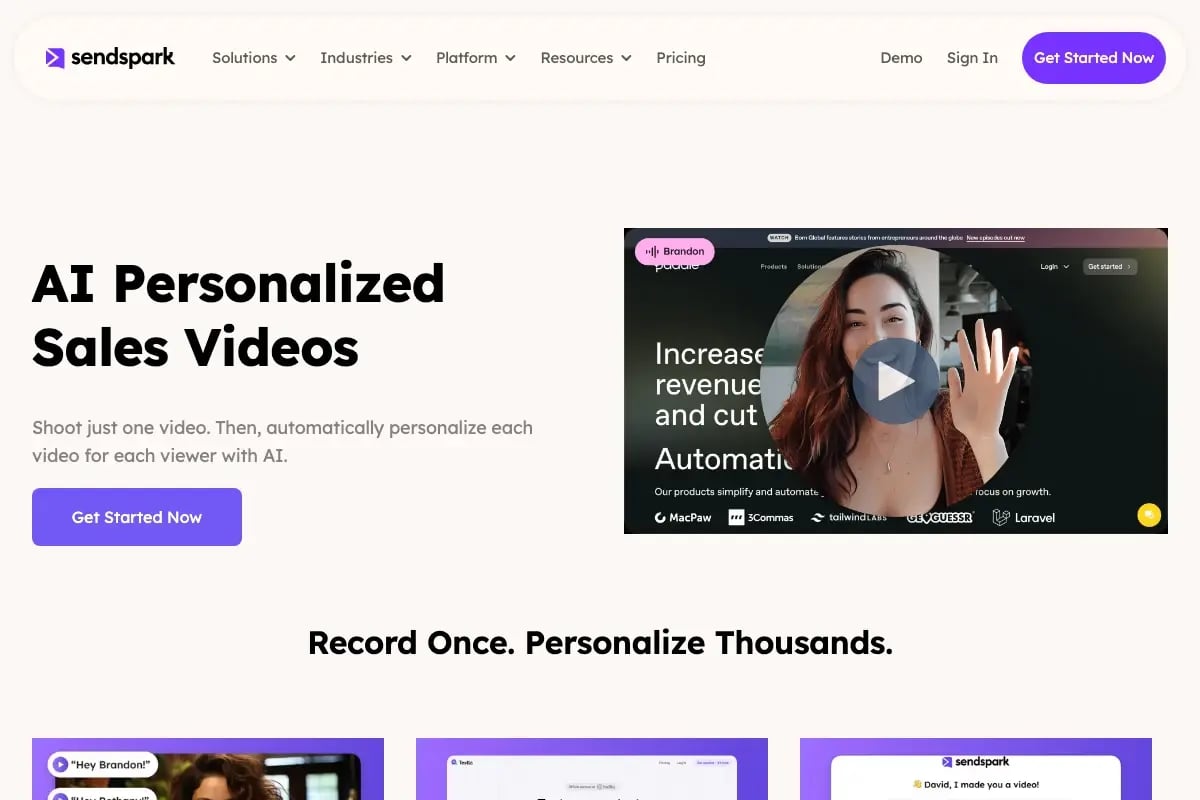
This approach pairs naturally with your HubSpot CRM integration — coaching videos can be triggered automatically when a deal enters a specific stage or stalls for too long, ensuring coaching happens at the moment of need rather than waiting for the next scheduled session.
Step 4: Measure Coaching Impact
Without measurement, coaching becomes a faith-based investment. Track these metrics before and after launching your program to quantify impact:
- Win rate — The percentage of qualified opportunities that close. A well-coached team should see win rate improvement of 5-15% within two quarters.
- Average deal size — Coaching on deal strategy and multi-threading typically expands deal size as reps engage higher-level stakeholders earlier.
- Forecast accuracy — The variance between forecasted and actual revenue. Executive coaching on inspection and deal qualification directly improves this metric.
- Deal velocity — The average time from opportunity creation to close. Coaching that removes stalled deals and identifies risks earlier shortens cycle time.
- Coaching cascade rate — The percentage of managers who regularly coach their own reps. This measures whether coaching is scaling beyond the executive tier.
For a deeper dive on the metrics that matter, our sales performance coaching guide covers the full measurement framework, including how to isolate coaching impact from other variables like market conditions and product changes.
Step 5: Scale Through the Coaching Cascade
The ultimate goal of executive sales coaching is not to make one VP better — it is to build a coaching culture that cascades through the organization. When your VP coaches directors, directors coach managers, and managers coach reps, the impact compounds. McKinsey research indicates that organizations with a strong coaching culture see 17% higher revenue growth than peers, driven not by any single coaching intervention but by the cumulative effect of continuous development at every level.
To build the cascade, start by training your managers in core coaching skills. Our sales call coaching guide provides the tactical framework for call-level coaching, while the complete sales coaching guide covers the full program structure. Once managers are competent coaches, the executive coaching you provide to VPs and directors naturally flows downward.
Common Executive Sales Coaching Mistakes
Even well-intentioned executive sales coaching programs fail when they repeat predictable mistakes. The five errors below are the most common reasons coaching programs lose momentum, fail to produce measurable results, or get cut in the next budget cycle. Each is preventable if you recognize it early and build guardrails into your program design.
| Mistake | Impact | Fix |
|---|---|---|
| Coaching without a cadence | Sessions get skipped, momentum dies within a quarter | Embed coaching into existing rituals (pipeline reviews, 1:1s) |
| Treating coaching as training | Senior sellers disengage from tactical content | Tailor coaching to executive-level strategic skills |
| No measurement framework | Cannot prove ROI, program gets cut in budget reviews | Track win rate, deal size, forecast accuracy before and after |
| Coaching only top performers | Mid-tier reps stagnate, overall team performance plateaus | Coach across the team; allocate more time to high-potential mid-tier |
| Ignoring the cascade | Coaching stays at the VP level, never reaches reps | Train managers to coach; measure cascade rate |
Common mistake
Don’t limit coaching to your top 20% of sellers. While it feels efficient to invest in your highest performers, the biggest revenue impact often comes from moving mid-tier reps up a tier. A 10% improvement in your middle 60% outperforms a 10% improvement in your top 20% in absolute revenue terms.
“Sales coaching is the number one driver of sales performance. Companies that make coaching a priority see measurable improvements in win rates, deal sizes, and rep retention — but only when coaching is sustained, specific, and tied to real deals rather than generic scenarios.”
For organizations looking to evaluate coaching tools that support their program, our best sales coaching tools guide compares platforms across coaching frameworks, integration depth, and pricing. And if you are weighing the investment, our pricing page shows how async video coaching fits within a typical sales enablement budget.
Frequently Asked Questions
What is executive sales coaching?
Executive sales coaching is a structured development practice for senior sellers, managers, and revenue leaders that focuses on strategic competencies like deal strategy, forecasting accuracy, and coaching cascade. Unlike standard sales coaching, which targets tactical skills like objection handling, executive coaching works on the complex, judgment-based skills that enterprise deals require.
How much does executive sales coaching cost?
Executive sales coaching typically costs $3,000 to $15,000 per leader per quarter for external 1:1 coaching. Group coaching programs range from $1,500 to $5,000 per participant per quarter. Internal-led programs using async video coaching tools like Sendspark can deliver coaching at $49 to $299 per seat per month, making it the most cost-effective option for scaling across the org.
How is executive sales coaching different from regular sales coaching?
Executive sales coaching targets strategic skills like deal strategy, stakeholder management, and coaching cascade, while regular sales coaching focuses on tactical execution like call scripts, objection handling, and follow-up cadence. Executive coaching also serves a different audience — senior sellers and leaders rather than SDRs and junior AEs — and measures outcomes in revenue metrics rather than activity metrics.
How long does it take to see results from executive sales coaching?
Most organizations see measurable improvements in win rate and forecast accuracy within 2 to 3 months of launching a structured coaching program. RAIN Group research shows that organizations sustaining coaching for 6 or more months see 15 to 20% pipeline growth. The key is sustained cadence — coaching that happens biweekly for two quarters outperforms intensive coaching that stops after a month.
Should we use an internal or external executive sales coach?
Use an external coach when your leadership team lacks coaching expertise, when senior sellers need a confidential sounding board, or when you need industry-specific pattern recognition. Use internal coaching when you have strong leaders with bandwidth, want to build a coaching culture, and need to control costs. A hybrid model — external coach for the first 90 days, then internal-led — often delivers the best balance.
What is the 70/30 rule in sales coaching?
The 70/30 rule in sales coaching means the coach should talk 30% of the time and the coachee should talk 70%. This ratio ensures the coachee is doing the thinking and problem-solving, not passively receiving instructions. For executive coaching specifically, this ratio may shift closer to 80/20 — senior leaders need even more space to work through complex strategic decisions themselves, with the coach asking questions rather than providing answers.
Can AI video replace live executive sales coaching?
AI video coaching does not replace live coaching — it complements it. Live sessions are best for strategic discussions, deal reviews, and career development. AI video, powered by voice cloning and dynamic personalization, excels at reinforcement, feedback delivery, and scaling coaching across distributed teams. The most effective programs use both: live coaching for depth, async video for frequency and scale.
Sources & References
- McKinsey & Company — “The untapped potential of sales coaching: companies that invest in sustained coaching see 17% higher revenue growth” (2023)
- HubSpot Blog — “Sales coaching best practices: training events produce short-term knowledge spikes that decay without reinforcement” (2024)
- RAIN Group — “Keys to effective sales coaching: organizations sustaining coaching for 6+ months see 15-20% pipeline growth” (2024)
- Harvard Business Review — “How to coach your sales team: coaching embedded in existing rituals outperforms standalone programs” (2020)
- Gartner — “Sales coaching insights: 70% of reps forget training content within a week without reinforcement” (2024)
Record One Video. AI Personalizes Thousands.
Sendspark is the AI video personalization platform for B2B sales. Record once, and AI voice cloning generates thousands of individually personalized videos with dynamic backgrounds and personalized thumbnails — each prospect hears their name, sees their website, in your voice. Sales teams see 2-3x more replies.
Get Started Now