Every AI-personalized video you send costs something. Not just your time recording the base take, but real, metered AI credits: Sendspark’s dynamic video minutes are consumed at one credit per personalized minute, per recipient. Send a 60-second personalized video to 1,000 prospects who were never going to buy, and you’ve burned 1,000 credits on people who will never open a deal. A tight ideal customer profile (ICP) is what keeps that spend pointed at accounts that actually convert, instead of subsidizing a list nobody vetted.
This guide breaks down what an ICP is, how it’s different from a buyer persona, the five components that make one usable (not just a slide in a deck), and a five-step process for building or tightening yours — including the one step most teams skip: validating it against how prospects actually engage with your outreach, not just how they looked on paper. It pairs well with our comprehensive guide to video prospecting if you’re building out a full outbound motion, not just a target list.
Key Takeaways
- An ICP describes the company most likely to buy, expand, and stay — firmographic, technographic, and behavioral fit, not just headcount and industry.
- Off-ICP outreach costs more with AI-personalized video than with plain text email: every send burns metered AI credits (Sendspark charges one dynamic video minute per personalized minute, per recipient) whether or not the prospect ever replies.
- Most teams write down what a good-fit account looks like but skip the anti-ICP — the disqualifying traits that let reps drop a dead-end lead in seconds instead of working it for a week.
- Build or refine an ICP in five steps: study your best current customers, interview them, map the firmographic and technographic patterns, score and tier your list, then validate against real engagement data.
- Per-recipient video analytics — watch percentage, drop-off point, CTA clicks — give you a live feedback loop for refining an ICP that a static CRM field never can.
What Is an Ideal Customer Profile?
An ideal customer profile is a detailed description of the type of company that gets the most value from what you sell and is most likely to buy, expand, and stick around. It’s built from your best existing customers’ firmographic, technographic, and behavioral traits — not a wish list of who you’d like to sell to. Getting it right matters more once you’re personalizing outreach with AI, because every send has a real, metered cost attached.
With a plain-text cold email, sending to the wrong account costs you almost nothing beyond a few seconds of a rep’s attention and a slightly worse sender reputation. With AI-personalized video, the math changes. Sendspark’s AI voice cloning and dynamic backgrounds are metered in dynamic video minutes — one credit per personalized minute, per recipient — so a 45-second personalized intro sent to a list that’s 60% off-ICP is spending real AI budget on accounts that were never going to close. An ICP is the filter that keeps that spend pointed at the 40% who might.
“86% of business buyers say they’re more likely to buy when their goals are understood.”
— Salesforce, State of Sales report
An ICP is what lets you understand those goals before you ever hit send — because you’re only targeting companies whose goals you’ve already studied through your best current customers.
ICP vs. Buyer Persona: What’s the Difference?
An ICP describes the company; a buyer persona describes the person inside that company you’re trying to reach. Your ICP might be “Series B-D B2B SaaS companies, 50-500 employees, using HubSpot and Outreach.” Your buyer persona is “Maria, VP of Sales at that kind of company, measured on pipeline coverage and rep ramp time.” You need both — an ICP without personas tells reps which companies to target but not who to call; personas without an ICP describe a great buyer at a company that will never close.
Building that persona properly takes more than a one-line description. Our guide to building a B2B buyer persona covers the five components a usable profile needs and a five-step research process for getting there.
As HubSpot’s research team puts it, your ideal customer profile describes the company your buyer persona works for — ICP is organizational fit, persona is individual fit, and confusing the two is one of the fastest ways to end up with a list that looks qualified on paper but never converts. For a video-outreach team specifically, this distinction decides two different things: your ICP decides which accounts are worth the AI credits to personalize at all, and your persona decides what that personalized video actually says — whose name it uses, whose pain point it opens with, and which dynamic background (their site, their LinkedIn, their product) will land.
Sendspark’s own B2B lead qualification framework uses ICP fit as one scoring input alongside budget, authority, need, and timeline — but qualification happens after a lead exists. An ICP is upstream of that: it decides who gets built into a list in the first place, which matters most for outbound prospecting teams deciding where to spend AI credits before a single email goes out.
Record One Video. AI Personalizes Thousands.
Sendspark is the AI video personalization platform for B2B sales. Record once, and AI voice cloning generates thousands of individually personalized videos with dynamic backgrounds and personalized thumbnails — each prospect hears their name, sees their website, in your voice. Sales teams see 2-3x more replies.
Get Started NowThe 5 Components of a B2B ICP
A usable B2B ICP has five components: firmographic fit, technographic signals, behavioral indicators, organizational readiness, and negative (exclusion) criteria. Firmographics alone — industry, headcount, revenue — are necessary but not sufficient; they’ll match thousands of companies, most of which still won’t buy. The other four layers are what narrow that list down to accounts actually worth personalizing outreach for.
| Component | What It Captures | Example Criteria |
|---|---|---|
| Firmographic fit | Basic company facts | Industry, employee count, revenue range, funding stage, geography |
| Technographic signals | Tools already in use | CRM (HubSpot/Salesforce), sales engagement platform (Outreach/SalesLoft/Apollo), data tools (Clay/ZoomInfo) |
| Behavioral indicators | Signs of active intent | Hiring SDRs, recent funding announcement, visiting pricing pages, engaging with competitor content |
| Organizational readiness | Whether they can actually buy | Budget authority at the target title, existing tooling that won’t block adoption, no active vendor lock-in |
| Negative (anti-ICP) criteria | Who to exclude outright | Below minimum headcount, wrong industry vertical, in an active legal/procurement freeze, prior lost deal within 6 months |
That last row is the one most B2B teams skip. Qualtrics’s ICP framework frames the exercise as building “a semi-fictional company” that would be your ideal lead — but a profile that only says who to chase, without also saying who to drop, still lets reps burn hours (and, if you’re sending personalized video, AI credits) on accounts that were disqualified the moment someone actually looked at the account.
Pro tip
Write your anti-ICP as a checklist a rep can run in under 10 seconds — “no dedicated sales team,” “under 20 employees,” “already a customer of X.” If disqualifying a lead takes longer than qualifying one, your ICP isn’t specific enough yet.
How to Build Your ICP in 5 Steps
Building an ICP means analyzing your best current customers for shared traits, interviewing a handful of them directly, mapping the resulting patterns into firmographic and technographic criteria, scoring and tiering your target list against those criteria, and then validating the whole thing against how real prospects actually engage — a step that’s easy to skip and the one that keeps an ICP from going stale.
Step 1: Analyze Your Best Current Customers
Pull your top 20-30 accounts by a metric that actually matters to your business — net revenue retention, expansion revenue, or lifetime value, not just deal size. Look for what they share: industry, size band, tech stack, the trigger event that got them to buy, and how fast they closed relative to your average sales cycle.
Step 2: Interview a Handful of Them
Talk to 5-10 of those accounts directly. Ask what almost stopped them from buying, what they tried before your product, and what they’d tell a peer company considering the same purchase. This surfaces the behavioral and readiness signals that firmographic data alone never will.
Step 3: Map the Patterns Into Criteria
Turn what you learned in Steps 1-2 into the five components above: firmographic, technographic, behavioral, readiness, and — critically — negative criteria. Keep the whole thing to one page. The more narrative you add, the less likely a rep is to actually use it before a call.
Step 4: Score and Tier Your Target List
Run your prospect list against the criteria and split it into tiers — for example, Tier 1 (matches all five components, worth your highest-touch personalized video), Tier 2 (strong firmographic/technographic fit but unconfirmed intent, worth a lighter-touch send), and Tier 3 (doesn’t clear the bar, don’t spend AI credits here at all).
Step 5: Validate With Real Engagement Data
This is the step a static ICP document can’t do on its own. Once outreach is live, per-recipient video analytics — watch percentage, drop-off point, and CTA clicks — tell you which “Tier 1” accounts actually behave like your best customers and which ones looked right on paper but never engage. That’s a live feedback loop a CRM field marked “ICP: Y/N” never gives you.
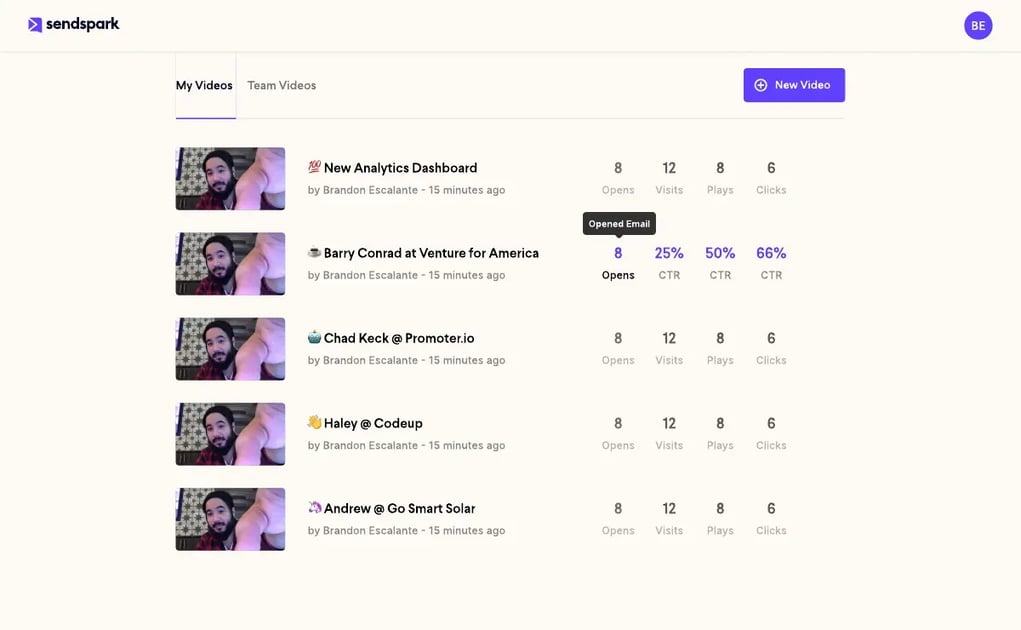
If a whole ICP tier consistently opens but never watches past the first few seconds, that’s a signal to revisit the profile itself, not just the script. How much AI personalization a video actually needs often matters less than whether it’s reaching the right company in the first place.
Common ICP Mistakes That Waste Your Outreach Budget
The most expensive ICP mistakes are building one too broad to actually filter anything, never writing down who to exclude, treating it as a one-time exercise instead of revisiting it quarterly, and building it in a slide deck nobody on the sales floor ever opens again. Each one quietly drains rep time and, for AI-personalized video specifically, real AI credit spend.
Common mistake
“Mid-market SaaS, 50-500 employees” sounds specific until you realize it matches tens of thousands of companies. If your ICP doesn’t disqualify the clear majority of your addressable market, it isn’t narrow enough to actually change who gets prioritized for a personalized send.
- Too broad to filter anything: An ICP that matches half your total addressable market gives reps no real prioritization signal — every account looks equally “in,” which means none of them are.
- No documented anti-ICP: Without explicit disqualifying criteria, reps default to chasing every inbound lead and every list a data vendor hands them, regardless of fit.
- Treated as a one-time exercise: Markets shift, your product changes, and your best customers 18 months ago aren’t necessarily your best customers today. An ICP built once and never revisited is running on stale assumptions.
- Built in isolation from sales: An ICP marketing writes without input from the reps actually working the accounts rarely survives contact with a real sales floor.
- No connection to outreach spend: Teams that don’t tie ICP fit to a real cost — AI credits, rep hours, ad spend — have no forcing function to actually enforce the profile instead of ignoring it under pipeline pressure.
An ICP that’s too loose shows up fastest in AI video minute consumption: teams that skip Step 5 above tend to discover the problem only when a monthly credit bundle on their plan runs out faster than expected, well before they’d have caught it from reply-rate data alone. It also shows up in stalled deals: a tight ICP still needs multi-threading across the buying committee once you’re in an account, and a good buyer enablement motion to help your champion sell internally.
| If Your ICP Looks Like This | Do This Instead |
|---|---|
| “B2B companies, any size, that need our category” | Add firmographic + technographic bounds until it excludes most of your addressable market |
| A slide with no negative criteria | Write an explicit anti-ICP checklist reps can run in under 10 seconds |
| Last updated 18+ months ago | Revisit quarterly against closed-won and closed-lost patterns |
| Built by marketing alone | Co-build with the reps and AEs actually working the accounts |
| No link to outreach cost | Tier your list and gate high-cost sends (AI-personalized video) to Tier 1 only |
Frequently Asked Questions
What is an ideal customer profile in simple terms?
An ideal customer profile is a description of the company most likely to buy your product, get real value from it, and stick around — built from the shared traits of your best existing customers, not a wish list of who you’d like to sell to.
How is an ICP different from a target market?
A target market or total addressable market describes every company that could theoretically buy your product. An ICP is a much narrower slice of that market — the companies most likely to actually buy, and buy again, based on real patterns in your existing customer base.
How often should you update your ICP?
Review your ICP at least quarterly, and immediately after any meaningful shift in your product, pricing, or market. An ICP built from last year’s closed-won deals can miss changes in who’s actually converting today.
Do I need both an ICP and buyer personas?
Yes. Your ICP tells you which companies to target; your buyer persona tells you which person inside that company to reach and what they care about. Skipping either one leaves a gap — a great persona at the wrong company, or the right company with no plan for who to contact.
How does an ICP apply to AI-personalized video outreach specifically?
AI-personalized video has a real, metered cost per send — Sendspark’s dynamic video minutes are consumed per personalized minute, per recipient. A tight ICP is what keeps that AI credit spend pointed at accounts worth the investment, instead of personalizing videos for prospects who were never going to convert.
What’s the biggest ICP mistake B2B teams make?
Building an ICP broad enough that it fails to disqualify anyone. If your profile still matches thousands of companies, it isn’t functioning as a filter — it’s just a description of your entire addressable market restated with more confidence.
Can you validate an ICP without running paid ads or big campaigns?
Yes — engagement data from outreach you’re already sending works. Per-recipient video analytics (watch percentage, CTA clicks) or even reply-rate data by account tier will show you which parts of your “ideal” profile actually behave like your best customers.
Sources & References
- Salesforce — “86% of business buyers say they’re more likely to buy when their goals are understood” (State of Sales report) (2026)
- HubSpot Blog — “Your Ideal Customer Profile describes the company that your buyer persona works for,” distinguishing organizational fit from individual fit (2026)
- Qualtrics — ICP framework describing a “semi-fictional company” built from industry, size, budget, tech stack, and pain-point criteria (2026)
- Gartner — Ideal customer profile development framework for sales and marketing alignment (2026)
Published September 2026
Record One Video. AI Personalizes Thousands.
Sendspark is the AI video personalization platform for B2B sales. Record once, and AI voice cloning generates thousands of individually personalized videos with dynamic backgrounds and personalized thumbnails — each prospect hears their name, sees their website, in your voice. Sales teams see 2-3x more replies.
Get Started Now