Most sales teams treat AI video personalization as a switch: on or off. Either you record a generic video and send it to everyone, or you go all-in on an AI-generated avatar that clones your voice and face. Neither extreme is right for most B2B outbound. There are at least four distinct levels of personalization between “one video for everyone” and “full AI avatar,” and picking the wrong one costs you either reply rate or trust.
This guide breaks down what each level actually does, what the research says about when heavier AI personalization helps or backfires, and how to set up each level inside Sendspark without over-engineering your first campaign.
Key Takeaways
- Sales video personalization isn’t all-or-nothing. It ranges from manual recording to merge-tag word-swaps to dynamic backgrounds to full AI voice cloning, and each level has a different setup cost and reply-rate ceiling.
- Reply rates climb with personalization depth: generic outreach converts at 1-3%, while multi-signal stacked personalization reaches 25-40%, according to Autobound’s 2026 benchmark data.
- 69% of B2B buyers still want a human sales rep to validate AI-generated content, according to Gartner — heavier AI isn’t automatically the better choice for trust-sensitive deals.
- Sendspark lets you dial personalization up or down per campaign from a single recorded video: first-name and company merge tags, dynamic website backgrounds, or full AI voice cloning.
- The right level depends on deal size, audience sophistication, and send volume, not on chasing the newest AI feature.
What Are the Levels of AI Personalization in Sales Video?
There are four practical levels of AI video personalization in sales video: manual recording with no personalization, merge-tag word-swaps (name and company), dynamic backgrounds that show the prospect’s own website, and full AI voice cloning that generates a unique greeting per recipient. Each level trades setup effort for reply-rate lift, and none of them requires the others. For a look at how this compares to fully synthetic AI avatars rather than a recorded video of yourself, see our AI avatar vs. real video breakdown.
Level 0 — Manual, no AI. You record one video and send the identical link to every prospect. Zero setup cost, zero personalization. This is the baseline every other level is measured against.
Level 1 — Merge-tag word-swap. The video (or its landing page and email copy) inserts the prospect’s first name, company, or job title using a text-replacement token. No re-recording, no AI voice work — just a personalized wrapper around a generic message.
Level 2 — Dynamic backgrounds. The system pulls the prospect’s actual website and displays it behind you as you talk, so it looks like you recorded the video while looking at their homepage. This is a visual signal of research, not an audio one.
Level 3 — AI voice cloning. You record a single video once, using a placeholder word where the prospect’s name goes. AI voice cloning then regenerates that portion of the audio in your own cloned voice for every recipient, so each person hears their own name spoken naturally, not just displayed as text on screen.
| Level | What It Does | Setup Effort | Best For | Reply-Rate Range |
|---|---|---|---|---|
| 0 — Manual | One video, no personalization | None | Broad top-of-funnel awareness sends | 1-3% |
| 1 — Merge-tag word-swap | Name/company inserted as text | Low | High-volume outbound, first tests of video as a channel | 5-9% |
| 2 — Dynamic backgrounds | Prospect’s website shown behind you | Low-Medium | Mid-funnel outbound where a visual research signal helps | 15-25% |
| 3 — AI voice cloning | Cloned voice speaks each name naturally | Medium | Named-account ABM, high-value pipeline, stacked with other signals | 25-40% |
Those reply-rate ranges come from Autobound’s 2026 benchmark analysis of cold email and outreach personalization, which found generic outreach converting at 1-3%, signal-based personalization at 15-25%, and multi-signal stacked personalization (layering several signals, including video) reaching 25-40%. The pattern holds directionally for video: more relevant, specific personalization outperforms generic sends, but the jump from Level 2 to Level 3 is smaller than the jump from Level 0 to Level 1. Most of the lift comes from adding any personalization at all, not from maximizing it.
Pro tip
Test one level at a time. If you jump straight from Level 0 to Level 3, you won’t know whether your reply-rate lift came from the AI voice cloning or just from finally adding a name and company to the message.
How Do You Choose the Right Personalization Level for Your Team?
Choose your personalization level based on three factors: deal size and account count, how sophisticated and trust-sensitive your audience is, and how much setup time your team can spend per campaign. High-volume, lower-stakes outbound favors Level 1 or 2. Named-account ABM with a handful of high-value targets justifies Level 3.
If you’re sending to hundreds or thousands of prospects a month across a broad ICP — the typical sales prospecting use case — merge-tag word-swaps (Level 1) or dynamic backgrounds (Level 2) usually make more sense than AI voice cloning. You get most of the reply-rate lift at a fraction of the setup time, and you can iterate on messaging faster because you’re not re-recording for every audio variation. Our guide to personalizing outbound at scale covers how to layer data signals into a high-volume campaign like this.
If you’re running account-based marketing against 20-50 named target accounts where each deal is worth six or seven figures, the extra setup time for AI voice cloning is easy to justify. A cloned-voice greeting by name, paired with a dynamic background showing the prospect’s own site, signals a level of individual attention that a text-only name-swap can’t match.
Audience sophistication matters too. Technical buyers and security-conscious industries (finance, healthcare, government) tend to scrutinize AI-generated content more closely and are more likely to notice — and question — a synthetic voice. Consumer-adjacent or high-volume transactional segments are generally more tolerant of heavier automation because the individual stakes per message are lower.
Team bandwidth is the practical constraint most guides skip. Merge-tag word-swaps take about as long to set up as uploading a CSV. Dynamic backgrounds add one extra field per contact. AI voice cloning takes longer to review before sending, since you’re checking pronunciation and pacing across a whole list rather than a single generic take. If your team is already stretched thin on a high-volume cadence, that review overhead is a real cost, not just a one-time setup step.
HubSpot’s 2026 State of Marketing research found that 93.2% of marketers say personalized or segmented experiences led to more leads and purchases — but 62.7% of the same marketers also said the market needs more human-centered content to compete with AI content. That tension is the whole point of thinking in levels instead of treating personalization as one dial that only goes up: more personalization is good, but more visible AI isn’t automatically the same thing as more personalization.
Record One Video. AI Personalizes Thousands.
Sendspark is the AI video personalization platform for B2B sales. Record once, and AI voice cloning generates thousands of individually personalized videos with dynamic backgrounds and personalized thumbnails — each prospect hears their name, sees their website, in your voice. Sales teams see 2-3x more replies.
Get Started NowWhat Does the Research Say About AI and Trust in Sales Outreach?
Research from Gartner, the Nuremberg Institute for Market Decisions, and independent AI-detection studies converges on one point: most buyers still want human validation behind AI-generated content, and disclosed or detectable AI use can reduce trust rather than build it. That doesn’t mean avoid AI personalization — it means match the visibility of the AI to the stakes of the deal.
A 2026 Gartner survey of 645 B2B buyers found that 69% prefer to validate AI-generated insights with a sales rep before acting on them, rather than trusting the AI output alone.
“Buyers still turn to sales reps to validate AI-generated insights, and support decision-making at critical moments in the journey.”
— Robert Blaisdell, VP Analyst, Gartner Sales practice
Separately, researchers at the Nuremberg Institute for Market Decisions (NIM) found that only 20% of consumers say they trust AI itself, and ads explicitly labeled “AI-generated” were perceived more negatively than identical ads labeled as human-made — participants reported lower willingness to engage with or purchase from the AI-labeled version. Dr. Fabian Buder, Head of Marketing and Consumer Behavior at NIM, summarized the core problem: transparency about AI use “reveals a fundamental problem but doesn’t solve it.”
Detection itself is also getting harder, which cuts both ways. Kapwing’s 2026 roundup of AI video statistics, citing Runway’s Turing Reel study, found that only 9.5% of viewers can reliably distinguish AI-generated video from real footage. Prospects mostly can’t tell Level 3 personalization from a human reading a script — but the NIM research suggests that when they suspect it, trust drops regardless of accuracy.
Common mistake
Don’t add AI voice cloning to a message that doesn’t need it. If a Level 1 merge-tag video already gets the reply, layering on a cloned voice adds setup time and a small chance of triggering “wait, is this AI?” skepticism for no extra lift.
The practical takeaway: heavier, more visible AI personalization works best when the account is valuable enough to justify the extra trust risk, and worst when the buyer is already primed to scrutinize vendor claims. For high-volume, lower-stakes outbound, a lighter touch that still shows real personalization (name, company, a visual reference to their site) usually outperforms a fully synthetic voice on a cold, unqualified list.
None of this research argues against AI personalization. It argues against defaulting to the heaviest available option regardless of context. A merge-tag word-swap or a dynamic background is still AI-assisted personalization — it’s just less visible as “AI,” which is exactly why it tends to avoid the trust penalty the Gartner and NIM research describes.
How Do You Set Up Each Personalization Level in Sendspark?
You set up each personalization level in Sendspark from the same recorded video using merge tags for Level 1, a background URL field for Level 2, and a wildcard placeholder plus AI voice cloning toggle for Level 3 — you don’t need separate tools or separate recordings for each level. If you’re deciding how many fields to personalize within any of these levels, our guide to personalizing beyond just a first name breaks down when a second or third variable is worth the setup time.
Setting up Level 1 (merge-tag word-swap): When building your campaign, click the “Personalize” button and insert a merge tag — firstName, company, or jobTitle — into your video’s on-screen text, landing page, or follow-up email. Sendspark pulls the value from each contact record and swaps it in automatically. This works with a CSV upload or directly from a connected CRM. This same merge-tag mechanism is also what makes per-recipient tracking possible when you send the resulting link by text instead of email — see our guide to SMS video marketing for how that works.
Setting up Level 2 (dynamic backgrounds): Add a backgroundUrl field to your contact list — the prospect’s homepage or any public page you want superimposed behind you in the video. Sendspark only requires an email address and a background URL to generate the dynamic video; if you don’t have the URL handy, you can extract it automatically from each contact’s email domain instead of collecting it manually.
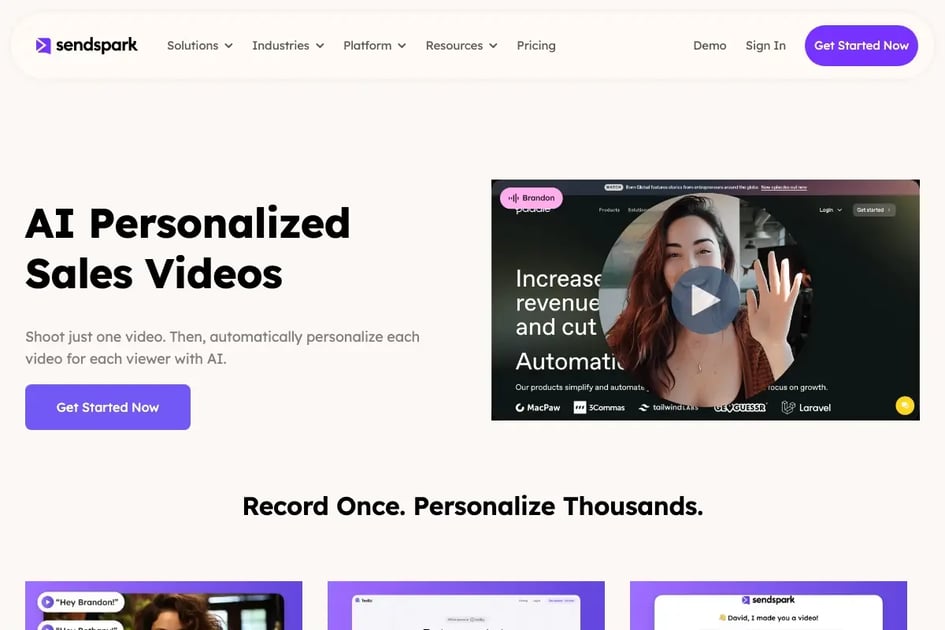
Setting up Level 3 (AI voice cloning): Record your video once, saying the wildcard placeholder word “Watermelon” in place of where each prospect’s name would go. Toggle on AI voice cloning for the campaign, and Sendspark regenerates that portion of the audio in your cloned voice for every recipient — so each person hears their actual name spoken naturally, not read as on-screen text. Combine this with a dynamic background for the highest-personalization tier available without recording a separate take per prospect.
For any level, you can trigger sends directly from HubSpot workflows so a new contact stage automatically kicks off a personalized video, and track opens, plays, and CTA clicks back in your CRM. Agencies running GoHighLevel instead of a CRM can trigger the same levels off a contact tag — see our GoHighLevel video personalization setup guide. Higher personalization tiers consume more Dynamic Video Minutes per send than a plain merge-tag video, so it’s worth checking your plan’s allocation before rolling AI voice cloning out to a large list. If you want personalization ideas that don’t feel like a mail-merge, our guide to non-creepy personalization scripts has templates for each level above, and our comprehensive guide to personalized video email covers the fundamentals if you’re starting from scratch.
| If you need to… | Use this level |
|---|---|
| Send one video to a broad, unqualified list | Level 0 — Manual |
| Test video as a new outbound channel at volume | Level 1 — Merge-tag word-swap |
| Add a visible research signal without re-recording | Level 2 — Dynamic backgrounds |
| Max out personalization for a short list of high-value accounts | Level 3 — AI voice cloning |
Published August 2026
Frequently Asked Questions
Do I have to use AI to personalize sales videos with Sendspark?
No. Sendspark supports personalization without any AI voice work: merge tags can insert a prospect’s name and company as on-screen text, and dynamic backgrounds can show their website, both without AI voice cloning. AI voice cloning is optional and only needed if you want the audio itself to say each recipient’s name.
What is the difference between merge-tag word-swap and AI voice cloning?
Merge-tag word-swap inserts a prospect’s name or company as text on screen, on the landing page, or in the follow-up email, using the same recorded video and audio for everyone. AI voice cloning regenerates the audio itself in your cloned voice, so each recipient hears their own name spoken naturally instead of just seeing it displayed.
Does more AI personalization always mean higher reply rates?
No. According to Autobound’s 2026 benchmark data, the biggest reply-rate jump comes from adding any personalization at all, moving from 1-3% generic reply rates to 5-9% with basic personalization. The gap between mid-tier and top-tier personalization is smaller, and for trust-sensitive audiences, heavier AI can sometimes underperform a lighter touch.
Will prospects know a video is AI-generated?
Most won’t be able to tell reliably. Kapwing’s 2026 analysis of Runway’s Turing Reel study found only 9.5% of viewers can distinguish AI-generated video from real footage. However, research from the Nuremberg Institute for Market Decisions found that when buyers do suspect AI involvement, trust drops even if the content is accurate, so it’s worth matching your personalization level to how scrutiny-heavy your audience is.
How much does higher-tier AI personalization cost?
AI voice cloning and dynamic backgrounds consume more Dynamic Video Minutes per send than a plain merge-tag video. Exact costs depend on your Sendspark plan and send volume — see our AI video pricing guide for a full breakdown of per-seat versus usage-based costs.
Can I mix personalization levels in the same campaign?
Yes. You can segment a single campaign so that your highest-value named accounts get Level 3 AI voice cloning and dynamic backgrounds, while the rest of the list gets Level 1 merge-tag personalization, all from one recorded video and one campaign setup.
What personalization level is best for cold outbound versus warm follow-up?
Cold, high-volume outbound generally performs well with Level 1 or Level 2, since the goal is testing the channel and getting a reply at scale. Warm follow-ups with an engaged prospect or a named account further along in the pipeline can justify Level 3, since the relationship already supports a higher-effort touch.
Sources & References
- Gartner — “69% of B2B buyers prefer to validate AI-generated insights with a sales rep” (survey of 645 B2B buyers) (2026)
- Nuremberg Institute for Market Decisions (NIM) — “Only 20% of consumers trust AI itself, and AI-labeled ads are perceived more negatively than human-made ads” (2026)
- Kapwing (citing Runway’s Turing Reel study) — “Only 9.5% of viewers can reliably distinguish AI-generated video from real footage” (2026)
- Autobound — “Reply rates by personalization depth: 1-3% generic, 5-9% basic, 15-25% signal-based, 25-40% multi-signal stacked” (2026)
- HubSpot — “93.2% of marketers say personalized or segmented experiences led to more leads and purchases” (2026)
Record One Video. AI Personalizes Thousands.
Sendspark is the AI video personalization platform for B2B sales. Record once, and AI voice cloning generates thousands of individually personalized videos with dynamic backgrounds and personalized thumbnails — each prospect hears their name, sees their website, in your voice. Sales teams see 2-3x more replies.
Get Started Now