Your elevator pitch has less time to work than an actual elevator ride. Gong’s analysis of 300 million cold calls found that opener wording alone can swing whether a prospect stays on the line from 2.15% to 11.24% — a bigger swing than anything you say in the next 40 seconds. The real problem for most B2B teams isn’t writing one good pitch. It’s that a good pitch has to get rewritten or re-recorded every single time you use it on someone new.
Published September 2026
Key Takeaways
- A working B2B elevator pitch has 4 parts — hook, solution, proof, call to action — delivered in 30 to 45 seconds, not a fixed “elevator ride.”
- 96% of B2B buyers research a company before a rep ever pitches them, according to HubSpot — a generic pitch that ignores what they already know falls flat immediately.
- Opener wording alone can swing cold call success more than 5x (2.15% vs. 11.24%) across Gong’s analysis of 300 million cold calls.
- Fully personalized outreach drives 2-3x higher reply rates than templated messaging, per Mailshake’s State of Cold Email 2026 report — but hand-rewriting a pitch per prospect doesn’t scale past a handful of contacts a day.
- Sendspark lets you record one elevator pitch once, then AI voice cloning and dynamic backgrounds personalize the name, company, and delivery for every prospect without re-recording.
The 4-Part Framework Every B2B Elevator Pitch Needs
A B2B elevator pitch needs four parts: a specific problem or hook, your solution in one sentence, one piece of quick proof, and a clear call to action — delivered in roughly 30 to 45 seconds. Skip any one of the four and prospects either tune out or finish the conversation without knowing what to do next.
Forget the idea that an elevator pitch has to hit exactly 30 seconds. That number came from the length of an actual elevator ride, not from any data on what converts. What matters is that all four parts show up, in order, without padding.
1. The Hook
Open with a specific problem your buyer already recognizes, not a description of your company. “Most RevOps teams lose a full day a week reconciling Salesforce and HubSpot data” lands harder than “We’re a data integration platform.” Name the pain before you name the product.
2. The Solution
State what you do in one sentence, using plain language instead of category jargon. If a stranger outside your industry wouldn’t understand the sentence, rewrite it.
3. The Proof
Add one specific, checkable detail — a customer name, a number, or a result. “Teams like [customer] cut reconciliation time by 60%” does more work than “we help companies save time.”
4. The Call to Action
End with one specific next step, not “let me know if you’re interested.” Ask for 15 minutes on a named day, or ask a single qualifying question that moves the conversation forward.
“What separates a good sales pitch from a great sales pitch is its ability to create emotional and rational alignment.”
— Elyse Fox, Former Sr. Director, Enterprise Sales at Highspot
That alignment is exactly what the four-part structure produces: the hook creates emotional recognition (“yes, that’s my problem”), and the proof creates rational confidence (“yes, this actually works”). Miss either half and the pitch feels either hollow or robotic.
Pro tip
Write your pitch as bullet points for each of the four parts, not a word-for-word script. Reps who memorize a script verbatim tend to sound stiff the moment a prospect interrupts with a question.
7 B2B Sales Elevator Pitch Examples You Can Steal
The right elevator pitch changes based on where you’re delivering it — a cold call opener needs a permission-based hook, while a referral pitch can skip straight to proof. Below are seven B2B pitch examples built on the four-part framework, one for each channel a rep actually uses.
These seven scenarios cover the situations B2B reps run into most often: a cold call, a cold outreach message, a social touch, an in-person moment, a stalled deal, an executive buyer, and a warm introduction. Swap in your own numbers and customer names before you use any of them.
Example 1: Cold Call Opener
Gong’s research on 25,000+ B2B cold calls found that permission-based openers consistently outperform a jump straight into the pitch. Ask before you pitch, and the prospect feels like they’re in control of the conversation.
“Hi Jamie, this is Alex from [Company] — I know I’m catching you out of nowhere, so I’ll be quick. We help RevOps teams at companies your size stop losing hours every week reconciling CRM data by hand. Is that something worth 20 seconds, or should I try you another time?”
Example 2: Cold Email / Video Opener
A written pitch and a spoken pitch use the same four parts, but a written version needs to earn a reply within the first two lines. See our cold email pitch anatomy guide for a full breakdown of the written version.
“Quick one, Jamie — noticed [Company] runs both Salesforce and HubSpot. Most teams in that setup lose a day a week reconciling the two by hand. We built a 10-minute fix. Worth a 15-minute look Thursday?”
Example 3: LinkedIn DM
LinkedIn pitches need to read as a message from a person, not a pasted script. Reference something specific about the prospect’s role or a recent post before you pitch.
“Saw your post on RevOps headcount freezes — that’s exactly the problem we built [Product] to solve. We help teams like yours reclaim the manual-reconciliation hours instead of hiring for them. Open to a quick look?”
Example 4: Trade Show / Networking
In person, you get a question back before you finish talking, so the hook has to be short enough to survive an interruption.
“We stop RevOps teams from losing a day a week to manual CRM reconciliation — what does your stack look like right now?”
Record One Video. AI Personalizes Thousands.
Sendspark is the AI video personalization platform for B2B sales. Record once, and AI voice cloning generates thousands of individually personalized videos with dynamic backgrounds and personalized thumbnails — each prospect hears their name, sees their website, in your voice. Sales teams see 2-3x more replies.
Get Started NowExample 5: Post-Demo Re-Pitch
When a deal stalls after a demo, re-pitch the original problem instead of repeating the feature tour. This works well as a short follow-up after a first sales call that’s gone quiet.
“When we spoke, the CRM reconciliation problem was costing your team about 6 hours a week. That’s still the piece we solve — want to revisit timing now that budget season is closer?”
Example 6: VP/Exec-Level Pitch
Economic buyers care about outcomes and risk, not features. Lead with a number tied to their goals, not a walkthrough of the product.
“Your RevOps team is likely spending 200+ hours a year on manual reconciliation — that’s payroll cost with zero pipeline impact. We get that back to zero in under a month, without a rip-and-replace of either system.”
Example 7: Referral-Based Pitch
A warm introduction lets you skip straight to proof, since the hook is already implied by the referral itself.
“[Mutual contact] mentioned your team is dealing with the same CRM reconciliation headache theirs had — we cut that down by 60% for them in about three weeks. Want me to show you exactly how?”
Elevator Pitch Mistakes That Kill B2B Deals
The four most common elevator pitch mistakes are feature-dumping instead of naming a problem, using one generic script for every prospect, ending without a specific call to action, and running long enough that the prospect stops listening before you reach the point.
Common mistake
Reciting a list of features (“we have dashboards, integrations, and automation”) tells a prospect nothing about why it matters to them. Every feature you mention should answer “so what?” before you move to the next one.
Feature-dumping happens when reps default to describing the product instead of the problem. Fix it by starting every pitch draft with the prospect’s pain, then working backward to the one feature that solves it.
Generic, one-size-fits-all pitches are the most common failure mode, and the hardest to fix by hand. HubSpot’s compiled sales research found that 96% of B2B buyers research a company and its products before ever engaging with a sales rep. A pitch that doesn’t acknowledge what they already found on your site or in a review reads as generic on arrival.
No call to action leaves the prospect holding the decision of what happens next, and most won’t make it. “Let me know if you have questions” isn’t a call to action — naming a day and a duration is.
Pitches that run too long lose the room before the proof point lands. If your hook and solution together take longer than 15 seconds to say out loud, cut it in half.
One Pitch, Every Prospect: Personalizing Your Elevator Pitch With AI Video
Rewriting your elevator pitch by hand for every prospect works for a handful of contacts a day, then breaks down completely at real outbound volume. Sendspark’s AI video personalization platform solves this by letting you record one elevator pitch once, then using AI voice cloning and dynamic backgrounds to generate an individually personalized version for every prospect — each one hearing their own name and seeing their own company site, in your voice, without you re-recording anything.
The math is straightforward: a rep sending 50 personalized video pitches a day would need to record 50 separate takes by hand, adjusting the name and company reference in each one. With AI-personalized video, the rep records the pitch once. AI voice cloning then re-speaks the prospect’s name and company inside that same recording, and dynamic backgrounds swap in the prospect’s own website behind the rep, for every send.
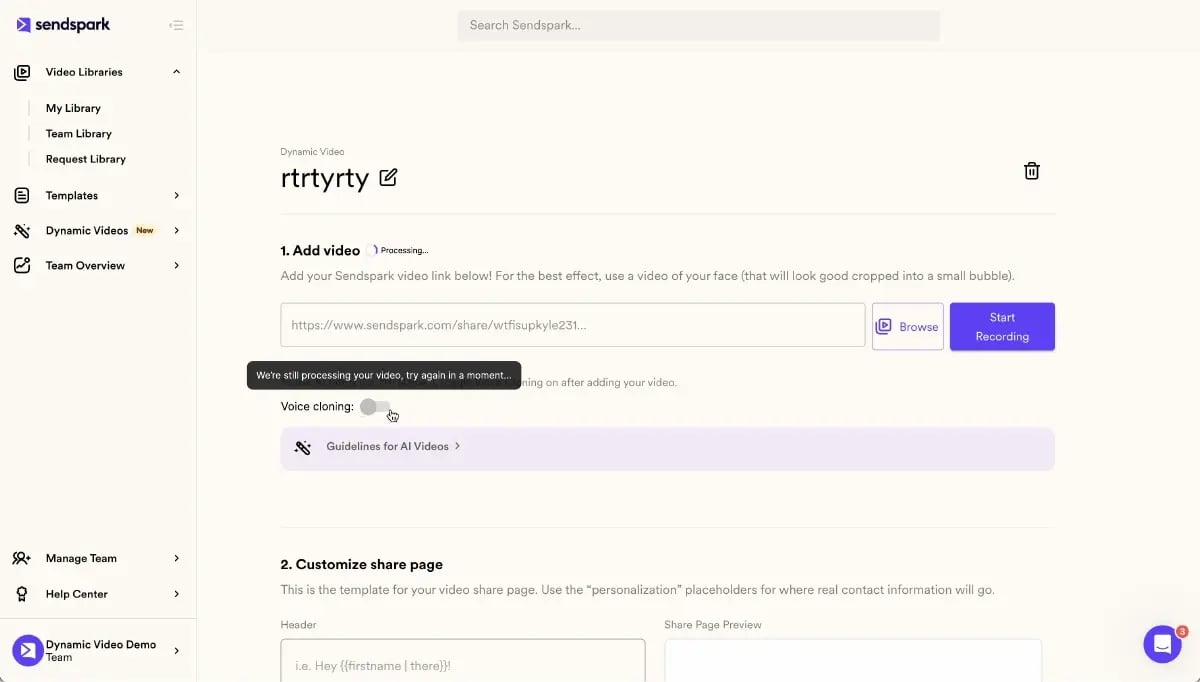
This directly answers the reply-rate problem named earlier: Mailshake’s State of Cold Email 2026 report, based on responses from 508 outbound professionals, found that only 5% of senders personalize every message individually — but those senders see 2-3x higher reply rates than teams relying on templates. AI-personalized video pitches put that same 1:1 personalization inside a channel prospects still open: outbound video prospecting sees 2-3x more replies and 40-50% more meetings booked compared to text-only outreach.
Advanced strategy
Don’t stop at the prospect’s first name. Sendspark supports personalizing up to three spoken variables per video — name, company, and job title — so a VP-level pitch and an individual-contributor pitch can come from the same recording. See how many variables you should actually personalize before you add more than that.
This is also why the same pitch works across every example above. Once you’ve recorded the four-part structure once, the delivery channel — cold call, email, LinkedIn, or AI-personalized video — becomes a distribution decision, not a rewriting job. Sendspark distributes the same personalized video through HubSpot, Outreach, Salesloft, Apollo, and 50+ other email and LinkedIn integrations.
Elevator Pitch Delivery Method Comparison
| Delivery Method | Personalization Depth | Prep Time Per Prospect | Reply/Engagement Signal |
|---|---|---|---|
| Written cold email script | Manual per prospect | 2-5 minutes | Baseline reply rate |
| Live cold call | Real-time, but not repeatable | 0 minutes (live) | 2.15%-11.24% connect-to-conversation rate, opener-dependent |
| Generic 1:many video | None (same video to everyone) | One-time recording | Lower than personalized outreach |
| AI-personalized video (Sendspark) | Name, company, job title, per send | One-time recording, then automated | 2-3x reply rate vs. templated outreach |
How to Practice and Refine Your Elevator Pitch
The fastest way to improve an elevator pitch is to hear yourself deliver it and fix one specific thing at a time — the length, the wording of the hook, or the pause before the call to action. Live roleplay, AI roleplay simulators, and recorded video review are the three practical ways to do that, and each fits a different stage of building confidence.
Live roleplay with a manager or peer catches things a script read-through never will, like where a prospect is likely to interrupt with a question. It also requires scheduling two people’s time, which is why most teams only do it occasionally.
AI roleplay simulators let a rep run the same pitch against a simulated objection-heavy buyer as many times as needed, without booking anyone else’s calendar. Our full comparison of roleplay training methods breaks down which simulators are worth the subscription.
Recorded video review is the fastest way to catch pacing and filler-word problems, since hearing your own pitch played back makes issues obvious that don’t show up on a live call. Record the same pitch three times, and most reps can hear the difference between attempt one and attempt three immediately.
Pro tip
Time your pitch out loud before you ever use it live. Most reps overestimate how fast they talk under pressure, and a pitch that reads as 30 seconds on paper often runs closer to 50 seconds spoken.
Before locking in a final version, run it past your own call preparation checklist and confirm it still fits naturally into your opening minute, whatever the call type.
Elevator Pitch Checklist: Summary
| Element | What It Should Do | Common Failure |
|---|---|---|
| Hook | Names a specific, recognizable problem | Describes the company instead of the pain |
| Solution | One plain-language sentence | Category jargon a stranger wouldn’t understand |
| Proof | One checkable number or customer name | Vague claims like “we help companies save time” |
| Call to Action | One specific next step | “Let me know if you’re interested” |
| Personalization | Name, company, and role reflected per send | Same script sent to every prospect unchanged |
Frequently Asked Questions
What is a B2B sales elevator pitch?
A B2B sales elevator pitch is a short, spoken pitch — typically 30 to 45 seconds — that names a specific buyer problem, states your solution in one sentence, adds a checkable proof point, and ends with a clear call to action. It’s used in cold calls, in-person meetings, and increasingly in video outreach.
How long should a sales elevator pitch be?
A sales elevator pitch should run 30 to 45 seconds spoken out loud, not just on paper. Most reps underestimate this when reading silently, since a pitch that looks like 30 seconds in writing often runs closer to 50 seconds once spoken at a normal pace.
What’s the best structure for an elevator pitch?
The best structure follows four parts in order: a specific problem the buyer recognizes, your solution in one sentence, one piece of proof, and a specific call to action. Skipping the proof or the call to action are the two most common structural mistakes.
What’s a good elevator pitch example for a cold call?
A good cold call elevator pitch opens by acknowledging the interruption, asks permission to continue, then delivers the four-part structure in under 20 seconds. Gong’s research on 25,000+ B2B cold calls found permission-based openers consistently outperform openers that jump straight into the pitch.
What’s the biggest mistake reps make with their elevator pitch?
The biggest mistake is using one generic pitch for every prospect. HubSpot’s research shows 96% of B2B buyers already research a company before a rep reaches out, so a pitch that ignores what the buyer already knows reads as generic and forgettable.
Can AI personalize my elevator pitch for each prospect?
Yes. Sendspark’s AI voice cloning lets you record your elevator pitch once, then automatically re-speaks the prospect’s name and company inside that same recording for every send, paired with dynamic backgrounds that show each prospect’s own website.
How do I practice my elevator pitch before using it live?
Practice your elevator pitch with live roleplay, an AI roleplay simulator, or by recording and reviewing yourself out loud at least three times. Recorded review is the fastest way to catch pacing and filler-word issues that don’t show up when you only read the script silently.
Sources & References
- Gong Labs (Armand Farrokh) — “Opener wording alone swings cold call success from 2.15% (“Did I catch you at a bad time?”) to 11.24% (“Heard the name tossed around?”) across 300 million+ analyzed cold calls“ (2026)
- HubSpot — “Most prospects (96%) research companies and products before engaging with a sales representative” (2026)
- Highspot (Elyse Fox, citing Salesforce’s State of the Connected Customer Report) — “84% of business buyers expect sales reps to be trusted advisors, yet 59% feel most never bother to learn their distinct challenges and needs” (2026)
- Mailshake, State of Cold Email 2026 report — “Only 5% of senders personalize every email individually, but they get 2-3x better reply rates” (based on 508 outbound professionals surveyed) (2026)
Record One Video. AI Personalizes Thousands.
Sendspark is the AI video personalization platform for B2B sales. Record once, and AI voice cloning generates thousands of individually personalized videos with dynamic backgrounds and personalized thumbnails — each prospect hears their name, sees their website, in your voice. Sales teams see 2-3x more replies.
Get Started NowYour best elevator pitch shouldn’t have an expiration date after the first prospect you use it on. Get the four-part structure right once, then let AI voice cloning carry it to every name on your list. Read our comprehensive guide to video prospecting for the rest of the outbound workflow this pitch fits into, and check Sendspark’s plans to see which tier includes AI voice cloning at your team’s volume.