
Most strategic account plans die the same way: a rep fills out a template the week before a QBR, nobody opens it again until the next QBR, and the “plan” quietly turns into a stale PDF nobody trusts. That’s not an account plan. That’s a form.
A real strategic account plan is a living map of who matters inside your highest-value accounts, what they still need from you, and how you’re tracking whether your outreach is actually landing. Done right, it’s the difference between hoping an account renews and knowing exactly which stakeholder went quiet last month. This guide walks through what a strategic account plan actually is, the research on why most of them fail, the six components every plan needs, a five-step framework for building one, and how to decide between a DIY template and dedicated software.
Key Takeaways
- A strategic account plan is a living, stakeholder-mapped growth plan for a named account — not a one-time form filled out before a QBR.
- A study of 1,034 professionals across 62 countries found formal account planning drives a 75% better win rate and 58% shorter sales cycles.
- Top-performing account teams are 2.5x more likely than everyone else to have a repeatable process for building account plans, per RAIN Group research.
- Every account plan needs six components: segmentation, stakeholder mapping, whitespace analysis, competitive positioning, goals/KPIs, and a review cadence.
- Plans fail when they’re static. Personalizing outreach per stakeholder and tracking who actually engages keeps the plan alive between QBRs.
Published October 2026
What Is a Strategic Account Plan?
A strategic account plan is a living document that maps the stakeholders, goals, risks, and growth opportunities inside one of your highest-value named accounts, used to guide how your team engages that account over months or years — not a single deal. It covers the whole relationship: who the decision-makers are, what they still need, where competitors have a foothold, and what success looks like for both sides.
It’s easy to confuse an account plan with two other documents this blog has already covered. A buyer persona describes an ideal customer archetype — useful for messaging, but not tied to one real company. A mutual action plan (MAP) is scoped to a single deal, with both sides agreeing on the steps to close it. A strategic account plan is broader than both: it covers the entire account relationship, spans multiple deals and renewal cycles, and keeps going after the deal closes.
Your ideal customer profile (ICP) tells you which accounts are worth this level of investment in the first place. Once an account clears that bar, the account plan is how you actually manage deal progression and expansion inside it for as long as you keep the account.
Advanced strategy
Don’t build a fresh account plan template for every account from scratch. Build one reusable framework, then populate it per account — consistency across your portfolio is what makes account plans comparable in a QBR, and comparable is what makes them actionable.
Why Most Strategic Account Plans Fail
Most strategic account plans fail because they’re treated as a one-time document instead of a living process — built once for a QBR, then never touched again until the next one. The data says the gap between having a plan and running one well is enormous: teams with a disciplined, repeatable account-planning process report measurably better win rates, shorter cycles, and bigger deals than teams that treat planning as a box to check.
A large-scale study cited by DemandFarm — the Account Planning Book of Evidence, which surveyed 1,034 professionals across 62 countries — found that organizations with formal account planning reported a 75% better win rate, 72% increased understanding of the customer’s business, 58% shorter sales cycles, 55% better customer loyalty, 49% increased deal size, 47% better executive access, and a 27% improvement in identifying non-competitive deals.
Having a plan isn’t the hard part. Running it well is. RAIN Group’s “Top Performance in Strategic Account Management” research, which surveyed 397 participants at companies with formal strategic account management programs, found that Top Performers are 2.5 times more likely than everyone else to have an effective, repeatable process for building account plans. The gap isn’t ambition — it’s discipline.
That discipline shows up most clearly in how teams track engagement. Most reps still rely on memory, gut feeling, or a CRM activity log that says an email was “sent” — not whether anyone actually read it. That’s the core reason plans go stale: without a real signal that something changed inside the account, nobody has a reason to update it.
“The account and contact signals are key for reaching out at important times, and the value-add messaging it creates unique to every contact helps save time and efficiency.”
— Daniel Pitman, Mid-Market Account Executive, Black Swan Data
There’s also a retention math problem underneath all of this. HubSpot’s sales blog points out that acquiring a new customer costs roughly five times more than retaining an existing one, and a 5% increase in retention can increase profits by up to 25%. An account plan that isn’t actively driving retention and expansion inside your best accounts is leaving that math on the table.
The 6 Components Every Strategic Account Plan Needs
Every strategic account plan needs six components to function as a real growth tool: account segmentation, stakeholder and relationship mapping, whitespace analysis, competitive positioning, goals and KPIs, and a recurring review cadence. Skip any one of these and the plan collapses into either a contact list or a wish list — not a plan.
| Component | What It Covers | Why It Matters |
|---|---|---|
| Account Segmentation & Tiering | Ranking accounts by current revenue, growth potential, and strategic fit (Tier 1, 2, 3) | Keeps your best resources on your highest-potential accounts instead of spread evenly across everyone |
| Stakeholder & Relationship Mapping | Every decision-maker, influencer, and blocker in the account, plus their current sentiment | Prevents single-threaded deals that collapse when one champion leaves or goes quiet |
| Whitespace Analysis | The gap between what the account buys today and what it could or should buy | Turns the plan from a retention document into a growth engine |
| Competitive Positioning | Which competitors are active in the account and your differentiation against each | Prepares the team to defend the account instead of reacting after a competitor shows up |
| Goals & KPIs | Specific, measurable targets — expansion revenue, stakeholder engagement, renewal rate | Defines what “success” means for this account so progress can actually be measured |
| Review Cadence | A set schedule (usually quarterly) for revisiting and updating the plan | Keeps the plan tied to what’s actually happening in the account, not what was true six months ago |
Segmentation tells you where to spend your time. Stakeholder mapping tells you who to talk to. Whitespace analysis tells you what to offer next. Competitive positioning tells you how to win when someone else is circling. Goals and KPIs tell you why you’re doing any of this. And review cadence is what keeps the other five honest. One stakeholder that account plans commonly miss entirely: the security or IT reviewer who has to sign off before a deal of any size closes — our guide to the B2B SaaS security review process covers how to map and manage that relationship specifically.
Common mistake
Building a detailed whitespace analysis and skipping the review cadence. A plan without a set date to revisit it doesn’t get revisited — it gets forgotten until the account is already at risk.
Record One Video. AI Personalizes Thousands.
Sendspark is the AI video personalization platform for B2B sales. Record once, and AI voice cloning generates thousands of individually personalized videos with dynamic backgrounds and personalized thumbnails — each prospect hears their name, sees their website, in your voice. Sales teams see 2-3x more replies.
Get Started NowHow to Build a Strategic Account Plan: A 5-Step Framework
Building a strategic account plan means moving from broad strategy to specific execution in five steps: select and tier your accounts, map every stakeholder, run a whitespace analysis, set measurable goals, and build an engagement plan you can actually track. Skipping straight to “build the engagement plan” without the first four steps is how plans end up full of activity and empty of results.
Step 1: Select and Tier Your Accounts
Not every customer deserves a full strategic account plan. Start by ranking your portfolio against your ICP: current revenue, growth trajectory, industry fit, and strategic alignment with where your product is headed. Tier 1 accounts get dedicated time and frequent touchpoints. Tier 2 accounts get regular but lighter attention. Tier 3 accounts are managed through lower-touch, more automated motions. This isn’t about playing favorites — it’s about putting your limited attention where the return is highest.
Step 2: Map Every Stakeholder
Once you’ve picked the account, map the people inside it: who’s the economic buyer, who evaluates technically, who actually uses the product day to day, and who’s your internal champion. This is multi-threading in practice — a plan built around one contact collapses the moment that person changes roles or stops responding. Note each stakeholder’s current sentiment: bought-in, skeptical, or unaware you exist.
Step 3: Run a Whitespace Analysis
Compare what the account buys today against what it could or should be buying. Are they on one seat when the team has grown to fifteen? Are they using a fraction of what the plan includes? Look for signals outside the account too — new hires, new initiatives, a funding round — that hint at a use case you haven’t pitched yet. This step is what turns an account plan from a defensive retention document into an offensive growth plan.
Step 4: Set Goals and KPIs
Vague goals produce vague plans. Instead of “grow the relationship,” set something specific: “get a working session with the VP of Sales by end of Q1” or “expand seat count by 20% at renewal.” Then tie each goal to a KPI you can actually track — not a feeling, a number.
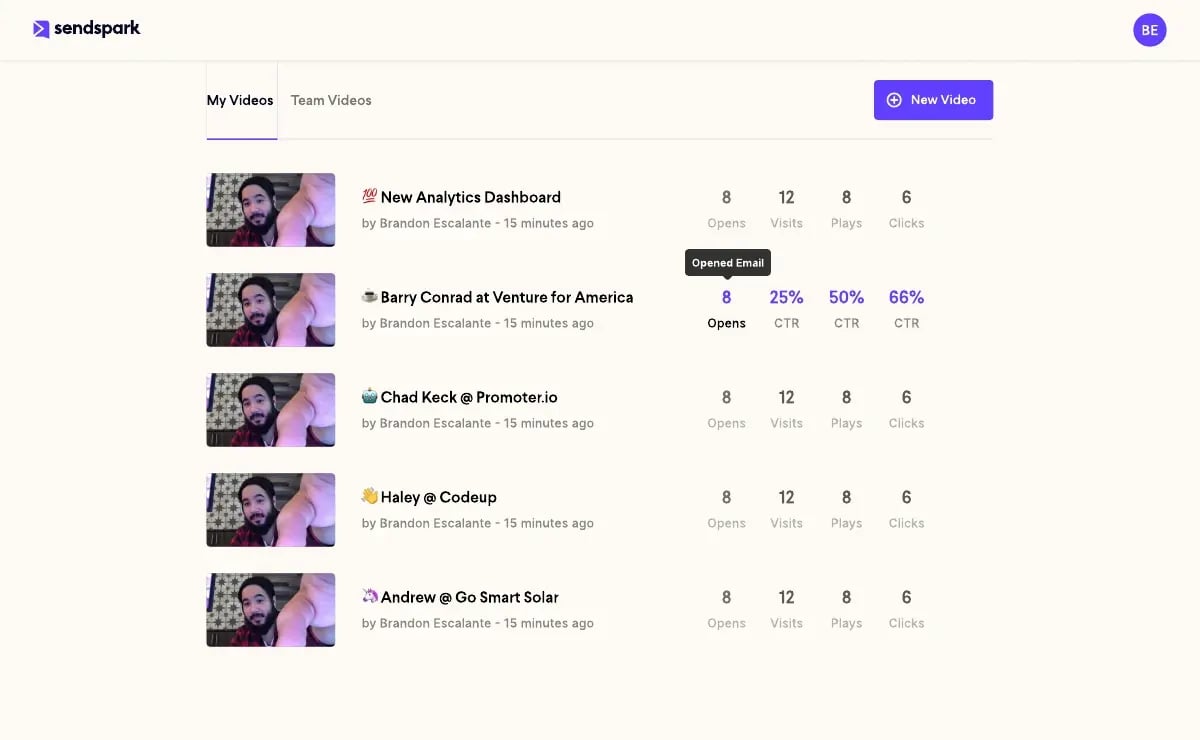
This is where engagement tracking usually breaks down. Most teams can tell you an email was sent. Few can tell you whether the stakeholder who matters actually opened it, let alone engaged with it. Sendspark’s per-recipient video analytics solve exactly this gap — for every video sent to a stakeholder, you can see plays, watch percentage, and CTA clicks at the individual level, not just an aggregate open rate. If your VP champion watches 90% of a video and clicks the CTA, that’s a concrete signal to act on. If they haven’t opened it in two weeks, that’s a concrete signal too. The same visibility matters during a formal RFP response process, where a written document gives you no read on which committee member actually reviewed your answer.
Step 5: Build the Engagement Plan
The final step is deciding how you’ll actually reach each stakeholder — and this is where most plans run out of time, because recording a unique, personalized video for every contact in a buying committee isn’t realistic for a busy rep. This is the specific problem Sendspark’s mechanism solves: record one video, and AI voice cloning personalizes it per recipient — using each stakeholder’s name, with dynamic backgrounds showing that stakeholder’s own company website or LinkedIn profile behind you, not a generic template. One recording becomes a distinct, personalized touch for the economic buyer, the technical evaluator, and the champion, without re-recording for each one.
Combine that with the per-recipient analytics from Step 4, and the account plan becomes a closed loop: you send personalized outreach, you see exactly who engaged and how much, and you update the plan based on real behavior instead of guesswork. That’s what separates a plan that’s “alive” between QBRs from one that’s a dead file waiting for the next review.
Strategic Account Plan Templates: DIY vs. Software
Most teams choose between a free DIY template, dedicated account-planning software built into their CRM, or a hybrid that layers engagement data on top of either one — and the right choice depends mostly on portfolio size and how much you need engagement data to be automatic rather than manually tracked.
| Factor | DIY Spreadsheet/Doc Template | Dedicated Account-Planning Software |
|---|---|---|
| Setup cost | Free, just time | License fee, usually per seat |
| Collaboration | Prone to version-control issues | Real-time, shared views across the team |
| CRM data sync | Manual copy-paste | Usually native or integrated |
| Engagement tracking | Relies on rep memory and self-reporting | Activity logs (sent, opened) but rarely individual-level depth |
| Best fit | Small teams, early-stage account planning | Larger portfolios needing standardization across many reps |
A DIY template is the right starting point if you’re formalizing account planning for the first time — it costs nothing and forces the same discipline as a paid tool. Dedicated software earns its cost once you’re managing enough accounts that standardization and CRM sync matter more than flexibility. Either way, neither option on its own tells you whether a specific stakeholder actually engaged with what you sent them — that’s the gap personalized video outreach and per-recipient analytics are built to close, layered on top of whichever template or software you use to track the plan itself.
Pro tip
Whichever format you choose, use win-loss data from accounts you’ve already closed or lost to sanity-check your whitespace assumptions before you finalize a new plan — it’s the fastest way to catch a growth thesis that doesn’t match reality.
Our comprehensive guide to video prospecting covers how to apply this same personalize-once, track-per-recipient approach earlier in the funnel, before an account ever gets tiered into a formal plan.
| Account Plan Element | Owned By | Reviewed |
|---|---|---|
| Segmentation & tiering | Sales leadership | Annually |
| Stakeholder map | Account owner | Monthly or after any org change |
| Whitespace analysis | Account owner + customer success | Quarterly |
| Goals & KPIs | Account owner + leadership | Quarterly, at QBR |
| Engagement tracking | Account owner | Continuous |
Frequently Asked Questions
What is a strategic account plan in B2B sales?
A strategic account plan is a living document that maps the stakeholders, goals, risks, and growth opportunities inside one named, high-value account. It guides how a team engages that account across multiple deals and renewal cycles, not just a single sale.
How is a strategic account plan different from a mutual action plan?
A mutual action plan (MAP) is scoped to closing one specific deal, with both buyer and seller agreeing on the steps to get there. A strategic account plan is broader — it covers the entire relationship with the account, including stakeholders and opportunities beyond the deal currently in progress.
Which accounts should get a strategic account plan?
Not every customer needs one. Reserve strategic account plans for accounts that clear your ideal customer profile and show high current revenue, strong growth potential, or strategic importance — typically your Tier 1 accounts, where the investment of time clearly pays off.
How often should you update a strategic account plan?
Review the full plan quarterly, ideally tied to your QBR cadence, and update the stakeholder map immediately after any known organizational change, such as a champion leaving or a new executive sponsor arriving. A plan that only gets touched once a year is effectively dead for eleven months.
What’s the biggest reason strategic account plans fail?
Most plans fail because they’re treated as a one-time document instead of a living process. Teams build a plan for a QBR, file it away, and have no real signal — beyond memory or guesswork — for when something inside the account has changed enough to warrant an update.
Do you need software to build a strategic account plan?
No. A spreadsheet or document template works fine for small teams or a first attempt at formal account planning. Dedicated software becomes worth the cost once you’re managing enough accounts that standardization and CRM sync save more time than they cost.
How does video fit into a strategic account plan?
Video gives you an objective engagement signal the rest of the plan usually lacks. With an AI video personalization platform, you record one video and personalize it per stakeholder using AI voice cloning, then track individual watch percentage and CTA clicks per recipient — turning “did this stakeholder engage” from a guess into a data point you can act on.
Sources & References
- DemandFarm — “Account Planning Book of Evidence study of 1,034 professionals across 62 countries: 75% better win rate, 72% increased customer understanding, 58% shorter sales cycles” (2026)
- RAIN Group — “Top Performers are 2.5 times more likely than The Rest to have an effective process for building account plans” (397 participants surveyed) (2026)
- Salesmotion — “Programs should aim for 115-130% net revenue retention, 30-40% expansion revenue as a share of total revenue” plus attributed quote from Daniel Pitman, Black Swan Data (2026)
- HubSpot — “Acquiring a new customer is roughly five times more expensive than retaining an existing one; a 5% increase in retention can increase profits by up to 25%” (2026)
Record One Video. AI Personalizes Thousands.
Sendspark is the AI video personalization platform for B2B sales. Record once, and AI voice cloning generates thousands of individually personalized videos with dynamic backgrounds and personalized thumbnails — each prospect hears their name, sees their website, in your voice. Sales teams see 2-3x more replies.
Get Started Now