Most B2B sales teams treat a proof of concept request as a green light. A prospect wants to test the software, so the deal must be close to done. That assumption is wrong more often than it’s right, and it’s an expensive mistake: a proof of concept (POC) can burn two to six weeks of engineering time, sales attention, and goodwill, and still end in a “thanks, we’re going with someone else.” The difference between a POC that closes and one that quietly dies almost never comes down to the product. It comes down to whether this deal-progression stage was structured at all.
Key Takeaways
- A structured B2B SaaS POC with success criteria agreed in writing converts to a signed deal 50-70% of the time; below 50% points to a qualification or criteria problem, not an execution one.
- 77% of B2B buyers describe their last purchase as very complex or difficult, and most of that complexity comes from evaluations running through disconnected stakeholders instead of one coordinated process.
- A POC, a pilot, and a proof of value test three different things (technical fit, real-world adoption, and quantified business value), and treating them as interchangeable is a common reason evaluations stall.
- The single most common failure mode is a POC that succeeds technically while the economic buyer never engages, because the sales engineer owned the deal alone.
- Recording one personalized kickoff video per stakeholder, instead of a fresh recap email every time someone new joins the evaluation, keeps the whole buying committee oriented without re-explaining anything from scratch.
What Is a B2B SaaS Proof of Concept (and How It Differs From a Pilot or POV)?
A B2B SaaS proof of concept is a limited, time-boxed evaluation where a prospect tests whether your product can technically solve one specific, high-risk problem before committing to a purchase. It is not a feature tour and it is not open-ended access. A POC exists to answer one question — “does this actually work in our environment, with our data?” — and nothing more.
That narrow scope is what separates a POC from the other evaluation formats prospects ask for. A demo shows what the product can do in general — and if you haven’t yet customized that demo for the specific stakeholders in the room, a POC is premature. A free trial hands over self-service access and lets the prospect explore on their own schedule. A pilot is a limited real-world deployment, usually after the purchase decision is directionally made, testing adoption across a live team. A proof of value (POV) goes a step further than a POC: instead of asking “can it work,” it quantifies “how much is it worth” in financial terms. Teams that use these four terms interchangeably end up running the wrong kind of evaluation for what the deal actually needs. A formal RFP is a fifth, document-based format that often runs in parallel with or ahead of a POC — see our RFP response process guide for how to decide whether to pursue one and how to structure the response.
How we evaluated these distinctions: we categorized each format by two variables — how much internal resourcing it demands from your team, and what specific claim it’s designed to prove or disprove. That lens is what produces the comparison below.
| Format | What It Proves | Typical Length | Who Runs It |
|---|---|---|---|
| Demo | General feature fit | 30-60 minutes | Account Executive |
| Free trial | Self-service usability | 14-30 days | Prospect, self-directed |
| Proof of concept (POC) | Technical feasibility for one defined use case | 2-6 weeks | AE + sales engineer |
| Proof of value (POV) | Quantified business/financial impact | 4-12 weeks | AE + customer success / finance |
| Pilot | Real-world adoption at scale | 1-3 months | IT / operations + end users |
A POC is warranted when the deal has real integration complexity, a high cost of failure if the rollout goes wrong, and an executive sponsor who’s explicitly asking for technical proof before they’ll sign. It’s overkill for simple, low-risk, self-serve software — if your product solves a basic workflow problem and the prospect could reasonably start using it in a free trial, offering a formal POC just adds weeks to your cycle for no added confidence. Reserve it for deals where “we’re not sure this will work for us” is a genuine, specific objection, not a vague stall.
Record One Video. AI Personalizes Thousands.
Sendspark is the AI video personalization platform for B2B sales. Record once, and AI voice cloning generates thousands of individually personalized videos with dynamic backgrounds and personalized thumbnails — each prospect hears their name, sees their website, in your voice. Sales teams see 2-3x more replies.
Get Started NowThe 6-Step Framework for Running a POC That Converts
A B2B SaaS POC converts into a signed deal when you qualify it hard before agreeing to run it, lock down written success criteria and a decision date, keep every stakeholder individually engaged, and treat the transition to a contract as part of the POC itself rather than an afterthought. Guideflow’s own benchmark data puts a well-structured POC’s close rate at 50-70% — and if yours is running below 50%, the fix almost never lives in the technical execution. It lives in one of the first two steps below. That contract transition usually runs alongside a parallel track most POC guides skip: a vendor security review, which can stall a POC that otherwise met every success criterion.
- Qualify the request. Not every POC ask is a real opportunity. Some prospects use a POC to stall a decision they’re not ready to make, or to gather competitive intelligence with no intent to buy. Before you agree, confirm three things: there’s an approved or approvable budget, the people in the room (or at least aware of the evaluation) include an actual decision-maker, and there’s a real deadline driving the timeline. If any of those is missing, offer a demo or a lighter-weight follow-up sequence instead — don’t spend sales engineering hours on a deal that isn’t real yet.
- Agree on success criteria and a hard decision date, in writing, before you start. “Show me it works” is not a success criterion. Specific ones look like “process a batch of 10,000 records in under 90 seconds” or “sync bidirectionally with our Salesforce instance within 48 hours of setup.” Pair the criteria with a committed decision date: if the criteria are met by that date, the prospect moves to procurement. Skipping this step is the single most common reason a POC turns into an open-ended, scope-creeping evaluation with no path to close.
- Map stakeholders to evaluation touchpoints. A technical evaluator cares about integration stability. An end user cares about whether the workflow actually gets easier. An economic buyer cares about cost and risk. Multi-threading the evaluation across all three — not just the technical contact who requested the POC — is what keeps the deal from stalling when it’s technically “done.” See our guide to multi-threading in B2B sales for the full stakeholder-mapping approach, and layer it onto the same strategic account plan you’re already building for the account.
- Execute with structured check-ins, not silence. Handing over access and disappearing for three weeks is how POCs die quietly. Schedule a short check-in at each phase: confirm setup in week one, troubleshoot blockers and review early data in week two, and start building the results narrative before the final week. These aren’t status updates — they’re your chance to catch a stalled stakeholder before the decision date arrives.
- Run a results readout against the original criteria. Compare actual outcomes to the specific criteria from step two, not to a general sense of how things went. If a criterion wasn’t met, be direct about why — a real product gap and an unrealistic criterion require two very different next conversations.
- Transition to a commercial discussion immediately. A POC that ends in “we’ll follow up soon” loses momentum fast. Have the contract and pricing discussion ready to go the moment the readout confirms success, and use a mutual action plan to turn the POC’s decision date directly into a signing date with named owners on both sides.
Pro tip
Build the mutual action plan at the same time you agree on POC success criteria, not after. A free POC template that pairs milestones with named owners on both sides makes the decision date feel inevitable instead of negotiable.
Keeping Every Stakeholder Engaged Without Rebuilding Content Each Time
The hardest part of a multi-week POC isn’t the technical work — it’s keeping every stakeholder oriented as the evaluation drags on and new people join partway through. Each time a new technical reviewer, end user, or executive sponsor gets looped in, the rep either writes a fresh recap email that gets skimmed or ignored, or burns a meeting slot re-explaining what’s already been covered twice.
This is where recording once and personalizing at scale solves a problem email can’t. Instead of writing a new recap for every stakeholder who joins the evaluation, record a single POC kickoff video covering the success criteria, the timeline, and what happens at each checkpoint. Sendspark’s AI voice cloning then generates an individually personalized version for each recipient — their name, their specific role in the evaluation, the success criterion that matters most to them — in your voice, without re-recording anything. The video’s dynamic background shows that stakeholder’s own company website or LinkedIn profile, not a generic template, which is what makes a mass-personalized video still feel individually made.
Measuring Engagement With Video Analytics
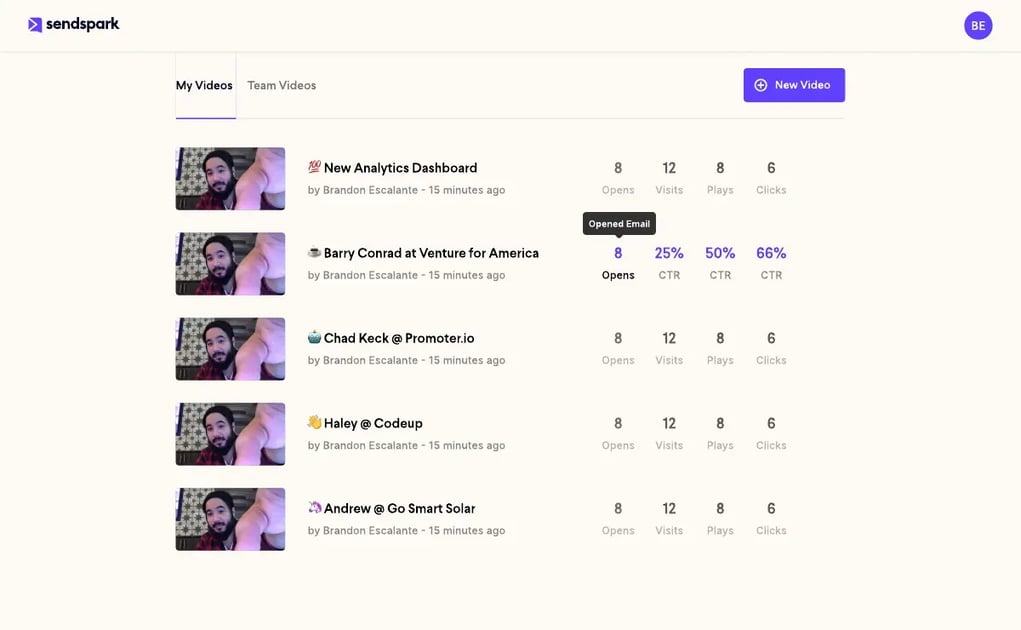
An email open rate tells you almost nothing about whether a stakeholder is actually engaged in the evaluation. Per-recipient video analytics give you an objective signal instead: watch percentage shows whether someone actually absorbed the kickoff content, and CTA clicks show whether they followed through to the mutual action plan or the next scheduling step. If the economic buyer’s video sits at 12% watched three days before your decision date, that’s a concrete reason to escalate — not a guess based on an unanswered email. Our guide to using video analytics to trigger follow-ups covers how to wire these signals into your CRM.
Advanced strategy
Use a Combined Video for the POC kickoff: a short personalized intro naming the stakeholder and their specific success criterion, merged with the same reusable technical walkthrough you send everyone else. You get the personalization without re-recording the core explanation for every person on the evaluation.
Common POC Mistakes That Kill B2B SaaS Deals
Most POCs that fail to close don’t fail because the product underperformed — they fail because of process mistakes made before a single line of the evaluation ran. The four below account for most of the stalled or dead POCs sales teams report, and each one is avoidable with a small change to how the evaluation gets set up.
No defined success criteria. Without specific, written criteria, the prospect can always find a new reason the evaluation isn’t quite done. Scope creeps, the timeline extends indefinitely, and eventually the deal just goes quiet. As FunnelStory’s Alok Shukla, Cofounder and CEO, puts it:
“Jumping into a PoC without clear indicators of what constitutes success is like setting sail without a compass.”
— Alok Shukla, Cofounder and CEO, FunnelStory
Common mistake
Agreeing to “start the POC and figure out success criteria as we go” feels collaborative in the moment, but it removes the one mechanism that forces a decision. Write the criteria down before any access is granted, not during week two.
Letting the sales engineer own the deal alone. When the SE runs point for the entire evaluation, the AE naturally disengages to focus on other pipeline. That leaves the technical team talking to the technical team while the economic buyer never hears a business case. The POC can succeed completely on technical merit and still not convert, because nobody kept the budget holder in the loop.
Running a POC for an unqualified deal. If the prospect can’t confirm a budget, a timeline, or a real decision-maker’s involvement, a POC isn’t a sales tool — it’s free engineering work handed to someone who was never going to buy. Qualify first, every time.
No transition plan from POC to contract. A POC that ends with “great, we’ll follow up” instead of a scheduled commercial conversation loses momentum the moment the prospect goes back to their day job. The contract and pricing discussion need to be ready before the final readout, not drafted after.
| Mistake | What It Costs You | Fix |
|---|---|---|
| No defined success criteria | Scope creep, indefinite delays | Write specific, measurable criteria before access is granted |
| SE owns the deal alone | Economic buyer never engages | AE stays the primary contact throughout |
| Unqualified POC request | Wasted engineering hours, low close rate | Confirm budget, authority, and timeline first |
| No transition plan | Lost momentum after the readout | Schedule the commercial discussion before the POC starts |
Frequently Asked Questions
What is a proof of concept (POC) in B2B sales?
A proof of concept is a limited, time-boxed evaluation where a prospect tests whether a product can technically solve one specific, high-risk problem before committing to a purchase. It’s narrower than a demo or free trial and is reserved for deals with real integration complexity or a high cost of failure.
What’s the difference between a POC, a pilot, and a proof of value (POV)?
A POC tests whether the product can technically do what’s claimed. A pilot is a limited real-world deployment that tests adoption across a live team, usually after the purchase decision is largely made. A proof of value quantifies the business or financial impact with hard numbers, going a step beyond “does it work” to “what is it worth.”
How long should a B2B SaaS POC last?
Most B2B SaaS POCs run two to six weeks. Shorter evaluations often don’t generate enough data to prove the specific use case; longer ones tend to lose momentum and invite scope creep. Set the length based on what the success criteria actually require to measure, then hold the deadline.
Who should run a POC — the account executive or a sales engineer?
The account executive should stay the primary point of contact throughout, with a sales engineer supporting the technical execution. When the SE runs the deal alone, the economic buyer typically disengages, which is one of the most common reasons a technically successful POC still doesn’t convert.
What’s a good POC-to-close conversion rate?
A well-structured POC with success criteria agreed in writing converts to a signed deal 50-70% of the time, according to Guideflow’s benchmark data. A rate below 50% usually points to a qualification problem or missing success criteria, not a product or execution issue.
What happens if a POC stalls?
Revisit the original success criteria and identify exactly where the evaluation is stuck. If a stakeholder has gone quiet, check objective engagement signals like video watch percentage rather than guessing from an unanswered email, then escalate directly to that stakeholder or their manager. If engagement doesn’t recover, it’s reasonable to end the POC and free up the engineering time for a qualified deal.
Do vendors charge for a POC?
Most B2B SaaS POCs are offered as a pre-sales activity at no charge, often as part of the plan tier a prospect is already evaluating in the vendor’s pricing. For highly complex, custom-integration evaluations that require significant engineering time, some vendors charge a fee, which should be disclosed and agreed to before the evaluation starts.
Sources & References
- Guideflow — “Target a POC-to-close rate of 50 to 70%,” and 77% of B2B buyers describe their last purchase as complex or difficult (citing Gartner) (2026)
- B2BLead.io — Definitional distinction between a POC, a pilot, and a proof of value, and the role of a mutual action plan inside a POC (2026)
- FunnelStory — “Jumping into a PoC without clear indicators of what constitutes success is like setting sail without a compass” — Alok Shukla, Cofounder and CEO (2023, updated 2025)
Published October 2026
Record One Video. AI Personalizes Thousands.
Sendspark is the AI video personalization platform for B2B sales. Record once, and AI voice cloning generates thousands of individually personalized videos with dynamic backgrounds and personalized thumbnails — each prospect hears their name, sees their website, in your voice. Sales teams see 2-3x more replies.
Get Started Now