Published August 2026
A discovery meeting is the first structured sales conversation where a rep digs into a prospect’s challenges, goals, and decision process before any pitch or demo. According to Gartner, 77% of B2B buyers describe their recent purchase as very complex, which means the quality of your discovery directly determines whether you earn the right to move forward. Yet many sales teams still treat discovery as a checkbox, rushing through a qualification framework so they can pitch faster. This guide breaks down how to run a discovery meeting that uncovers real buying intent, builds trust, and sets up your next steps with precision.
Key Takeaways
- A discovery meeting is an investigative sales conversation focused on understanding prospect pain, priorities, and process, not pitching or qualifying with a rigid checklist.
- Gartner reports 77% of B2B buyers find their purchase complex, making structured discovery the highest-leverage activity in the sales cycle.
- The most effective discovery meetings follow a 4-phase structure: rapport, problem exploration, impact quantification, and next steps, each with clear time allocation.
- Active listening and open-ended questions outperform scripted qualification frameworks like BANT in modern discovery meetings, per research from Gong and RAIN Group.
- AI-personalized video follow-up after a discovery meeting increases reply rates 2-3x compared to text-only email, keeping deals moving forward.
What Is a Discovery Meeting?
A discovery meeting is a structured sales conversation where a rep investigates a prospect’s business challenges, goals, decision-making process, and timeline before presenting a solution. The purpose is to understand the prospect’s current state deeply enough to determine whether your product fits and to tailor everything that follows. Unlike a qualification call, which checks boxes against a framework, a discovery meeting prioritizes open conversation, context gathering, and relationship building over a rigid checklist.
Think of it as the diagnostic phase of a sale. A doctor does not prescribe before understanding symptoms, history, and lifestyle. Similarly, a sales rep who skips discovery ends up pitching features that may not address the prospect’s actual problem. According to Gartner’s sales research, B2B buyers who rate their purchase experience as “easy” are 86% more likely to complete the purchase and repurchase. Discovery is where that ease begins.
Discovery Meeting vs. Qualification Call vs. Demo
These three sales conversations serve different purposes, and confusing them leads to missed deals. A qualification call determines fit using a framework like BANT or MEDDIC. A discovery meeting goes deeper, exploring the story behind the pain. A demo shows the product in action. Discovery should always come before the demo, because you cannot deliver a relevant demo without first understanding what the prospect actually needs.
Many teams compress discovery and qualification into a single call, which works for transactional deals but breaks down in complex B2B sales. If your average deal size exceeds $10,000 or your sales cycle is longer than 30 days, treat discovery as its own meeting with a dedicated agenda and preparation.
Why Discovery Matters More Than Ever
The modern B2B buyer completes roughly 70% of their research before speaking to a sales rep, according to Gartner. By the time a prospect agrees to a discovery meeting, they already know your category. What they need from you is insight specific to their situation, not a generic overview. A well-run discovery meeting delivers that specificity, while a poorly run one confirms the prospect’s suspicion that you are just another vendor.
“The best salespeople don’t sell during discovery. They listen, diagnose, and help the buyer see their problem more clearly than they could before the conversation.”
— RAIN Group, Top Performance in Sales Discovery research
That diagnostic approach is what separates reps who win complex deals from those who lose them. The RAIN Group research on top-performing salespeople found that elite reps spend significantly more time on discovery and needs analysis than average performers, and they ask questions that reframe how the buyer thinks about their own problem.
How to Prepare for a Discovery Meeting
Preparation for a discovery meeting involves researching the prospect’s company, role, and industry, drafting an agenda, and setting up your tools so you can capture and act on everything you learn. Reps who spend 15 minutes on pre-call research are 30% more likely to book a second meeting, according to sales effectiveness research from Gong. The goal is to enter the meeting knowing enough about the prospect that your questions go deeper than what a Google search could answer.
Pre-Call Research Checklist
Strong discovery starts with research that goes beyond the prospect’s homepage. Here is a checklist that covers the essential bases:
- Company context — Read the prospect’s recent news, funding announcements, product launches, and leadership changes. Understand their business model and revenue drivers.
- Prospect’s role and background — Review their LinkedIn profile for tenure, previous companies, and shared connections. Understand what they are likely evaluated on.
- Industry pressures — Identify 2-3 trends affecting their industry right now. Reference these naturally to show you understand their world.
- Tech stack signals — Check if they use tools in your ecosystem (HubSpot, Salesforce, Outreach, etc.) using a tool like BuiltWith or their job postings.
- Trigger events — Look for recent triggers: leadership changes, funding rounds, product launches, layoffs, or expansion news that create urgency.
- Existing content engagement — Check if the prospect has visited your website, downloaded content, or attended a webinar. Use this to tailor your questions.
For a deeper dive into pre-call research methodology, our sales call preparation guide covers the full pre-call playbook with templates and checklists.
Set and Share an Agenda
Sending a short agenda before the meeting signals professionalism and sets expectations. A simple agenda might read: “I’d like to spend 30 minutes understanding your current sales process, the challenges your team is facing, and what success looks like for you this year. I’ll share a few relevant examples if they fit, and we’ll agree on next steps before we wrap up.”
This approach does two things. First, it tells the prospect that the meeting is about them, not you. Second, it gives the prospect permission to say what they actually want to cover, which often reveals information you would not have surfaced otherwise.
Tool and CRM Preparation
Make sure your CRM integration is set up so that notes, action items, and recording transcripts flow directly into the prospect’s record. If your team uses sales prospecting workflows, ensure your discovery notes trigger the right downstream sequences. Nothing kills momentum like a rep scrambling to find the right CRM record while the prospect waits on hold.
Pro tip
Prepare three hypothesis questions before the meeting. Instead of asking “What are your challenges?” try “I noticed your team expanded into the US market last quarter. How is that affecting your outbound workflow?” Hypothesis-driven questions show research and get richer answers.
How to Structure a Discovery Meeting
An effective discovery meeting follows a 4-phase structure that moves from rapport to commitment in 30-45 minutes. Each phase has a specific purpose and time allocation, and skipping any phase weakens the meeting’s outcome. The structure below is based on patterns observed across high-performing B2B sales teams and aligns with consultative selling methodology.
The 4-Phase Discovery Meeting Structure
| Phase | Time (30 min) | Time (45 min) | Goal |
|---|---|---|---|
| 1. Rapport & Agenda | 5 min | 5 min | Build trust, confirm the meeting purpose |
| 2. Problem Exploration | 12 min | 18 min | Understand current state, pain points, and goals |
| 3. Impact Quantification | 8 min | 12 min | Measure the cost of inaction and urgency |
| 4. Next Steps | 5 min | 10 min | Agree on the next meeting or action |
Phase 1: Rapport and Agenda Setting
The first five minutes set the tone for the entire meeting. Start with genuine rapport building based on your pre-call research, not generic small talk. Reference something specific you found: a recent company announcement, a shared connection, or a relevant industry event. Then confirm the agenda and ask if there is anything the prospect wants to add. This small act of asking gives the prospect ownership of the meeting and often surfaces the real reason they agreed to talk.
Phase 2: Problem Exploration
This is the core of the discovery meeting. Your job is to understand the prospect’s current state, the specific challenges they face, and what they have tried so far. Use open-ended questions that start with “how,” “what,” or “tell me about.” Avoid “yes/no” questions in this phase, because they shut down conversation. Listen for three things: the stated problem, the unstated problem, and the emotional context behind both.
According to Gong’s conversational intelligence research, top-performing reps ask 11-14 questions during a discovery call, while average reps ask 6-7. The difference is not just quantity. Top reps ask follow-up questions that dig into the prospect’s answer, while average reps move to the next prepared question without listening to the response.
Phase 3: Impact Quantification
Once you understand the problem, quantify its impact. This is where many discovery meetings fall short. If a prospect says “our response rates are low,” you need to understand what “low” means, how it affects revenue, and what happens if nothing changes. Ask questions like: “How does that affect your team’s quota attainment?” or “What does that cost you per quarter in missed pipeline?”
Impact quantification creates the business case for your solution. According to Forrester research, 63% of B2B purchases now require ROI justification, which means the data you gather in this phase directly affects whether your deal gets approved by the buying committee later.
Phase 4: Next Steps
Never end a discovery meeting without agreeing on the next step. The next step should be specific, time-bound, and committed to by both parties. Instead of “I’ll follow up next week,” say “I’ll send you a summary of what we discussed by Thursday, and let’s schedule a 30-minute call next Tuesday to review whether a demo makes sense.” This level of specificity keeps deals moving and prevents the prospect from going dark.
Record One Video. AI Personalizes Thousands.
Sendspark is the AI video personalization platform for B2B sales. Record once, and AI voice cloning generates thousands of individually personalized videos with dynamic backgrounds and personalized thumbnails — each prospect hears their name, sees their website, in your voice. Sales teams see 2-3x more replies.
Get Started NowDiscovery Meeting Questions That Uncover Real Buying Intent
The right discovery meeting questions reveal buying intent by uncovering the prospect’s problem, its impact, their decision process, and their timeline. The best questions are open-ended, follow-up-driven, and organized by category so you can adapt based on where the conversation goes. For a comprehensive list of 30 questions across BANT, MEDDIC, and SPIN frameworks, see our dedicated discovery call questions guide. If your team hasn’t settled on one framework yet, our comparison of SPIN, Challenger, MEDDIC, and Sandler breaks down which one fits your deal size and sales cycle.
Question Categories for Discovery Meetings
Organize your questions into four categories that map to the phases above. You do not need to ask every question in every category. Instead, use them as a menu and select 2-3 from each based on the conversation’s direction.
| Category | Purpose | Sample Question |
|---|---|---|
| Current State | Understand how things work today | “Walk me through how your team handles outbound prospecting today.” |
| Pain Points | Identify friction and frustration | “What is the hardest part of that process for your team right now?” |
| Impact & Urgency | Quantify the cost of inaction | “If nothing changes in the next two quarters, what does that mean for your team’s targets?” |
| Decision Process | Map who decides and how | “Who else would need to be involved in evaluating a solution like this?” |
Framework Comparison: BANT vs. MEDDIC vs. SPIN
Different qualification frameworks shape how you structure discovery questions. None is universally better than the others. The right choice depends on your deal size, sales cycle, and whether you sell to a buying committee or a single decision-maker. Here is how the three most common frameworks compare for discovery meetings:
| Framework | Best For | Discovery Strength | Limitation |
|---|---|---|---|
| BANT | Transactional deals, single buyer | Simple, fast qualification check | Too rigid for complex buying committees |
| MEDDIC | Enterprise deals, multi-stakeholder | Thorough decision-process mapping | Can feel interrogational if poorly executed |
| SPIN | Consultative selling, solution sales | Problem-focused, builds need organically | Slow to urgency if prospect is early-stage |
Common mistake
Do not read questions from a framework script. Discovery frameworks are scaffolding for the rep, not a questionnaire for the prospect. If the prospect feels like they are being interviewed for a survey, trust drops and answers get shorter.
Active Listening Techniques
Asking good questions is only half the skill. The other half is what you do with the answers. Active listening means focusing completely on what the prospect says, reflecting it back, and asking follow-up questions that show you understood. Three techniques make this work:
- Mirroring — Repeat the last 1-3 words of the prospect’s statement as a question. “Your response rates dropped 40%?” This encourages them to elaborate.
- Labeling — Name the emotion you hear. “It sounds like that has been frustrating for the team.” This builds rapport and validates their experience.
- Strategic silence — After a prospect answers, wait 3 seconds before responding. According to Gong’s conversation analysis, top reps use silence strategically to let prospects think and add more depth to their answers.
The goal of active listening is not just to gather information but to make the prospect feel heard. A prospect who feels understood is far more likely to continue the conversation, share sensitive information, and eventually trust your recommendation.
Common Discovery Meeting Mistakes and How to Avoid Them
The most common discovery meeting mistakes are pitching too early, asking surface-level questions, ignoring the buying committee, skipping impact quantification, and failing to agree on next steps. Each mistake kills deals in a different way, but they all stem from the same root cause: treating discovery as a hurdle to clear rather than the foundation of the sale. Here are the five mistakes that hurt the most, with specific fixes for each. Ignoring the buying committee is worth its own deep dive — see our guide to multi-threading in B2B sales for how to map and engage every stakeholder before it becomes a blocker.
The 5 Most Common Discovery Meeting Mistakes
| Mistake | Why It Happens | The Fix |
|---|---|---|
| Pitching in the first 10 minutes | Rep fears the prospect will lose interest | Commit to asking questions for the first 20 minutes minimum |
| Asking only yes/no questions | Rep relies on a qualification checklist | Rewrite questions to start with “how,” “what,” or “walk me through” |
| Not mapping the buying committee | Rep assumes the prospect is the sole buyer | Ask “Who else evaluates solutions like this?” early in the meeting |
| Skipping impact quantification | Rep feels uncomfortable asking about money | Frame questions around cost of inaction, not budget |
| Vague next steps | Rep runs out of time and rushes the close | Reserve the last 5 minutes for agreeing on a specific next meeting |
Post-Discovery Follow-Up That Keeps Deals Moving
What happens after the discovery meeting is just as important as what happens during it. A prospect’s attention is highest in the 24 hours after a good conversation, so your follow-up speed and quality matter. According to research on sales follow-up timing, leads contacted within an hour of expressing interest are 7x more likely to convert than those contacted after 24 hours.
The best post-discovery follow-up combines a written summary with a personalized video. The summary recaps what you heard, confirms the next step, and addresses any open questions. A personalized video adds a human touch that text alone cannot achieve. With Sendspark’s AI-personalized video, you can record one video and use AI voice cloning to personalize it for each prospect by name and company, making the follow-up feel individual without the time cost of recording each one separately.
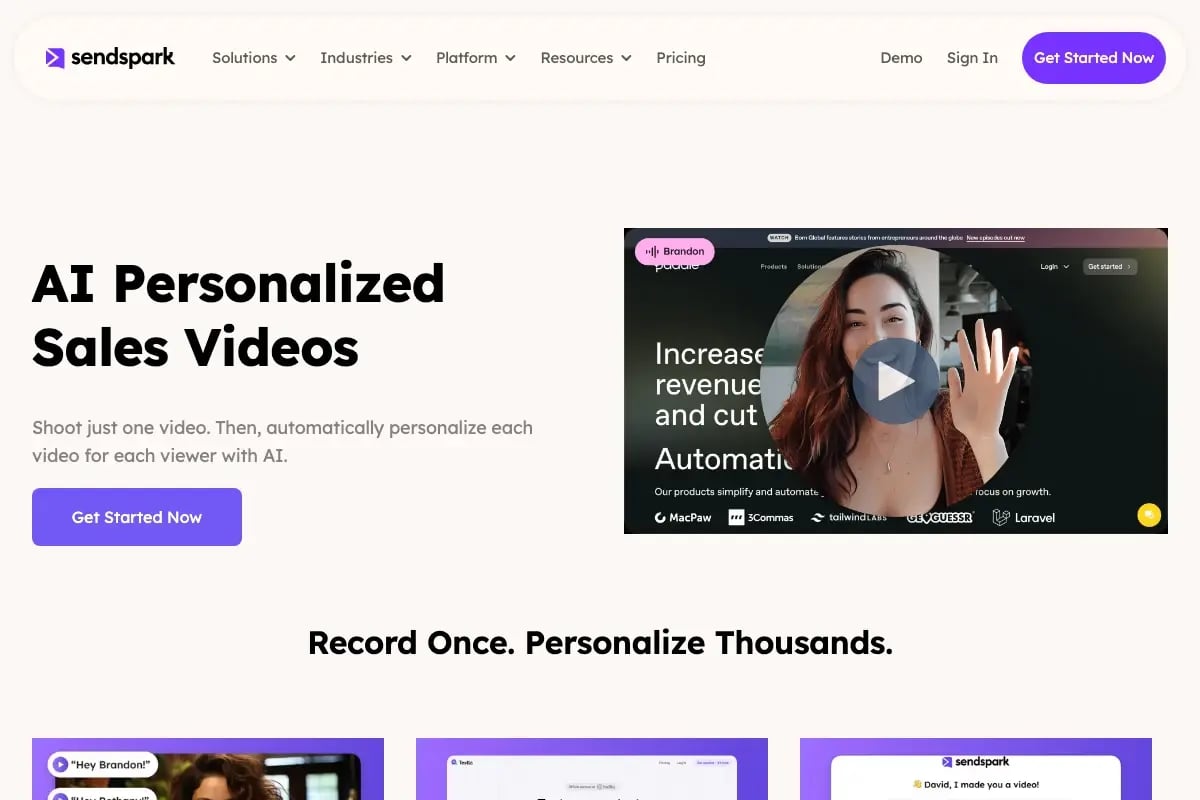
For maximum impact, send a 30-second AI-personalized video recap within 2 hours of your discovery meeting. Reference a specific pain point the prospect shared and outline one way your solution addresses it. This reinforces that you listened and keeps you top of mind while the prospect is still processing the conversation.
Discovery Meeting vs. First Sales Call: Knowing the Difference
Some teams use “discovery meeting” and “first sales call” interchangeably, but they are not the same. A first sales call is typically broader and may include an introduction to your company, an initial qualification, and sometimes a brief demo. A discovery meeting is narrower and deeper. It is exclusively about understanding the prospect’s situation, with no pitch and no demo. If your prospect has already been qualified through a previous conversation, the discovery meeting is where you go deep on their specific context before tailoring a solution.
Knowing when to use each depends on where the prospect is in your funnel. For inbound leads who have already shown intent, a discovery meeting is usually the right first step. For cold outbound prospects, a first sales call that includes light discovery may be more appropriate, since you are also establishing credibility from scratch.
Frequently Asked Questions
What is a discovery meeting?
A discovery meeting is a structured sales conversation where a rep investigates a prospect’s challenges, goals, and decision process before pitching a solution. Its purpose is to understand the prospect deeply enough to determine fit and tailor everything that follows. Discovery meetings typically last 30-45 minutes and follow a 4-phase structure: rapport, problem exploration, impact quantification, and next steps.
What happens during a discovery meeting?
During a discovery meeting, the sales rep asks open-ended questions to understand the prospect’s current state, pain points, and the impact of those pain points on their business. The rep listens actively, takes notes, and quantifies the cost of inaction. The meeting ends with an agreement on specific next steps, such as a follow-up call, a demo, or an introduction to other stakeholders. The rep does not pitch or demo during a discovery meeting.
What happens after a discovery meeting?
After a discovery meeting, the rep sends a follow-up within 24 hours that includes a written summary of what was discussed, confirmation of the agreed next steps, and any additional resources promised. High-performing reps also send a personalized video recap to reinforce the conversation. The prospect’s CRM record is updated with discovery notes, and the deal stage is advanced based on the buying signals uncovered during the meeting. If the deal is complex enough to involve multiple stakeholders and a longer cycle, this is also the right moment to introduce a mutual action plan, built together with the buyer rather than sent afterward.
What are examples of discovery questions?
Effective discovery questions include: “Walk me through how your team handles outbound prospecting today,” “What is the hardest part of that process right now,” “If nothing changes in the next two quarters, what does that mean for your targets,” and “Who else would need to be involved in evaluating a solution like this?” Good discovery questions are open-ended, specific to the prospect’s context, and organized by category: current state, pain points, impact, and decision process.
How is a discovery meeting different from a qualification call?
A qualification call checks whether a prospect meets your criteria using a framework like BANT or MEDDIC. A discovery meeting goes deeper, exploring the story and context behind the prospect’s challenges. Qualification asks “does this prospect fit?” while discovery asks “what does this prospect actually need?” For complex B2B deals, you need both, with discovery typically following initial qualification.
How long should a discovery meeting last?
A discovery meeting should last 30-45 minutes for most B2B sales scenarios. 30 minutes works for transactional deals or when the prospect has limited availability. 45 minutes allows for deeper exploration of complex buying situations. The key is to allocate time across four phases: 5 minutes for rapport, 12-18 minutes for problem exploration, 8-12 minutes for impact quantification, and 5-10 minutes for next steps.
Who should attend a discovery meeting?
For the selling side, a discovery meeting is typically run by an account executive or senior SDR. For complex enterprise deals, a sales engineer or solutions consultant may join. For the buying side, the primary contact who agreed to the meeting should attend, and you should encourage them to include anyone else involved in the evaluation. Asking “who else should be in this conversation?” early helps surface the buying committee before later stages.
Sources & References
- Gartner Sales — Discovery in B2B sales and its impact on buyer experience (2025)
- Gartner — B2B buyers complete 70% of research before speaking to sales (2025)
- Gong — Conversational intelligence data on discovery call question patterns and active listening (2025)
- RAIN Group — Top Performance in Sales Discovery research on diagnostic selling (2025)
- Forrester Research — 63% of B2B purchases require ROI justification before committee approval (2025)
Record One Video. AI Personalizes Thousands.
Sendspark is the AI video personalization platform for B2B sales. Record once, and AI voice cloning generates thousands of individually personalized videos with dynamic backgrounds and personalized thumbnails — each prospect hears their name, sees their website, in your voice. Sales teams see 2-3x more replies.
Get Started Now