Published October 2026
Most B2B SaaS deals do not start with a request for proposal. They start with a quieter, earlier document called a request for information (RFI), and it is the RFI, not the RFP, that decides which vendors even get invited to bid. An RFI typically goes out to eight, ten, or more vendors at once, often before anyone on the buying committee has a name attached to your product yet. Respond to it like a form letter and you never make the shortlist. Respond to it like a full proposal and you burn a week on a deal that was never winnable. This guide breaks down what actually separates an RFI from an RFP, how to decide whether a given RFI is worth answering, and how to make your response memorable enough to survive the cut.
Key Takeaways
- An RFI usually goes out to eight or more vendors at once, often before anyone on the buying committee has a name attached to your product. An RFP goes only to the shortlist that survives the RFI.
- Treating an RFI like a full proposal wastes real hours on deals that were never winnable, while treating it like a form letter gets you cut before the RFP stage even starts.
- Most RFP responses never advance to a shortlist at all, which means a surprising amount of the deal actually gets decided during the earlier, lower-effort RFI stage.
- A short personalized video addressed to the actual evaluator by name, not a generic “Dear Procurement Team,” is one of the few things that makes a response stand out in a stack of near-identical PDFs.
- Decline fast when a prospect clearly fails your ideal customer profile. A thorough RFI response can cost real internal hours on a deal that was never going to close.
RFI vs. RFP: What’s the Actual Difference?
An RFI (request for information) is an early-stage document a buyer sends to a wide list of vendors to learn who exists in a category and whether any of them are worth a closer look. An RFP (request for proposal) goes only to the vendors that survive that first cut, and asks for a detailed, scored proposal against a defined set of requirements. The RFI asks “who are you,” the RFP asks “prove you’re the one.”
A third document, the RFQ (request for quotation), shows up later still, once a buyer has already picked a solution approach and just needs a final price for an exactly defined scope. Most B2B SaaS deals only ever reach the RFI and RFP stages; an RFQ is more common for commodity purchases where the feature set is already settled.
| Document | When It’s Sent | What It’s Asking | Typical Number of Vendors |
|---|---|---|---|
| RFI (Request for Information) | Before a shortlist exists | “Who are you, and can you even do this?” | 8 to 20 or more |
| RFP (Request for Proposal) | After the RFI narrows the field | “Prove you’re the right fit, in detail, against our requirements” | 2 to 5 |
| RFQ (Request for Quotation) | After the RFP, once the approach is settled | “What’s the final price for exactly this scope?” | 1 to 3 |
That volume difference is the practical takeaway. An RFI is low-commitment to answer individually but high-volume across a sales team’s pipeline, while an RFP is the opposite: heavy effort, but reserved for the handful of deals that already cleared the first filter. Treating every inbound document like the last one is how teams either burn out on RFIs or under-invest in the RFPs that actually matter.
The wording also matters for how a response gets scored. An RFI is typically read informally, sometimes by a single procurement analyst building a longlist, and a strong answer just needs to be clear and credible. An RFP is almost always scored against a formal rubric by multiple reviewers, so vague or marketing-heavy language that worked fine in an RFI response can actually cost points once the same vendor reaches the RFP stage.
Where RFI and RFP Fit in a B2B SaaS Buying Process
RFIs and RFPs sit inside a longer, fairly linear enterprise buying sequence. A buyer defines its ideal vendor profile, issues an RFI to screen for fit, narrows to a shortlist, issues an RFP for a full proposal, runs a proof of concept, then routes the finalist through security and legal review before anyone signs. Knowing where you are in that sequence tells you how much effort a given document actually deserves.
Sendspark’s own coverage of enterprise deal progression tracks this exact sequence from a buyer’s first signal to a signed contract: building an ideal customer profile before you scale outreach, mapping the buying committee once multiple stakeholders get involved, formalizing a strategic account plan for named enterprise accounts, surviving the RFP response process once you make the shortlist, then clearing the prospect’s security review and legal review before the contract gets signed. An RFI sits right at the front of that sequence, often before a single named stakeholder has agreed to a call with your team.
That early position is also what makes an RFI harder to personalize than almost any other stage. Procurement, not the eventual end-user champion, usually owns the RFI, and a buying committee at this stage may not yet exist as named individuals your sales team can look up. For more on how our AI video personalization approach works when you have limited or imperfect contact information, our broader resource on outbound sales covers the groundwork this stage depends on.
How to Decide Whether to Respond to an RFI
Respond to an RFI only when the issuing company is close enough to your ideal customer profile that winning the deal would be a genuine fit, not just a theoretical possibility. A fast go or no-go call, made within a day of receiving the document, protects the hours a thorough response actually requires for the RFIs that are worth winning.
Run every inbound RFI through the same quick checklist before committing real time:
- Company fit. Does the issuing company’s size, industry, and stated use case match your ideal customer profile, or does the document read like a generic, vendor-agnostic template written for a different category entirely?
- Budget and scope signals. Does the RFI mention a project scope, rough budget range, or number of seats, or is it silent on anything that would let you size the opportunity?
- Timeline realism. Is the stated evaluation and implementation timeline plausible for a deal this size, or does it suggest procurement is still at the earliest stage of market research with no real urgency behind it?
- Named ownership. Is there any indication of an economic buyer or a defined evaluation committee, even if you cannot reach them directly yet?
- Requirement match. Do the actual questions being asked match what your product does, or do they describe a category you are adjacent to but do not really compete in?
Common mistake
Answering a vague, widely-distributed RFI with the same multi-day effort you’d put into a shortlisted RFP. Time-box an RFI response to a few focused hours: a clear overview of what you do, direct answers to the specific questions asked, and no custom slide deck.
Responding thoroughly to every RFI that lands in your inbox is not sustainable at scale. Responsive’s 2026 research on RFI practices found that 83 percent of procurement professionals use RFIs regularly, and a quarter of them issue more than 50 a year, which means a vendor on the receiving end of steady inbound demand can realistically see dozens of these a year. Keeping a tight, reusable core response and personalizing only the opening and the most relevant sections is what makes that volume manageable without burning out a sales or solutions team.
“What would have taken days was done in just two hours, an absolute game-changer in terms of efficiency.”
— Ben Johns, Senior Proposal Manager at Allego, via SiftHub
How to Stand Out When You’re One of a Dozen Vendors
Most RFI responses look identical: a PDF, a feature matrix, and a generic cover letter addressed to a department instead of a person. A short personalized video cover, paired with per-recipient analytics on who actually opened it, is one of the few differentiators left when a dozen vendors are all submitting the same format on the same deadline.
Buying committees reviewing a stack of RFI responses are scanning quickly, not reading closely, so a dense cover letter gets skimmed or skipped entirely. A 60 to 90 second AI-personalized video intro, recorded once by a rep and regenerated for each recipient with the evaluator’s own company website as the dynamic background, gives your response a human face before anyone opens the attached PDF. Because an RFI often lacks a single named point of contact, lead with the company name and the role title on the document (for example, “Head of Procurement at [Company]”) rather than forcing a first-name personalization you do not actually have.
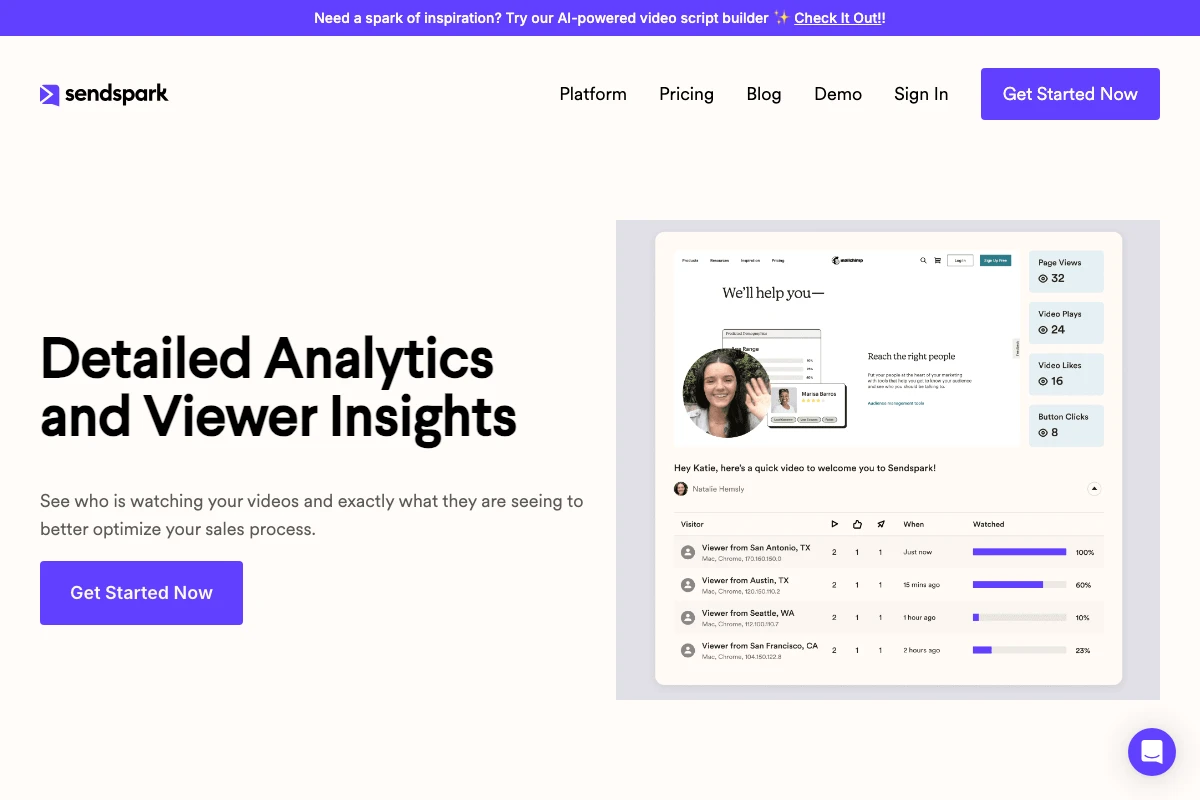
Since an RFI response frequently reaches several people on the evaluation committee independently, per-recipient video analytics showing who opened the video, how much of it they watched, and whether they clicked through to a scheduling link give a seller the first real signal of which evaluator is actually engaged, often days before anyone on the buying committee says so out loud.
Advanced strategy
Build a small library of RFI-specific video intros for your two or three most common buyer categories (for example, healthcare, financial services, general B2B SaaS), so personalizing a new RFI response becomes a swap of name, company, and background rather than a from-scratch recording every time.
For RFIs that ask you to walk through a specific capability in depth, pair the short personalized intro with a longer, reusable demo using a combined video: one short, AI-personalized greeting stitched to one longer, static walkthrough you only have to record once. The evaluator still gets a video addressed to them by name and company, but your team is not re-recording a full demo for every RFI that comes through.
From RFI to RFP: What Changes and How to Prepare
Making the RFP shortlist does not guarantee a win, and the competitive pressure actually tightens at this stage rather than loosening. Loopio’s analysis of RFP performance found that only 46 percent of RFP responses advance to a shortlist, down from 54 percent the year before, which means the RFI stage already eliminated most of the field before a single detailed proposal was written.
The RFP asks for depth, not breadth: specific requirements scored against a rubric, a live demo, references, and often a formal security questionnaire covering the same ground our guide to the B2B SaaS security review process walks through, plus the detailed Trust Center documentation available at security.sendspark.com. Many buying committees also expect a tighter procurement timeline once an RFP goes out than they ever committed to at the RFI stage, since the field has already been narrowed and internal pressure to decide starts building.
To prepare for that shift, use whatever engagement data your RFI response generated. If your per-recipient video analytics showed a specific evaluator watching closely or clicking through, that is the person worth a direct follow-up the moment the RFP lands, not a generic “thank you for advancing us” email sent to the whole committee at once. Carrying that engagement signal forward also gives your RFP response a head start: you already know which stakeholder cares most about which capability, so the opening of your proposal can speak directly to that instead of restating your entire pitch from zero.
| Dimension | RFI | RFP |
|---|---|---|
| Goal | Narrow a wide field of vendors | Score the narrowed field in detail |
| Audience | Often a department, not a named contact | A defined evaluation committee |
| Format | Short overview, high-level capability questions | Detailed, scored responses against requirements |
| Effort to answer well | A few focused hours | Days, often with legal and security input |
| Where personalization helps most | A short video intro that earns attention in a crowded stack | Per-recipient analytics showing exactly who on the committee is engaged |
Frequently Asked Questions
What does RFI stand for in B2B sales?
RFI stands for request for information. It is an early-stage procurement document a buyer sends to a wide list of vendors to learn who exists in a category and whether any of them deserve a closer look, well before a formal proposal process begins.
What is the difference between an RFI and an RFP?
An RFI goes to a broad list of vendors and asks general, high-level questions to build a shortlist. An RFP goes only to that shortlist and asks for a detailed, scored proposal against specific requirements. An RFI narrows the field; an RFP decides the winner.
Should I always respond to every RFI we receive?
No. Run a quick fit check against your ideal customer profile, budget signals, and timeline realism before committing real time. A vague, vendor-agnostic RFI with no clear fit is rarely worth a full response, while one that closely matches your ICP deserves a fast, focused one. Declining the clear non-fits is what gives a sales or solutions team the capacity to do a thorough job on the RFIs that are actually winnable.
How long should an RFI response take to prepare?
A well-prepared RFI response should take a few focused hours, not days. Keep a reusable core answer set for common questions and personalize only the opening and the sections most relevant to that specific buyer’s stated use case.
What comes after an RFI: RFP or RFQ?
An RFP almost always comes next. The RFI narrows a wide vendor list to a shortlist, and the RFP asks that shortlist for a detailed, scored proposal. An RFQ, which asks only for final pricing on an already-settled scope, typically comes later and is less common in B2B SaaS deals than in commodity purchasing.
Can personalized video actually help an RFI response stand out?
Yes. Most RFI responses are a PDF and a generic cover letter, so a short video addressed to the evaluator’s company and role stands out in a stack of near-identical submissions. Per-recipient analytics on who opened and watched the video also give a seller an early read on which evaluator is actually engaged.
Who typically reviews an RFI inside the buying company?
Procurement usually owns the RFI process, often before the eventual end-user champion has been looped in or named. That is why RFI responses are harder to personalize by first name than later-stage documents, and why addressing the company and role, rather than guessing at an individual, works better at this stage. Once the deal advances past the RFI, expect additional stakeholders, including security, legal, and the end-user team, to join the review.
Record One Video. AI Personalizes Thousands.
Sendspark records your video once, then clones your voice to greet each evaluator on a buying committee by name, in front of their own company's website.
Get Started NowSources & References
- Responsive: “83 percent of procurement professionals use RFIs regularly, and 25 percent issue more than 50 a year” (2026)
- CloudEagle, citing the Institute of Supply Management: “43 percent of organizations use RFIs to gather information on products or services” (2026)
- Loopio: “On average, companies progressed to the shortlist 46 percent of the time, down from 54 percent last year” (2026)
- SiftHub: attributed customer quote from Ben Johns, Senior Proposal Manager at Allego, on response-time efficiency (2026)