
Most B2B SaaS companies treat every RFP the same way: drop everything, assemble a tiger team, and grind out a 40-page response before the deadline. That instinct is usually wrong. The real first decision in any RFP response process isn’t how to answer the questions — it’s whether you should answer them at all. Buyers spend 67% of their time in B2B purchasing on internal discussion and research before a vendor ever sees the document, and producing a single response takes your team an average of 24 hours. Spend those hours on the wrong bid and you’ve burned a week your pipeline didn’t have.
This guide walks through the 7-step framework winning teams actually use, the go/no-go criteria that should kill most RFPs before you write a word, the mistakes that quietly disqualify strong products, and one tactic most B2B SaaS vendors still aren’t using: personalized video inside the response itself.
Key Takeaways
- A single RFP response takes an average of 23.8 hours to produce, so a disciplined go/no-go decision matters more than writing speed.
- Top-performing RFP teams win at 45-50%, mostly by reusing pre-approved content rather than adding headcount — they handle roughly 40% more RFPs a month than less mature teams.
- 61% of buyers say achieving vendor compliance (SOC 2, ISO 27001) was required to win or renew the contract, so security answers need to be pre-approved, not improvised under deadline pressure.
- RFPs are scored by multi-person buying committees — procurement, security, end users, and executives — and a written response can’t show you which of them actually engaged with your answer.
- Recording one personalized video response per section and tracking per-recipient watch data turns a blind submission into a visible, stakeholder-level signal.
What Is an RFP Response Process?
An RFP response process is the structured workflow a vendor follows to evaluate, write, review, and submit an answer to a buyer’s formal Request for Proposal — and the strategic decision of whether to pursue that deal at all. It’s not just a writing exercise. According to Responsive’s research citing APMP benchmark data, buyers spend the majority of their purchasing cycle — 67% of their time — on internal discussion and research before a vendor ever sees the RFP. By the time it lands in your inbox, a buying committee has often already formed an opinion about what they need.
That context matters because a response isn’t cheap to produce. A typical RFP response takes a proposal team an average of 23.8 hours to complete, spread across research, drafting, subject-matter-expert input, and compliance review. That’s close to three full working days of effort for one document — which is exactly why the next decision matters more than any sentence you’ll write in the response itself.
Should You Respond? The Go/No-Go Decision
You should respond to an RFP only when you have a realistic path to winning it — a warm relationship or credible entry point, a confirmed budget, a timeline that matches your sales cycle, and the ability to meet every “must-have” requirement without major gaps. If any of those are missing, decline or de-prioritize it, because the 24 hours you’d spend chasing a long shot are 24 hours you can’t spend on a deal you can actually close.
Run every inbound RFP through a short triage before anyone opens a blank document. A five-minute go/no-go call prevents a five-day scramble on a bid you were never going to win.
| Criteria | Go Signal | No-Go Signal |
|---|---|---|
| Relationship | Existing contact, referral, or prior conversation with the buying team | Cold, anonymous submission with no internal contact |
| Budget | Budget range disclosed and realistic for your pricing tier | No budget mentioned, or clearly below your solution’s cost |
| Requirements fit | You meet every “must-have” line item | Major capability gaps in non-negotiable requirements |
| Timeline | Decision date allows for a proper evaluation and demo cycle | Unrealistically compressed, suggesting a decision already made |
| Competitive field | Genuinely open market with multiple vendors under consideration | Sole-source or incumbent-favored — the RFP is a formality |
Common mistake
Treating every inbound RFP as mandatory. A blanket “always respond” policy drains your best proposal writers and SMEs on bids with no realistic path to close, while deals you could actually win sit in queue behind them.
If a bid fails two or more of these criteria, it’s a no-go — not a “write a weaker version and see what happens.” Your win rate on cold, unqualified RFPs runs closer to 10-20%, compared with 45-50% for teams that triage hard and only pursue bids they’re positioned to win, per Inventive’s 2026 benchmark data.
The 7-Step RFP Response Framework
A reliable RFP response follows seven steps: triage the opportunity, assign an owner, pull from a reusable content library instead of starting blank, draft technical sections with subject-matter experts, weave in differentiation instead of just compliance answers, run a legal and security review, then submit and follow up. Skipping any one of these is where responses fall apart under deadline pressure. That security review step often outlasts the RFP itself — our guide to passing a B2B SaaS security review covers how to keep it from stalling a deal the RFP already won.
- Go/no-go triage. Run the criteria above before assigning any work. Log the decision so the next RFP from the same buyer or industry has a reference point.
- Assign an owner and hold a kickoff. One person owns the response end to end. The kickoff meeting assigns sections to the right subject-matter experts — security, implementation, pricing — and sets the internal deadline, which should sit at least two days before the buyer’s actual due date.
- Build or reuse a content library. Don’t start from a blank page. Top-performing teams handle roughly 40% more RFPs a month (14-15 versus 10-11 for less mature teams) by reusing pre-approved answers and win themes instead of hiring more proposal writers.
- Draft with subject-matter experts, not just the proposal team. Security, engineering, and implementation questions need an accurate answer from the person who actually owns that area — a proposal writer paraphrasing secondhand information is where inaccurate answers creep in.
- Weave in win themes, not just compliance. Most RFP responses answer the literal question and stop. The ones that win also connect each answer back to a business outcome the buyer cares about — faster time-to-value, lower total cost, less implementation risk.
- Run a legal, security, and formatting review. A missing page-limit compliance or an unanswered security sub-question can disqualify an otherwise strong response before a human even reads the content. This is also where you confirm every certification claim is current — see the security section below.
- Submit, then follow up. Confirm receipt, offer to walk the committee through anything unclear, and stay visible through the evaluation window instead of going quiet until the decision date.
Record One Video. AI Personalizes Thousands.
Sendspark is the AI video personalization platform for B2B sales. Record once, and AI voice cloning generates thousands of individually personalized videos with dynamic backgrounds and personalized thumbnails — each prospect hears their name, sees their website, in your voice. Sales teams see 2-3x more replies.
Get Started NowCommon RFP Response Mistakes That Cost Deals
The mistakes that sink RFP responses are rarely about the product losing on merit — they’re execution failures: generic boilerplate that reads as low effort, missed formatting requirements that trigger automatic disqualification, no executive summary tying the response to business outcomes, security answers rushed at the last minute, and no follow-up plan after submission. Each one is avoidable with a documented process rather than a last-minute scramble.
| Mistake | Why It Costs Deals | The Fix |
|---|---|---|
| Generic boilerplate | Evaluators can tell when an answer was copy-pasted from another bid — it reads as low effort and low relevance | Customize every answer to the buyer’s stated use case, even when pulling from a content library |
| Ignoring formatting rules | Procurement teams disqualify responses that exceed page limits or use the wrong file format, often without reading further | Assign one reviewer whose only job is checking compliance with the RFP’s formatting instructions |
| No executive summary | Busy evaluators skim; without a summary that ties your answers to outcomes, your differentiation gets lost in the detail | Open with a one-page summary connecting your strongest three answers to the buyer’s stated goals |
| Rushed security answers | Vague or inconsistent security responses raise red flags with procurement and IT reviewers specifically | Pre-approve security and compliance language in advance, and keep your SOC 2 report request-ready |
| No follow-up plan | The response disappears into a black box, and you have no visibility into where it stands in the evaluation | Schedule a check-in within 48 hours of submission and offer a walkthrough before the decision date |
Advanced strategy
Build your security and compliance answers once, get legal sign-off, and store them alongside your SOC 2 report in a request-ready folder. Review your own plan’s security posture before an RFP deadline forces you to scramble for it.
Security questions deserve particular attention. Citing Secureframe’s 2026 survey, 61% of respondents said achieving compliance — SOC 2, ISO 27001, or similar — was required to win or renew a contract. If your own company holds a current SOC 2 Type 2 report, that’s exactly the kind of answer that should be pre-approved and ready, not drafted under deadline pressure. (Sendspark’s own SOC 2 Type 2 report and other compliance documentation are available through our Trust Center, for reference on how to structure this.)
Using Personalized Video to Strengthen Your RFP Response
Personalized video strengthens an RFP response by giving you visibility a written document can’t: proof of which specific evaluator on the buying committee actually engaged with your answer, and where. RFPs are typically part of a longer deal progression cycle, scored by multi-person committees — procurement, security, end users, and executives — and a static PDF gives you no signal about which of them read which section, or whether they read it at all.
The mechanism is straightforward. Record one video answering a specific RFP section — your implementation process, your security architecture, your onboarding timeline — once. Because Sendspark is an AI video personalization platform for B2B sales, AI voice cloning takes that single recording and personalizes it per evaluator: the video opens by addressing each committee member by name and role, and the dynamic background can show that specific evaluator’s own company website or LinkedIn profile behind you, rather than a generic company video. You’re not recording five separate videos for five stakeholders — you’re recording once and letting AI handle the rest. The same approach works for a personalized video email you send alongside the written document, not just the response itself.
“AI is fundamentally changing how revenue teams operate. We’re starting to see what’s possible when knowledge is no longer trapped in silos and AI agents help coordinate work across the entire pursuit. It’s early days, but the potential to shift how we qualify, collaborate, and win is enormous — and we’re building the foundation now.”
— Daniel Tscharner, Head of Bid Management at Swisscom, in Responsive and APMP’s 2025 State of Strategic Response Management report
The analytics layer is what makes this more than a nice-to-have. Per-recipient video analytics show you exactly which stakeholder opened the video, how much of it they watched, and whether they clicked a follow-up link — down to the individual evaluator. If your technical architecture section gets a 95% watch rate from the person tagged as your security reviewer but the procurement lead never opens it, that’s a concrete signal about where to focus your follow-up call, not a guess.
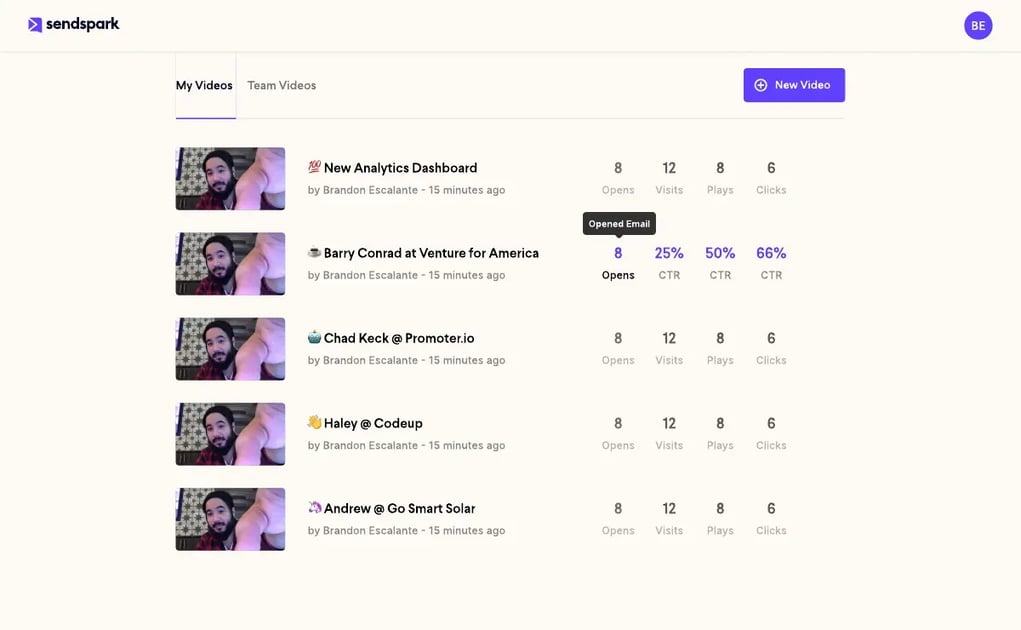
This isn’t a replacement for the written response — procurement will still require the formal document as the artifact of record. It’s a supplementary differentiator: link the video from your executive summary, or attach it alongside the sections it answers. For responses where a buying committee needs to agree on a vendor (the exact dynamic covered in our guide to multi-threading B2B deals), giving each stakeholder a version of your answer addressed to them, in your voice, costs you one recording — not one per person. And if your committee is already working from a mutual action plan or you’re mid-way through a proof of concept alongside the RFP, the same per-recipient analytics give you an objective read on engagement across both processes, not just a self-reported status update.
If your buying committee spans multiple departments with genuinely different priorities — which is the norm for enterprise deals — pair this with a documented strategic account plan so the personalization in your video responses lines up with the stakeholder map you’ve already built, rather than treating each RFP as a one-off.
| Approach | Evaluator Visibility | Effort per Stakeholder | Best For |
|---|---|---|---|
| Written response only | None — no way to see who read what | Fixed, one document for all | RFPs requiring a formal document as the sole deliverable |
| One generic video for the whole committee | Aggregate views only, no per-person data | Low — one recording | Smaller bids with a single decision-maker |
| AI-personalized video per evaluator | Per-recipient watch %, CTA clicks, by name and role | Low — record once, AI personalizes per recipient | Multi-stakeholder enterprise RFPs with a formal buying committee |
Published October 2026
Frequently Asked Questions
What is an RFP response process?
An RFP response process is the structured workflow a vendor uses to decide whether to pursue a Request for Proposal, then research, draft, review, and submit an answer within the buyer’s deadline. It includes a go/no-go decision, content development with subject-matter experts, a compliance review, and post-submission follow-up — not just the writing itself.
What are the 7 steps in an RFP response?
The seven steps are go/no-go triage, assigning an owner and holding a kickoff, building or reusing a content library, drafting with subject-matter experts, weaving in win themes beyond compliance, running a legal and security review, and submitting with a follow-up plan. Skipping any step is usually where strong products lose to weaker but better-executed responses.
How long does it take to respond to an RFP?
A single RFP response takes an average of 23.8 hours to produce, covering research, drafting, SME input, and review. Teams that reuse a pre-approved content library instead of starting from scratch can handle significantly more RFPs in the same amount of time.
What are common RFP mistakes to avoid?
The most common mistakes are generic boilerplate that reads as low effort, missing the RFP’s formatting or page-limit requirements, skipping an executive summary that ties answers to outcomes, rushing security and compliance answers, and having no follow-up plan after submission. Each of these is avoidable with a documented, repeatable process.
Should you always respond to an RFP?
No. You should only respond when you have a realistic path to winning — an existing relationship or credible entry point, a confirmed and realistic budget, a timeline that fits your sales cycle, and the ability to meet every must-have requirement. Responding to every inbound RFP regardless of fit drains your proposal team’s capacity on bids you were unlikely to win.
What is the role of an RFP in the B2B buying process?
An RFP standardizes how a buyer compares multiple vendors on the same criteria — pricing, capabilities, security, and implementation approach — inside a formal procurement process. For the vendor, it’s a high-stakes opportunity to demonstrate fit and differentiation to a buying committee that has typically already done significant internal research before the document goes out.
Sources & References
- Responsive, “11 Interesting RFP Statistics and What They Mean for You” — “67% of a buyer’s time in B2B purchasing is spent on internal discussion and research,” citing APMP benchmark data (2025)
- Responsive and APMP, 2025 State of Strategic Response Management report — “86% view bid and proposal teams as pivotal revenue drivers,” plus the attributed quote from Daniel Tscharner, Head of Bid Management at Swisscom (2025)
- Inventive, “RFP Response Trends, Benchmarks & Win Rates in 2026” — “a single RFP response takes an average of 23.8 hours to produce” and top teams win at 45-50% (2026)
- Bright Defense, “60 SOC 2 Compliance Statistics for 2026” — “61% of respondents said achieving compliance was required to win or renew a contract,” citing Secureframe’s 2026 survey (2026)
Record One Video. AI Personalizes Thousands.
Sendspark is the AI video personalization platform for B2B sales. Record once, and AI voice cloning generates thousands of individually personalized videos with dynamic backgrounds and personalized thumbnails — each prospect hears their name, sees their website, in your voice. Sales teams see 2-3x more replies.
Get Started Now