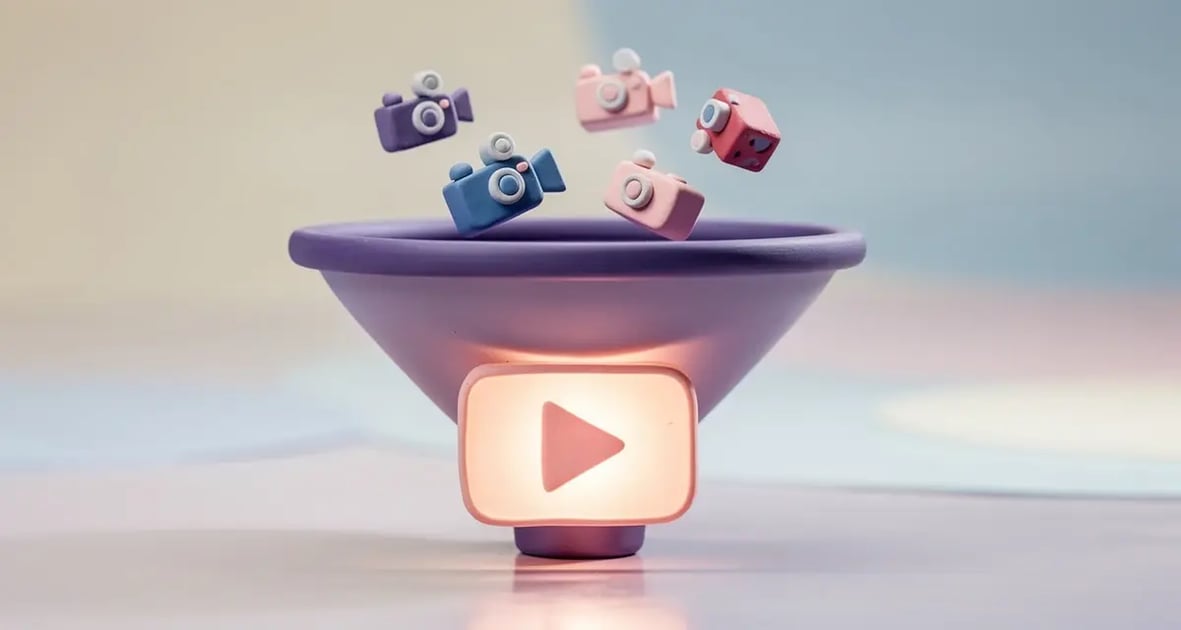
A video marketing funnel turns cold traffic into sales-ready leads by putting the right video, in front of the right prospect, at the right funnel stage — awareness, consideration, or decision. Done well, it hands your sales team a steady stream of warm leads instead of forcing them into expensive, low-reply cold outreach.
Updated August 2026
If your video marketing funnel needs a tune-up — or you don't have one yet — this guide covers what a video marketing funnel is, why it works, how to map one stage by stage, and how AI video personalization now lets you personalize every stage at scale instead of hand-recording a version for every segment.
Key Takeaways
- 91% of businesses now use video as a core marketing tool and 93% call it an important part of their strategy, according to HubSpot's 2026 State of Video report.
- A video marketing funnel maps different video formats to each stage — awareness (TOFU), consideration (MOFU), and decision (BOFU) — instead of using one generic video everywhere.
- AI video personalization now lets teams record one video and use AI voice cloning and dynamic backgrounds to personalize it for thousands of prospects at every funnel stage, without re-recording.
- Highly personalized outreach earns an 18% reply rate versus 9% for generic messages, per Salesforce's 2026 State of Sales report — a gap that widens further with personalized video.
- Video engagement metrics like watch-through rate now double as funnel-qualification signals, letting sales teams prioritize video-qualified leads (VQLs) the moment they show interest.
What Is a Video Marketing Funnel?
A video marketing funnel is a customer journey map that uses video content at each key touchpoint — from first discovery through purchase decision — to move prospects toward conversion faster than text or static content alone. Instead of one generic explainer video doing all the work, different video formats serve different stages of buyer intent.
A funnel is simply a way of visualizing the ideal customer journey: the touchpoints a prospect passes through with your brand before they convert. It's called a "funnel" because the numbers naturally taper as you move down it — some prospects drop off at every stage, and the job of funnel optimization is to lose as few of them as possible between milestones.
"Convert" means different things depending on where you are in the funnel. It might mean submitting an email address, booking a demo, or completing a purchase. In most B2B funnels, the critical conversion point is handing off a qualified lead from marketing to sales — traditionally a Marketing Qualified Lead (MQL), and increasingly a video-qualified lead based on engagement signals we'll cover later.
The simplest model splits the funnel into three stages: Top of Funnel (TOFU, awareness), Middle of Funnel (MOFU, consideration), and Bottom of Funnel (BOFU, decision). A video marketing funnel maps specific video content to each of these stages to keep prospects moving instead of stalling out. For the full strategic framework behind this, see our guide on B2B video marketing strategy, and for the underlying 2026 framework this guide builds on, check our video marketing strategy framework. This funnel approach also pairs naturally with a broader lead nurturing funnel if your buying cycle spans multiple touches over weeks or months.
Video for Every Funnel Stage: Awareness, Consideration, Decision
Video outperforms text and static images at every funnel stage because it builds trust faster, explains complex ideas more clearly, and keeps prospects engaged longer — but the right format changes dramatically from top to bottom of the funnel. Using the same video everywhere wastes its biggest advantage: relevance.
The case for video isn't just intuition anymore. According to HubSpot's 2026 State of Video report, 91% of businesses now use video as a marketing tool and 93% say it's an important part of their strategy — video has moved from "nice to have" to table stakes across B2B and B2C alike.
Video also helps with visibility and rapport, both of which matter throughout the funnel:
- Video on your website improves dwell time and reduces bounce rate — both signals search engines reward.
- Rich snippets that surface video in search results drive higher click-through on relevant queries.
- A face, a name, and a voice build rapport far faster than text — "people buy people," and video is the closest thing to a handshake you can send at scale.
Awareness stage (TOFU) video content
At the awareness stage, prospects are discovering you through search engines and social networks, and your content needs to be useful or entertaining around a problem they already have. The strongest formats here are:
- Educational content: demonstrations of how to do a task better, or how to evaluate a category of solution. Video lets you show instead of just tell.
- Brand and culture content: what it's like working with you — this builds the early rapport that later stages rely on.
- Explainer animations: useful for distilling complex or dry topics into something visually engaging.
Pro tip
Don't let cold leads go dark. A short, personal re-engagement video — using the prospect's name and a reference to what they viewed — consistently outperforms a generic "just checking in" email for reviving stalled TOFU leads.
Consideration stage (MOFU) video content
Once a prospect starts comparing you against alternatives, their questions change — and your video content needs to change with them. The most effective formats here include:
- Product demos and comparison videos: seeing the product in action is more convincing than reading a feature list.
- Case studies and testimonials: nothing beats hearing a satisfied customer say it in their own words. For a practical walkthrough of building this kind of content, see our post on techniques for creating compelling video content.
- Deeper educational content: more use cases and applications that show prospects value they hadn't considered — useful for nurturing leads who aren't ready to convert immediately.
Not everything belongs in video — pricing details, for instance, are usually clearer in writing.
Decision stage (BOFU) video content
At the bottom of the funnel, video's job is to remove the last bit of perceived risk and get the prospect over the line. The formats that work best here:
- Social proof at scale: stacking multiple testimonials reassures prospects that results aren't a one-off.
- Personalized videos: a direct, named appeal from a rep converts far better than a templated final-touch email.
- Tips and power-user advice: conversational, insider-feeling content that treats the prospect as already part of the relationship.
- Video sales letters: a full sales pitch delivered on video, saving your reps time on repetitive live pitches.
How to Map and Build Your Video Marketing Funnel
Building a video marketing funnel starts with mapping every touchpoint a prospect passes through from first awareness to conversion, then designing video content that maximizes the odds of them taking the next intended action at each one. Skipping the mapping step is the single biggest reason funnels underperform.
You could map your entire sales and marketing process as one giant funnel, from total strangers to paying customers — but that gets unwieldy fast, and oversimplifying it to stay manageable usually costs you the ability to optimize anything. It's more effective to zoom in on specific sub-funnels within that larger journey, such as:
- How you generate awareness and capture contact details via landing pages, social ads, or organic search.
- How you nurture email contacts until they're ready to talk to a sales rep.
- How you convert website visitors into demo or trial signups.
For each sub-funnel, identify three things: where the audience starts, what counts as conversion, and what could stop someone from taking the desired action at each step in between — plus what you could change to make that action more likely.
Take a landing page as an example. Ask yourself:
- Does the page immediately demonstrate relevance to what the visitor searched for? That first impression is a make-or-break touchpoint.
- Is it obvious what to do next? Unanswered questions leak prospects out of the funnel.
- Are there distracting UI elements pulling attention away — which is why many landing pages deliberately drop navigation back to the homepage?
- Is the CTA clear, and is the signup flow simple?
- Is there anything else nudging visitors along — a chatbot, an exit-intent offer, a personalized video?
Once you've mapped the touchpoints and flagged where prospects leak out, decide where video is genuinely the best tool for each one — it won't always be the right fit, but where it is, it tends to outperform every other format by a wide margin.
Record One Video. AI Personalizes Thousands.
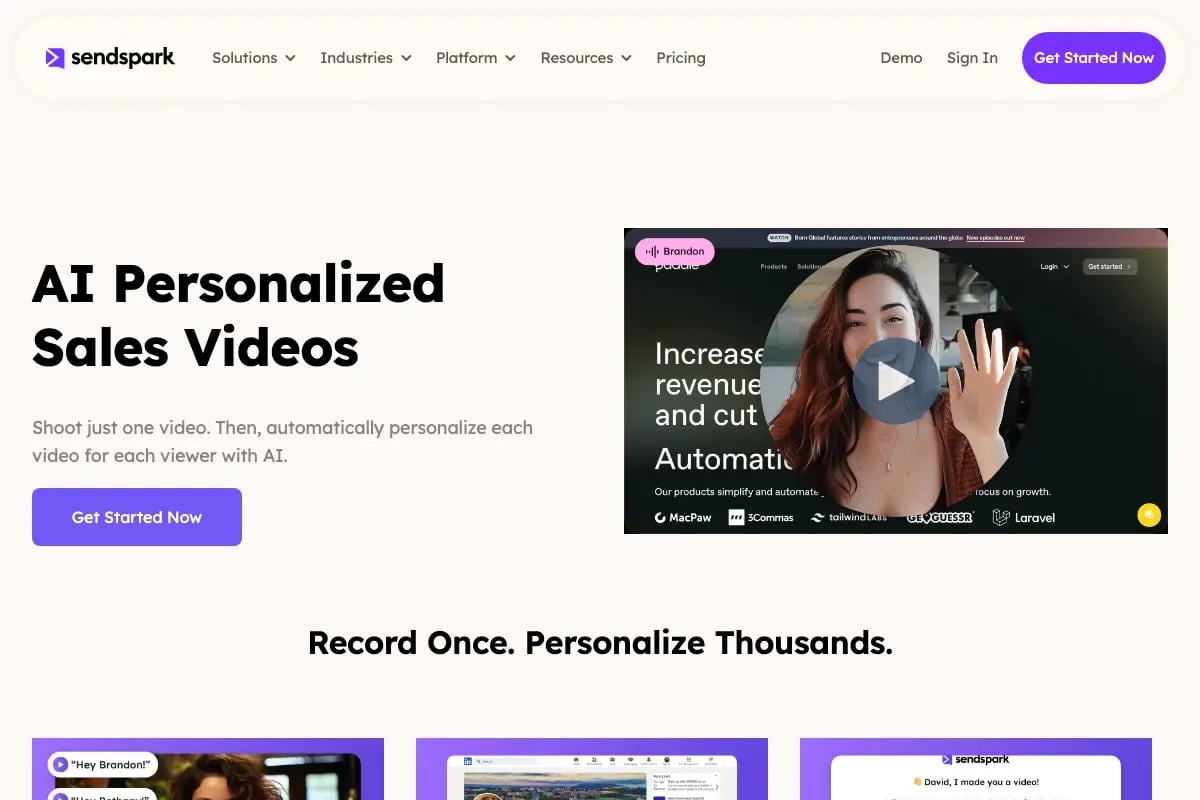
Sendspark is the AI video personalization platform for B2B sales. Record once, and AI voice cloning generates thousands of individually personalized videos with dynamic backgrounds and personalized thumbnails — each prospect hears their name, sees their website, in your voice. Sales teams see 2-3x more replies.
Get Started NowHow AI Video Personalization Powers Every Funnel Stage
AI video personalization lets marketing and sales teams record one video and use AI voice cloning and dynamic backgrounds to generate a uniquely personalized version for every prospect at every funnel stage — without re-recording a single take. That single shift changes what's actually possible at each stage of the funnel described above.
This wasn't a mainstream category when video marketing funnels were first popularized. But 2026 research from Gartner predicts 60% of brands will use agentic AI to deliver streamlined one-to-one interactions by 2028, and Forrester's 2026 B2B predictions describe B2B marketers approaching a tipping point in generative AI adoption for go-to-market motions. Video personalization at scale is one of the clearest, most measurable expressions of that shift — see our comprehensive guide to personalized video marketing strategy, examples, and AI scale for the full picture beyond the funnel context here.
Here's what changes at each stage:
- Awareness (TOFU): instead of a single generic explainer, account-based video personalization lets you swap in an account's name, logo, or industry into the intro of one base video — relevant at scale, without a production team per segment.
- Consideration (MOFU): AI-generated personalized thumbnails featuring the prospect's own website or company name dramatically increase open rates on nurture emails, because the video visibly looks made for them before they even press play.
- Decision (BOFU): a rep records one closing pitch, and AI voice cloning personalizes the prospect's name and deal specifics throughout — the "personalized video" tactic from the section above, but without asking a rep to record hundreds of individual takes using dynamic videos at scale.
These same capabilities are why more marketing teams are building this into their broader marketing use cases, not just treating it as a sales-outbound trick.
This is also reshaping how funnels get built for outbound-adjacent motions, not just inbound nurture — many teams now treat their outbound sequence as a digital sales room extension of the funnel, where every touch (LinkedIn, email, CRM task) triggers a fresh personalized video instead of a static template. The result, per Salesforce's 2026 State of Sales report, is that personalized cold emails generate a 32% higher response rate than non-personalized messages, and highly personalized outreach hits an 18% reply rate versus 9% for generic messages — a gap that widens further once the personalization is delivered on video instead of text.
Common mistake
Don't personalize everything just because you can. Swapping in a prospect's name and company logo is high-signal; over-stuffing a video with every scraped data point you own reads as invasive rather than relevant, and can tank reply rates instead of lifting them.
Measuring Funnel Performance: Video Engagement Metrics That Matter
The metric that matters most for a video marketing funnel isn't views — it's watch-through rate, because it tells you whether a prospect actually absorbed your message or bounced after three seconds. Pairing watch-through data with click and reply signals turns video engagement into a genuine funnel-qualification layer, not just a vanity number.
For a deeper walkthrough of setting this up, see our guide on using video analytics for sales follow-ups. Track these signals at each stage:
- Watch-through rate: the percentage of the video a viewer actually watched — a far stronger intent signal than an open or a click.
- Click-through on in-video CTAs: whether viewers acted on the specific next step you offered inside the video itself.
- Video engagement scoring: combining watch-through, replays, and CTA clicks into a single score that feeds your CRM alongside traditional lead-scoring inputs.
- First-party video signals: as third-party cookies phase out, engagement data collected directly from your own video player becomes one of the more reliable, consent-based signals left for qualifying interest.
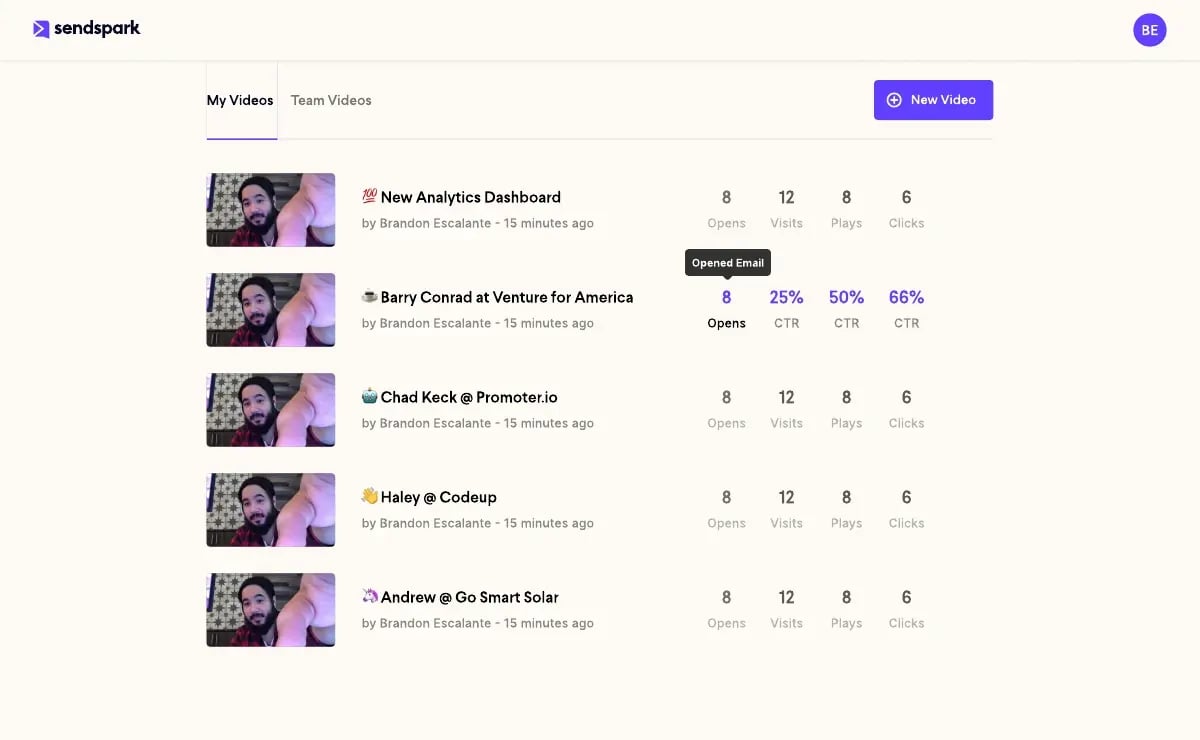
Combine these signals and you get a genuinely useful new category: the video-qualified lead — a prospect who has demonstrated real engagement with your video content (high watch-through, a replay, a click on an in-video CTA) and is worth prioritizing over one who merely opened an email. Routing VQLs straight to sales, ahead of leads that only cleared a generic MQL threshold, is one of the highest-leverage changes you can make to a video marketing funnel in 2026.
| Funnel Stage | Best Video Format | AI Personalization Angle | Primary Goal |
|---|---|---|---|
| Awareness (TOFU) | Educational, brand/culture, animation | Account-based intro personalization | Earn attention and trust |
| Consideration (MOFU) | Product demos, case studies, testimonials | Personalized thumbnails, dynamic backgrounds | Answer comparison questions |
| Decision (BOFU) | Personalized closing pitch, video sales letters | AI voice cloning for name/deal specifics | Remove final risk, close |
| Post-conversion | Onboarding, QBR recaps | Personalized thumbnails, dynamic backgrounds | Reduce churn, drive expansion |
Frequently Asked Questions
What is a video marketing funnel?
A video marketing funnel is a customer journey map that uses video content at each stage — awareness, consideration, and decision — to move prospects toward conversion faster than static content. Different video formats are matched to different stages of buyer intent rather than using one generic video everywhere.
How do I create a video sales funnel?
Start by mapping every touchpoint a prospect passes through from first contact to conversion, then decide where video is the strongest format at each one. Match awareness-stage content to educational and brand videos, consideration-stage content to demos and testimonials, and decision-stage content to personalized closing videos.
What type of video works best at each funnel stage?
Educational and brand-culture videos work best at the awareness stage, product demos and customer testimonials work best at the consideration stage, and personalized closing videos or video sales letters work best at the decision stage. Matching format to intent is more important than production quality.
How does AI video personalization improve funnel conversion rates?
AI video personalization lets a single recorded video be automatically customized with each prospect's name, company, or website using AI voice cloning and dynamic backgrounds, which drives higher reply and conversion rates than generic content. Salesforce's 2026 State of Sales report found highly personalized outreach earns an 18% reply rate versus 9% for generic messages.
What is a video-qualified lead (VQL)?
A video-qualified lead is a prospect who has shown strong engagement with your video content, such as a high watch-through rate, a replay, or a click on an in-video call-to-action. VQLs are typically worth routing to sales ahead of leads that only cleared a generic marketing-qualified-lead threshold.
How long should funnel videos be?
Awareness-stage videos should stay short and focused, typically under two minutes, while consideration-stage demos and testimonials can run slightly longer if every second adds new information. Decision-stage personalized videos work best kept tight and specific to the individual prospect rather than padded with general content.
Do personalized videos really increase conversion rates?
Yes. Personalization consistently outperforms generic content across email and video: personalized cold emails see a 32% higher response rate than non-personalized ones, according to Salesforce's 2026 State of Sales report, and that gap widens further when the personalization is delivered on video rather than text alone.
Sources & References
- HubSpot Blog — "91% of businesses use video as a marketing tool; 93% say it's an important part of their strategy" (2026)
- Gartner — "60% of brands will use agentic AI to deliver streamlined one-to-one interactions by 2028" (2026)
- Forrester — "B2B marketers approach a tipping point in their adoption of AI-enabled technologies" (2026)
- Salesforce State of Sales — "Personalized cold emails generate a 32% higher response rate; highly personalized outreach earns 18% reply rates vs 9% for generic emails" (2026)
- RAIN Group — "Top-performing sellers convert 52 of every 100 target contacts into meetings versus 19 for everyone else" (2026)
Record One Video. AI Personalizes Thousands.
Sendspark is the AI video personalization platform for B2B sales. Record once, and AI voice cloning generates thousands of individually personalized videos with dynamic backgrounds and personalized thumbnails — each prospect hears their name, sees their website, in your voice. Sales teams see 2-3x more replies.
Get Started Now