
Your email provider won’t let you attach that 400MB 4K video. Neither will Outlook. And while you could compress it down to 25MB, you’ll end up with something that looks like it was filmed on a 2010 flip phone. There are better options — and one of them turns the whole file-size problem on its head.
This guide covers five proven methods to send large video files, explains when each one makes sense, and shows why B2B sales and marketing teams have moved beyond file transfer entirely — using AI-powered video links that track who watched, for how long, and what they clicked.
Key Takeaways
- Gmail limits attachments to 25MB, Outlook to 20MB — a single minute of 4K video can hit 400MB, so attachments rarely work for professional video.
- The five main methods are: video hosting links, cloud storage, file transfer services, video compression, and platform-native large file support.
- For B2B sales and marketing teams, AI-powered video links (via Sendspark) solve the file-size problem and add personalization, analytics, and CRM tracking.
- Video link sharing gives recipients instant streaming — no download required, no quality loss.
- According to Sendspark customer data, AI-personalized video outreach sees 2-3x higher reply rates than text-only email.
Why Large Video Files Are Difficult to Send
Email providers cap attachments at 20–25MB because servers were designed for text-based messages, not media files. A 60-second video shot on a modern smartphone in 4K resolution can easily hit 400MB — sixteen times the Gmail limit. Even a 1-minute HD video averages around 130MB. The gap between what video cameras produce and what email servers accept has never been wider.
Here’s a quick look at the attachment limits for common platforms and how they compare to typical video file sizes:
| Platform | Attachment Limit | Equivalent Video Length |
|---|---|---|
| Gmail | 25 MB | ~17 seconds of 4K / ~11 seconds of 1080p HD |
| Outlook / Office 365 | 20 MB | ~13 seconds of 4K / ~9 seconds of 1080p HD |
| 16 MB (video) | ~10 seconds of 4K / ~7 seconds of 1080p HD | |
| Slack | 1 GB (free) / 5 GB (paid) | ~10 minutes of 4K / ~2 hours of 1080p HD |
| iMessage | ~100 MB (auto-compressed) | Visible quality loss on most videos |
Video compression can technically squeeze a file under the limit, but it always trades quality for size. A 400MB 4K recording compressed to 25MB loses resolution, sharpness, and audio quality — which is a real problem for sales demos, product walkthroughs, and training recordings where clarity matters. The better solution is to stop thinking of video as a file and start thinking of it as a link.
Common mistake
Compressing a video to meet an email attachment limit before sending it to a prospect. Compressed video looks unprofessional and signals low effort — the opposite of what you want in a first impression.
5 Methods to Send Large Video Files
There are five reliable ways to send large video files in 2026. Each has a different tradeoff between simplicity, quality, and business utility. The right choice depends on who you’re sending to and why.
Method 1: Video Hosting with a Shareable Link (Best for Business)
Upload your video to a hosting platform and share a streaming link instead of attaching the file. The recipient clicks the link and watches online — no download, no quality loss, no file size limit. For B2B use cases, Sendspark’s video hosting is the most capable option — it generates a personalized video link for each recipient and combines that with video link tracking, analytics, and CRM integration.
For a detailed breakdown, see our Sendspark vs Tavus.
Here’s how to do it with Sendspark:
- Install the Sendspark Chrome Extension — takes about 30 seconds and requires no standalone app download.
- Record or upload your video — click the Sendspark icon in Chrome to record new footage, or log into the web app and click “Upload Video” for existing files. Any resolution up to 4K is supported.
- Copy your video link — Sendspark instantly generates a streaming link. Click “Copy Link” from the extension or web app. Alternatively, select “Linked GIF” to copy both the link and an animated thumbnail — this is especially useful for embedding in email since it previews the video visually.
- Send the link — paste it into an email, LinkedIn message, Slack, or any other channel. Recipients stream the video from our servers — no download needed.

Record Once, Personalize at Scale
Stop recording the same video over and over. Sendspark uses AI to personalize your videos with each prospect's name and website — automatically. Sales teams see 2-3x more replies.
Get Started NowMethod 2: Cloud Storage (Google Drive, Dropbox, OneDrive)
Upload your video file to a cloud storage service, then share a link to the file. Google Drive, Dropbox, and OneDrive all support files in the gigabyte range, making them workable for long videos. The downside for business use: the viewer lands on a generic cloud storage page with no branding, no analytics, and no CTA. You also have no idea if they actually watched the video.
Best for: sharing video files internally with colleagues or clients you know well, where professional presentation isn’t critical.
Method 3: File Transfer Services (WeTransfer, Send Anywhere)
File transfer services like WeTransfer let you upload files up to 2GB (free) or 200GB (paid) and generate a download link with a 7-day expiry. The recipient downloads the full file rather than streaming it. This is fine for personal use — sending a wedding video to family, for instance — but it’s not suitable for business video outreach. Download links feel transactional, expire automatically, and provide no engagement data.
Best for: one-time large file sharing with individuals outside your regular workflow, especially non-business contexts.
Method 4: Video Compression
Tools like HandBrake (free, open-source) or online compressors reduce file size by lowering bitrate, resolution, or frame rate. A 400MB 4K video can be compressed to under 25MB — but the quality loss is significant. Text in screen recordings becomes blurry. Audio can become tinny or distorted. Faces look blocky in compressed video.
Best for: situations where you’re required to send an actual file (not a link), file size is the only option, and the recipient doesn’t care about quality — for example, quick internal screen recordings where content matters more than clarity.
Method 5: Platform-Native Large File Support
Some platforms handle large video differently. Slack allows video uploads up to 1GB on the free plan and 5GB on paid plans. Microsoft Teams integrates with SharePoint for virtually unlimited video storage. Apple’s AirDrop transfers large files locally without any size limit. These work well inside teams and organizations, but are not practical for sending video to external prospects, customers, or partners who aren’t on the same platform.
Best for: sharing video within a team using the same internal collaboration tool (Slack, Teams, etc.).
Method 6: Online Storage
Upload your video file to a cloud storage service, then share a link to the file. Google Drive, Dropbox, and OneDrive all support files in the gigabyte Google Drive, Dropbox, and OneDrive all support files range, making them workable for long videos. For teams managing large recordings, online storage can also help keep video files accessible without relying on email attachments or local devices.
How AI Video Links Changed Large File Sharing for B2B Teams
The file-size problem was the original reason video hosting links became popular for business. But AI-powered video links have moved well beyond just “a way to send a video without the attachment.” For B2B sales and marketing teams in 2026, the ability to send large videos is almost a secondary benefit — the primary value is AI video personalization at scale.
Record Once, Personalize for Every Recipient
Traditional large-file workarounds (cloud storage, file transfer) give every recipient the exact same video. AI video personalization changes that. With Sendspark’s AI Intros, you record a single video and the platform generates personalized versions for each recipient — automatically adding their name, company name, and even their own website as the video background. The file-size problem disappears because there’s no file; there’s a dynamic, personalized link.
Video Analytics: Know Exactly Who Watched What
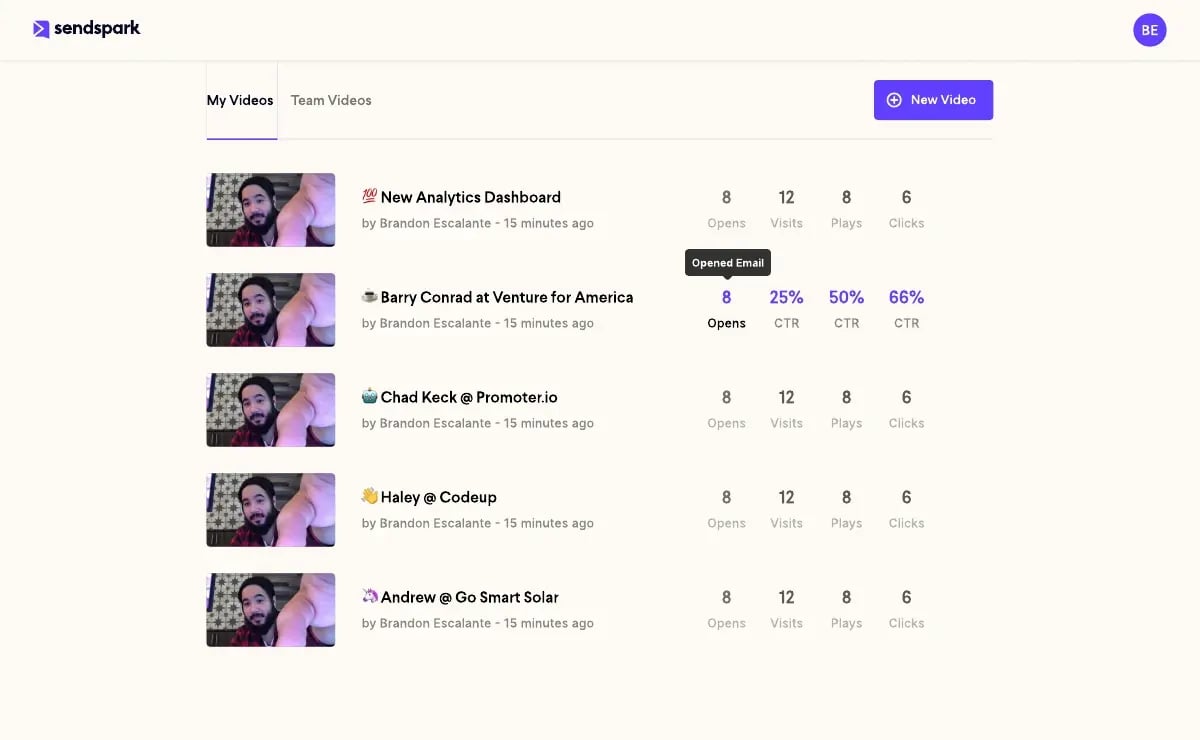
With a standard cloud storage link, you know if the link was clicked — nothing more. Sendspark’s video analytics track watch time per recipient, where they dropped off, and when they clicked your CTA. This video engagement data tells you which prospects are genuinely interested (they watched 90% of your demo) versus which ones clicked but bounced after 5 seconds.
For a sales rep managing 50+ active prospects, knowing who engaged with your video that morning is the difference between a well-timed follow-up call and a wasted one.
CRM-Integrated Video Sharing
Sendspark’s HubSpot integration and Salesforce integration log video views, watch time, and CTA clicks directly in the contact record. Instead of manually noting “sent video on Tuesday,” your CRM shows exactly how long Sarah at Acme Corp watched your product demo and whether she clicked the “Book a Demo” button. This CRM-integrated video sharing workflow turns video into measurable pipeline activity — not just content you sent and hoped for the best.
Advanced strategy
Set up a Sendspark automation that sends a follow-up email automatically when a prospect watches more than 75% of your video. This triggers exactly when their interest is highest — while your video is still fresh in their mind. See how in our complete guide to sending video through email.
AI Voice Cloning for High-Volume Outreach
For teams running high-volume outbound campaigns, manually recording individual personalized intros isn’t scalable. Sendspark’s AI voice cloning clones your voice from a short sample recording and generates a personalized spoken intro for each prospect — using their name and company. You record the main body of the video once; AI handles the personalized opening. This makes B2B video outreach genuinely scalable at volumes of 500+ prospects per week without losing the personal feel.
For a deeper look at how to structure personalized AI-personalized videos from first contact through close, see our post on how to make personalized video emails.
Best Practices for Sending Large Video Files
Whether you’re sending a 30-second sales intro or a 45-minute product training session, these practices improve the experience for both sender and recipient.
Match Your Method to Your Audience
Use a video hosting link (Sendspark, YouTube unlisted) for business outreach and customer-facing video. Cloud storage works for internal team sharing. File transfer services fit one-off personal sharing. Don’t use a WeTransfer link to send a prospect their first product demo — it sets the wrong tone. For B2B sales prospecting, a branded video landing page with a clear CTA converts significantly better than a raw file download link.
Keep Business Videos Under 3 Minutes
Viewer attention fades quickly on longer videos. For prospecting, aim for 60-90 seconds. Save longer videos (demos, webinar recordings, onboarding) for recipients who’ve already opted in to your content. A 10-minute demo video hosted and tracked via Sendspark tells you exactly how much of it your prospect actually watched — giving you data to have a smarter follow-up conversation.
Add a Thumbnail or Animated Preview
AI-personalized videos with a dynamic video thumbnail — an animated GIF that plays in the inbox — get higher click-through rates than plain text links. Sendspark automatically generates this dynamic video thumbnail from your video that you can embed directly in Gmail or Outlook. When the recipient sees a moving preview in their inbox, they’re more likely to click through to the full video. This is a significant advantage over a plain cloud storage URL.
For examples of what high-performing AI-personalized videos look like, see our personalized video email examples post.
Test the Link Before Sending
Open the video link in an incognito browser window before sending it to a prospect or a list. Verify the video plays, the thumbnail looks correct, and the CTA button works. A broken video link in a cold email is worse than no video at all — it signals carelessness. Sendspark shows a real-time preview of exactly what your recipient will see before you copy the link.
Send at the Right Resolution
For screen recordings and product demos: 1080p is the sweet spot. It’s sharp on any screen, streams quickly, and doesn’t require the massive file sizes of 4K. For talking-head videos recorded on a phone: 1080p 30fps is fine. Save 4K for high-production content like company brand videos where the extra sharpness is worth the larger file. Sendspark supports up to 1080p streaming, preserving full quality without any compression.
Quick Comparison: 5 Methods for Sending Large Videos
| Method | File Size Limit | Quality Loss | Analytics | Best For | Cost |
|---|---|---|---|---|---|
| Sendspark video link | No limit | None (up to 1080p) | Full (watch time, CTA, CRM) | B2B sales & outreach | From $49/mo |
| Google Drive | 5TB (paid) | None | View count only | Internal sharing | Free / Google One |
| WeTransfer | 2GB (free) / 200GB (paid) | None | Download notification only | One-time large file transfers | Free / from $12/mo |
| Video compression | Reduced to meet limit | Significant | None | When file delivery is required | Free tools available |
| Platform-native (Slack/Teams) | 1–5GB (Slack) / large (Teams) | None | None | Internal team video | Included in platform |
Frequently Asked Questions
How to send large video files?
The best way to send large video files is to upload the video to a hosting platform and share a streaming link — this avoids file size limits entirely and preserves full quality. For business use, Sendspark generates a shareable link instantly from any video upload or recording. For personal sharing, cloud storage (Google Drive, Dropbox) or file transfer services (WeTransfer) are reliable free options.
How to send large video files via email?
To send a large video file via email, upload the video to Sendspark, Google Drive, or Dropbox and paste the shareable link into your email body. Gmail limits attachments to 25MB and Outlook to 20MB — most videos exceed this quickly. A streaming link bypasses both limits while giving recipients instant playback without downloading anything. For Gmail specifically, Sendspark’s animated GIF preview embeds directly in the email body.
What is the best way to send large video files for free?
For free large video file sharing: Google Drive (up to 15GB free storage) or WeTransfer (up to 2GB per transfer, links expire in 7 days). Sendspark’s 7-day free trial adds link sharing with viewer analytics. The best free option depends on whether you need streaming (Google Drive) or one-time file delivery (WeTransfer). Compression tools like HandBrake are also free but reduce video quality significantly.
How large is a 1-minute HD video file?
A 1-minute HD video (1080p at 30fps) averages around 130MB as an uncompressed recording. A 1-minute 4K video (2160p at 30fps) runs approximately 375–400MB. This is why standard email attachment limits (20–25MB) make it essentially impossible to send even short HD videos as email attachments — they’re 5–20x over the limit before any editing or processing.
How do you send a long video in an email?
To send a long video in an email, convert it to a shareable link rather than attaching the file. Upload the video to Sendspark or another hosting platform, copy the link, and paste it into your email. For the best click-through rate, use Sendspark’s “Linked GIF” option — this embeds an animated thumbnail in the email so recipients can preview the video before clicking. Most email clients (Gmail, Outlook) support this format natively.
What platform should I use to send large video files for business?
For B2B sales and marketing, Sendspark is the most capable option — it combines no-limit video hosting with AI video personalization, watch-time analytics, and CRM integration with HubSpot and Salesforce. For basic business file sharing with colleagues, Google Drive or Microsoft OneDrive work well. For external clients where professional presentation matters, Sendspark’s branded video landing pages make a better impression than a plain cloud storage link.
How do I know if my video file is too large to send as an attachment?
Your video is too large to send as an email attachment if it exceeds 25MB (Gmail) or 20MB (Outlook). For reference: a 10-second 4K clip is already close to the Gmail limit. Any recording over 30 seconds at HD quality will typically exceed both limits. The reliable solution is to always use a video hosting link for email delivery rather than trying to stay under attachment limits.
Sources & References
- Google Support — “Gmail has a maximum attachment size of 25MB” (2024)
- Microsoft Support — “For internet email accounts such as Outlook.com or Gmail, the email size limit is 20 megabytes (MB).”
Record Once, Personalize at Scale
Stop recording the same video over and over. Sendspark uses AI to personalize your videos with each prospect's name and website — automatically. Sales teams see 2-3x more replies.
Get Started NowTopics: Tips & Tricks