
Less than half of sales leaders trust their own forecast. According to Gartner’s State of Sales Operations Survey, only 45% of sales leaders and sellers have high confidence in their organization’s forecasting accuracy — which means most B2B revenue teams are building budgets, hiring plans, and board updates on numbers they don’t fully believe. The problem usually isn’t effort. It’s method: most teams pick a forecasting approach by default (usually whatever their CRM does out of the box) instead of matching the method to their data maturity and sales cycle.
This guide compares eight sales forecasting methods side by side, shows you how to pick the right one for your team’s stage, and covers the mistakes that quietly skew forecasts even when the method itself is sound.
Key Takeaways
- Only 45% of sales leaders and sellers have high confidence in their forecast accuracy, according to Gartner’s State of Sales Operations Survey.
- Stage-based (weighted pipeline) forecasting is the most widely used method, but it tops out around 60-75% accuracy when CRM data hygiene is inconsistent, per Clari’s 2026 benchmarking.
- Deal-level machine learning forecasting can reach 75-90% accuracy — a 20-30% improvement over stage-weighted approaches alone, according to Clari.
- The right method depends on data maturity and team size: early-stage teams should start with historical/trend-based forecasting, while teams with 12+ months of clean CRM data can layer in weighted-pipeline or AI-driven models.
- Forecasts built only on CRM stage movement miss qualitative deal-risk signals — buying-committee turnover, engagement drop-off, stalled follow-ups — that surface earlier in call and video activity than in a stage change.
What Is Sales Forecasting?
Sales forecasting is the process of estimating future revenue by analyzing pipeline data, historical close rates, and deal-level signals over a set period — typically a month, quarter, or fiscal year. It’s the number finance, leadership, and the board plan around, which is why forecast accuracy matters more than forecast optimism.
The accuracy problem is bigger than most teams admit. Gartner’s State of Sales Operations Survey found that less than 50% of sales leaders and sellers have high confidence in their organization’s forecast accuracy, and only 47% believe their organization’s underlying pipeline data is high quality. That combination — low confidence and questionable data — is exactly why picking the right sales forecasting methods for your team’s stage matters more than picking the most sophisticated one.
“Heads of sales operations are under constant pressure to produce accurate forecasts to help shape decision making.”
— Craig Riley, Senior Principal Analyst, Gartner Sales Practice
That pressure is exactly why so many teams default to whatever forecasting view their CRM ships with, rather than choosing a method that fits their actual data maturity. The next section breaks down the eight most common approaches so you can see where yours fits.
8 Sales Forecasting Methods Compared
The eight most common sales forecasting methods range from simple historical extrapolation to AI-driven deal-level modeling, and each trades off setup effort against accuracy. Teams with less than a year of clean CRM data should start with simpler methods; teams with mature pipelines and consistent stage hygiene get the most value from weighted or AI-driven models.
| Method | Best For | Data Required | Setup Effort |
|---|---|---|---|
| Historical/trend-based | Stable, mature product lines with limited history | 1+ years of sales data | Very low |
| Straight-line | Early-stage teams, quick budget checks | Minimal | Very low |
| Length-of-cycle | Long, complex enterprise sales cycles | Historical cycle-length data by segment | Moderate |
| Top-down | Market-sizing checks, early planning | Total addressable market estimates | Low |
| Bottom-up | Teams that want rep-level accountability | Rep-level pipeline and quota data | Moderate |
| Qualitative/judgmental (Delphi) | New products or markets with no history | Expert or panel input | Moderate |
| Weighted pipeline (stage-based) | Mid-market teams with established CRM hygiene | Consistent stage definitions and win-rate history | Moderate |
| Deal-level AI/ML forecasting | Teams with 12+ months of clean CRM and engagement data | Large historical dataset across many fields | High |
Each method answers a slightly different question, and understanding which question you’re actually asking is the fastest way to stop misusing one:
- Historical/trend-based forecasting applies last year’s growth rate or seasonal pattern to this year’s number. It’s a fast directional check, not a deal-level prediction — it assumes the future looks like the past, so it breaks down the moment your market, product, or team headcount changes materially.
- Straight-line forecasting divides total pipeline value evenly across the remaining periods in a quarter. It’s the simplest method to set up and the easiest to explain to a board, but it ignores deal-level probability entirely and tends to smooth over real volatility.
- Length-of-cycle forecasting uses your historical average time-to-close by segment to predict when open deals should close, and flags deals that have overstayed their typical cycle as at-risk rather than just “still open.” This is one of the better tools for catching the “zombie pipeline” problem, where reps leave stale deals open to pad next quarter’s number.
- Top-down forecasting starts from a market-level number (total addressable market, category growth rate) and works down to a team target. It’s useful for early planning and board conversations, but it isn’t grounded in your actual pipeline, so it should never be the only method a team relies on.
- Bottom-up forecasting starts from individual rep pipelines and quotas and rolls them up into a team number. It creates clearer rep-level accountability than top-down forecasting, but it’s only as accurate as each rep’s honesty about their own deals — which is exactly where sandbagging and happy-ears optimism creep in.
- Qualitative (Delphi-style) forecasting replaces historical data with structured input from a panel of experienced reps, managers, or subject-matter experts, usually gathered anonymously and refined over a few rounds. It’s the right tool for a brand-new product or market where no historical data exists yet.
- Weighted pipeline (stage-based) forecasting multiplies each open deal’s value by a probability tied to its CRM stage — a deal in “Proposal” that historically closes 50% of the time contributes half its value to the forecast. According to Clari’s 2026 forecasting research, this is the industry-standard method for mid-market B2B teams, but it’s also the method most vulnerable to bad data: Clari found that only 60-70% of CRM fields are consistently populated across B2B organizations, which directly caps how accurate a stage-based forecast can be.
- Deal-level AI/machine learning forecasting analyzes hundreds of signals per deal — engagement patterns, email response times, meeting cadence, historical win/loss data — instead of relying on a single stage-based probability. Clari’s benchmarking found deal-level ML forecasting can reach 75-90% accuracy, a 20-30% improvement over stage-weighted approaches alone, but it requires enough historical data and consistent tracking to train on.
Pro tip
Most B2B teams don’t need to pick one method — they need a primary method (usually weighted pipeline) plus one sanity-check method (usually length-of-cycle) to catch stalled deals the primary method alone would miss.
How to Choose the Right Forecasting Method for Your Team
The right forecasting method depends on three factors: how much clean historical data you have, how long your sales cycle runs, and how consistently your team updates CRM stages. A team with less than a year of data should start simple; a team with mature CRM hygiene and 12+ months of history can layer in more sophisticated models without the added complexity backfiring. If your sales cycle is the bottleneck, it helps to think in terms of sales velocity rather than forecast accuracy alone — shortening the cycle-length lever compounds into faster, more predictable revenue regardless of which forecasting method you pick.
Use this as a starting filter, not a rigid rule:
- Under 12 months of CRM data, or a brand-new product line: start with historical/trend-based or straight-line forecasting. Anything more sophisticated will overfit to noise you don’t have enough data to explain.
- 12+ months of data, inconsistent stage hygiene: length-of-cycle forecasting is often more reliable than weighted pipeline, because it doesn’t depend on reps accurately updating stage probabilities — it just tracks whether a deal is moving at its normal pace.
- 12+ months of data, consistent stage definitions and win-rate history: weighted pipeline (stage-based) forecasting becomes viable and is usually the right default for a mid-market B2B team.
- Long sales cycles with multiple stakeholders (typical of Series A-D B2B SaaS selling into 50-500 employee companies): combine weighted pipeline with length-of-cycle as a cross-check, since a single stalled stakeholder can freeze a deal’s stage for months without triggering a probability change.
- Enough volume and history to train a model (usually 12+ months, hundreds of closed deals): deal-level AI/ML forecasting delivers the highest accuracy ceiling, per Clari’s benchmarking, but isn’t worth the setup cost for smaller pipelines.
Whatever method you land on, RevOps should own the forecasting process end to end — including which method is used, how often it’s recalibrated, and who’s accountable for data hygiene. Our guide to structuring a RevOps team covers who should own that responsibility as your team scales, and our RevOps overview covers how forecasting fits into the broader function. If you’re still building out the earlier stage of the funnel that feeds this pipeline, our comprehensive guide to video prospecting covers how personalized outreach affects the deal volume a forecast is built on.
Record One Video. AI Personalizes Thousands.
Sendspark is the AI video personalization platform for B2B sales. Record once, and AI voice cloning generates thousands of individually personalized videos with dynamic backgrounds and personalized thumbnails — each prospect hears their name, sees their website, in your voice. Sales teams see 2-3x more replies.
Get Started Now5 Sales Forecasting Mistakes That Skew Your Numbers
Most forecast misses trace back to one of five recurring mistakes: stale CRM stages, sandbagging or happy-ears optimism, unweighted deal values, ignoring qualitative deal-risk signals, and forecasting in isolation from RevOps. Fixing the method you use matters less than fixing these, since a good method built on bad inputs still produces a bad number.
| Mistake | Why It Skews the Forecast | Fix |
|---|---|---|
| Stale CRM stages | Deals sit in outdated stages for weeks, inflating weighted-pipeline probability | Enforce weekly stage reviews tied to specific exit criteria per stage |
| Sandbagging or happy ears | Reps under- or over-report deal likelihood based on incentive or optimism, not evidence | Cross-check rep-reported probability against length-of-cycle and engagement data |
| Unweighted deal values | Treating every open deal as equally likely to close overstates the forecast | Apply stage- or model-based probability weighting, never raw pipeline value |
| Ignoring qualitative signals | CRM stage alone misses buying-committee turnover and engagement drop-off | Layer in call, email, and video engagement data as a leading indicator |
| Forecasting in isolation from RevOps | Sales-only forecasts miss marketing pipeline contribution and renewal/expansion signal | Give RevOps ownership of the forecasting process and cadence, per the RevOps team structure guide |
Common mistake
Treating a weekly pipeline review as a forecast call. A pipeline review inspects deal health; a forecast call commits a number. Blending the two encourages reps to defend their pipeline instead of surfacing real risk.
How Deal Visibility Improves Forecast Accuracy
Deal visibility improves forecast accuracy by surfacing risk signals that CRM stage data misses entirely — buying-committee changes, engagement drop-off, and stalled follow-ups all show up in deal activity well before a stage field gets updated. McKinsey’s 2026 Global B2B Pulse survey, which gathered responses from nearly 4,000 B2B decision-makers across 13 countries, found that 52% of B2B buyers would stop working with a supplier whose teams give inconsistent information — a sign of how easily a deal can quietly go cold across a buying committee without a single CRM stage ever changing.
The same McKinsey research found that B2B buyers now use an average of ten touchpoints across in-person, remote, and digital channels during a single purchase journey. A stage-based forecast built only on the primary contact’s activity has no way of seeing whether the other nine touchpoints are actually engaged — which is exactly the qualitative gap that pipeline stage data alone can’t close.
This is where deal progression tools built for visibility, not just pipeline tracking, add real signal. Sendspark is an AI video personalization platform for B2B sales that lets reps record one video and use AI voice cloning and dynamic backgrounds to personalize it for every stakeholder in a deal — and its video analytics track opens, plays, watch time, and CTA clicks per recipient. For a deal with five buying-committee members, that means a rep (and their manager, during a pipeline review) can see exactly which stakeholders have gone quiet weeks before the deal’s CRM stage would ever flag it as at-risk – exactly the visibility a mutual action plan is built to surface at the milestone level, not just the deal-stage level. That same engagement data is also worth feeding into a win-loss analysis once the deal closes, to check whether what a buyer says in an interview actually matches what they watched and clicked.
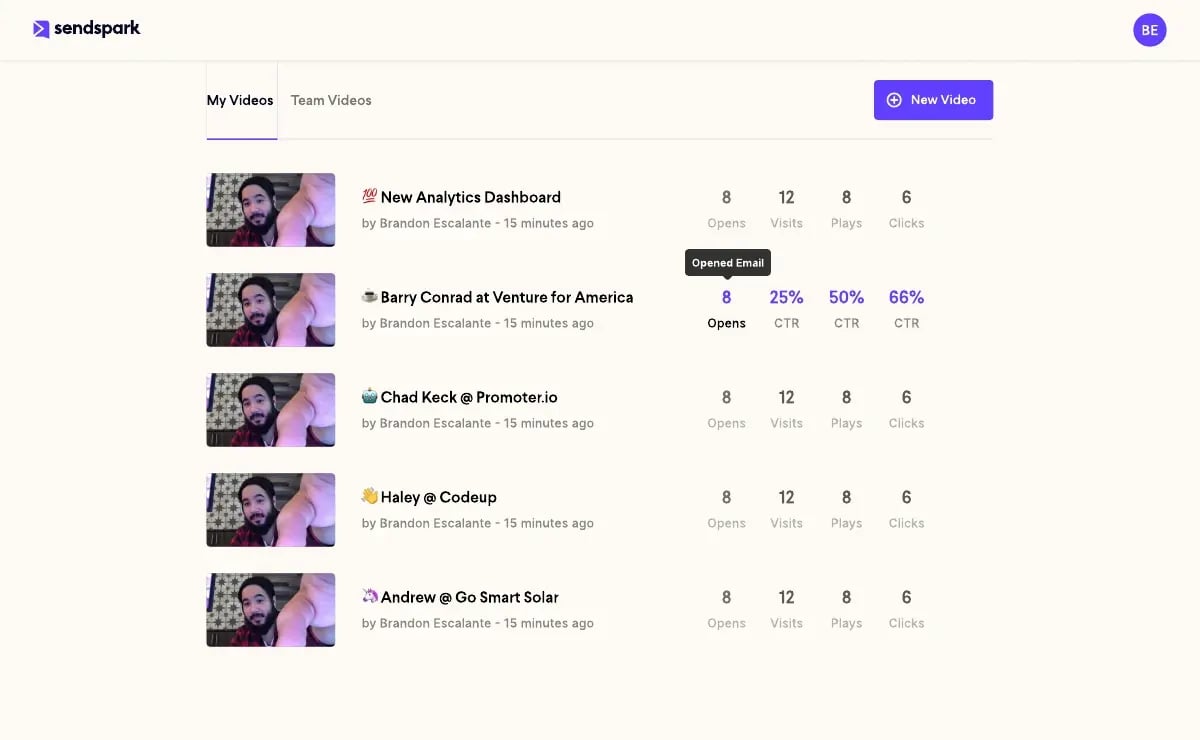
Advanced strategy
During weekly pipeline reviews, ask managers to check per-stakeholder video engagement alongside CRM stage before accepting a rep’s forecast category. A “Commit” deal with three cold stakeholders out of five is a different risk profile than one with five actively engaged, even at the identical CRM stage.
None of this replaces a structured forecasting method — it supplements one. Teams that pair a weighted-pipeline or deal-level AI forecast with real engagement visibility catch the deals that look healthy on paper but are quietly stalling, which is exactly the gap between the 45% of leaders who trust their forecast and the 55% who don’t.
Quick reference: matching forecast method to team stage. Use the table below to sanity-check the method (or method pair) you chose in the section above against your team’s current stage:
| Team Stage | Primary Method | Sanity-Check Method |
|---|---|---|
| Pre-product-market fit / new product line | Qualitative (Delphi-style) | Top-down (market-sizing) |
| Early-stage, under 12 months of CRM data | Historical/trend-based or straight-line | Bottom-up (rep-level rollup) |
| Mid-market, established CRM hygiene | Weighted pipeline (stage-based) | Length-of-cycle |
| Enterprise, long multi-stakeholder cycles | Weighted pipeline + deal engagement visibility | Length-of-cycle |
| Mature, 12+ months clean data, high deal volume | Deal-level AI/ML forecasting | Weighted pipeline |
Frequently Asked Questions
What is the most accurate sales forecasting method?
No single method is universally most accurate — accuracy depends on data quality and maturity. Clari’s 2026 benchmarking found deal-level AI/machine learning forecasting can reach 75-90% accuracy versus 60-75% for stage-based weighted pipeline forecasting, but only when a team has enough clean historical data to train the model on.
Can you forecast sales without historical data?
Yes, using qualitative (Delphi-style) or top-down forecasting, which rely on expert judgment or market-sizing estimates instead of historical close rates. These methods are less precise than data-driven approaches but are the standard starting point for a brand-new product or market where no sales history exists yet.
What is the difference between sales forecasting and pipeline management?
Pipeline management is the ongoing process of tracking and progressing individual deals through stages, while sales forecasting uses that pipeline data (plus historical trends) to predict future revenue. A weekly pipeline review inspects deal health; a forecast call commits a specific revenue number based on that pipeline.
How often should you update your sales forecast?
Most B2B teams update deal-level pipeline data weekly and recalibrate the overall forecast number at least monthly, with a full method review each quarter. Deal movement inside a quarter is where forecast accuracy is typically won or lost, so a longer review cadence lets a slipping deal go unnoticed for weeks.
What sales forecasting method works best for startups?
Startups with under 12 months of CRM data should start with historical/trend-based or straight-line forecasting, since more sophisticated methods like weighted pipeline or AI-driven models need consistent historical data to be reliable. As deal volume and CRM hygiene mature, teams can layer in length-of-cycle or weighted-pipeline forecasting.
Can AI improve sales forecasting accuracy?
Yes — Clari’s 2026 research found deal-level AI/machine learning forecasting, which analyzes engagement signals and historical win/loss patterns across hundreds of data points per deal, can improve accuracy by 20-30% over stage-weighted forecasting alone. AI models require enough historical data and consistent CRM tracking to train on before they outperform simpler methods.
What is a good sales forecast accuracy rate?
According to Clari’s 2026 benchmarking, quarterly forecasts across most B2B industries typically land within 8-15% of actuals, while top-performing teams reach 95%+ accuracy. Landing consistently within roughly 10% of actuals, quarter after quarter, is a reasonable target for a mature B2B sales organization.
Sources & References
- Gartner — “Less than 50% of sales leaders and sellers have high confidence in forecasting accuracy” and quote from Craig Riley, Senior Principal Analyst, Gartner Sales Practice (2020)
- Clari — “Quarterly forecasts across most B2B industries land within 8-15% of actuals, with top performers reaching 95%+ accuracy,” and deal-level ML forecasting reaching 75-90% accuracy versus 60-75% for stage-weighted forecasting (2026)
- McKinsey — Global B2B Pulse survey of nearly 4,000 B2B decision-makers found 52% of buyers would switch suppliers over inconsistent information, and buyers use an average of ten touchpoints per purchase journey (2026)
Published September 2026
Record One Video. AI Personalizes Thousands.
Sendspark is the AI video personalization platform for B2B sales. Record once, and AI voice cloning generates thousands of individually personalized videos with dynamic backgrounds and personalized thumbnails — each prospect hears their name, sees their website, in your voice. Sales teams see 2-3x more replies.
Get Started Now